
Smart Content Interactive Legal Tools for Modern Law Firms

Legal professionals today face a constant flood of new tools, claims, and promises. Between AI-powered research, automated document review, and endless practice management platforms, it is easy to feel overwhelmed. You know technology can help your firm run better, but cutting through the noise to find solutions that actually work feels harder than ever.

This is where smart content interactive legal approaches come in. Instead of static web pages or generic client forms, smart content adapts to what each visitor needs based on their behavior, location, or past interactions. As BrightEdge explains, smart content is customer-centric content that is targeted, optimized, always on, and integrated across devices.

For a law firm, that might mean a website that shows different practice area highlights to a corporate client versus an individual consumer, or an interactive intake tool that guides a potential client through their legal question step by step.
Interactive legal tools go a step further. They turn a one-way brochure into a two-way conversation. Think online calculators for settlement estimates, chatbots that answer basic case questions after hours, or dynamic document assembly that lets clients fill in their details and get a first draft agreement instantly. These technologies do more than save time. They build trust and show your firm is modern and client-focused.
With so many options from legal tech providers like Cetient Legal AI or Clio Law Management Software, choosing the right tools can be paralyzing.
That is why we wrote this guide. We will give you a clear framework to evaluate smart content and interactive platforms, decide which ones fit your practice, and adopt them without wasting money or losing momentum.
To stay ahead of these changes and get clear daily updates on AI in the legal field, subscribe to The AI Newsletter Worth Reading. It delivers concise insights straight to your inbox.
Now let us explore how technology reshapes the attorney role and then dig into the specific tools that are redefining legal work in 2026.
Understanding Smart Content in Legal Technology
You hear the term "smart content" a lot these days. But what does it actually mean for your law firm? At its core, smart content is digital information that changes based on who is looking at it. It adapts. It learns. And in the legal world, that can be a game changer.
Smart content in legal technology uses artificial intelligence, natural language processing, and dynamic assembly to create personalized legal documents and communications. Instead of sending every client the same generic contract, smart content can pull in their specific details, jurisdiction, and history to build a tailored document on the fly. As described in a Base22 article on smart content and why it matters for law firms, intelligent or smart content dynamically adapts to each user depending on demographics, behavior, and engagement. That means your website, your client portal, and even your emails can feel custom-made for every person who interacts with your firm.
For lawyers, this goes far beyond marketing. Imagine a client intake form that asks different follow-up questions based on the type of case someone selects. Or a compliance checklist that updates itself when a regulation changes in a specific state. These are real applications of smart content that save time, reduce errors, and build trust with clients.
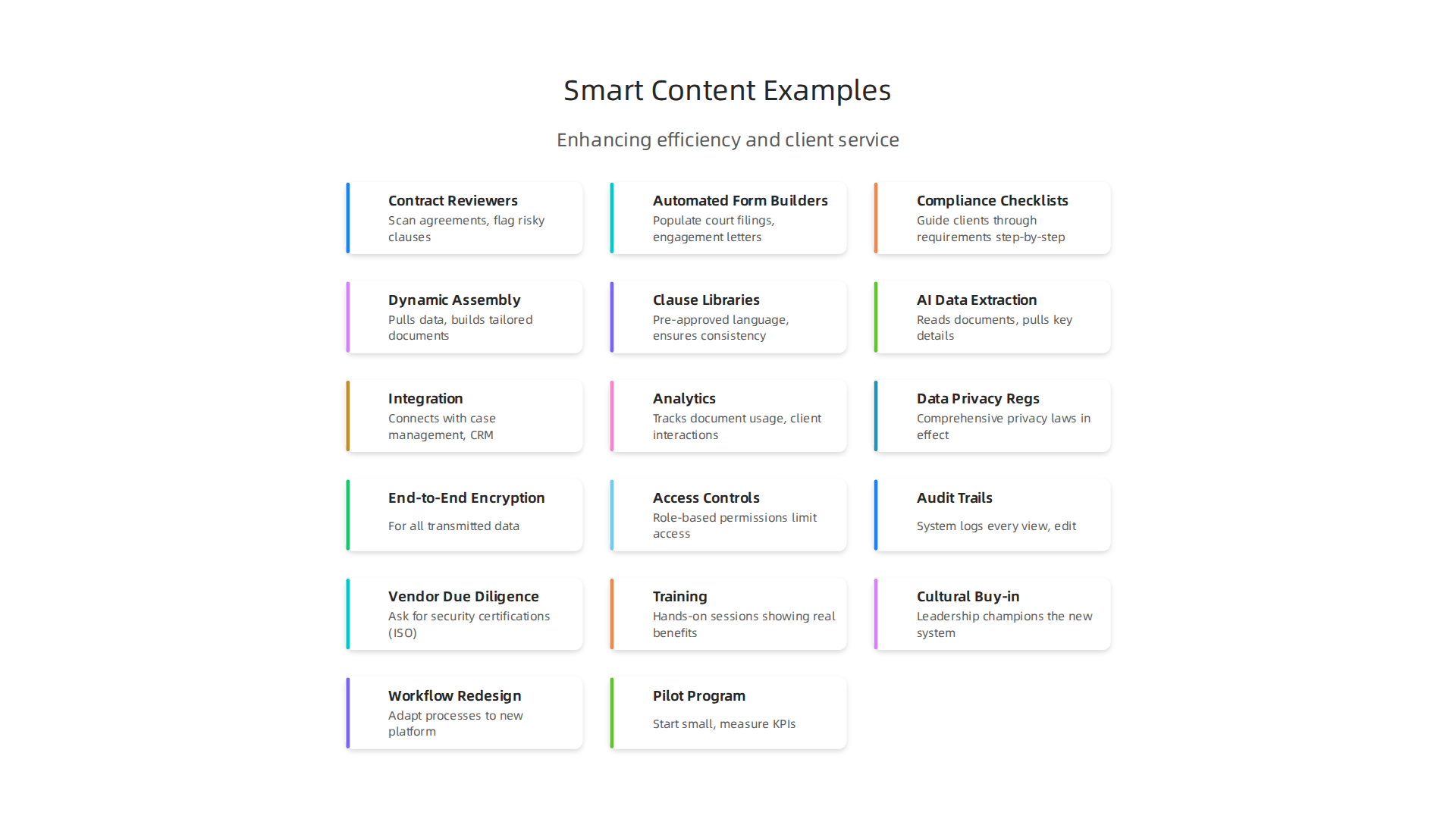
**Examples of smart content in practice include:
**
- Intelligent contract reviewers that scan agreements and flag risky clauses based on your firm’s specific playbook.
- Automated form builders that populate court filings or engagement letters with client data you already have.
- Interactive compliance checklists that guide corporate clients through regulatory requirements step by step.
These tools do more than automate busywork. They improve transparency because clients can see exactly what is happening with their case. And they boost satisfaction because clients get faster, more accurate responses without waiting for a lawyer to manually type everything.
Smart content also helps your firm stand out from competitors. When a potential client visits your website and sees practice area highlights or case results that match their specific situation, they feel understood. That immediate relevance can be the difference between a click and a closed case.
To see how technology is reshaping every part of legal work, including the daily responsibilities of attorneys, read our complete guide on the malpractice attorney role in 2026 and legal tech trends. It covers how smart tools are changing what lawyers actually do each day.
As you think about adopting smart content, remember that the best approaches start with a clear goal. Do you want to speed up document creation? Improve client onboarding? Make your website more relevant? Picking one clear win helps you avoid getting overwhelmed by all the possibilities out there.
Definition and Core Features
Now let’s break down what makes smart content actually work. The core features give you the building blocks to achieve that clear win you picked from the previous section.
So what is smart content exactly? According to HubSpot’s definition, smart content refers to elements of a website, ad, or email that change based on the viewer’s interests or past behavior. It creates a custom experience for each person. In legal technology, that means every client sees something different based on their unique situation.
The core features that power smart content include:

- Dynamic document assembly. This pulls client data from your system and builds tailored contracts, engagement letters, or court filings on the fly. No more copy-pasting from old templates.
- Clause libraries. These are collections of pre-approved legal language that your system inserts based on case type, jurisdiction, or risk level. It keeps your documents consistent and compliant.
- AI-driven data extraction. The software reads uploaded documents and pulls out key details like names, dates, and obligations automatically. This saves hours of manual review.
But features alone aren’t enough. Smart content works best when it’s connected to the rest of your tech stack. Integration with case management and CRM systems is critical. Without it, your smart content sits in a silo and you end up typing the same data twice. With integration, client information flows automatically from intake to billing to document creation.
Another key feature is analytics. Smart content platforms often offer dashboards that track document usage and client interactions. You can see which clauses get used most often, where clients stop reading, or which email templates drive the best response. That data helps you keep improving.
To see how AI tools like these handle real contract work, check out our overview of Iristel Law 2026 and AI contract analysis for legal teams.
If you want to stay ahead of the latest AI tools transforming legal work, consider subscribing to The AI Newsletter Worth Reading. It delivers daily AI updates straight to your inbox, keeping you informed about the innovations that matter most to your practice.
Examples of Smart Content in Practice
These features come to life in real law firms every day. Here are three common ways smart content is reshaping legal work in 2026.
International law firms now use smart content tools to generate contracts for routine M&A and real estate transactions. Instead of starting from scratch, their systems pull data from previous deals and automatically populate new agreements. This cuts drafting time dramatically. According to a 2026 legal tech transformation report, AI now reads millions of documents in hours and automates contract generation across practice areas. One large international firm reported cutting document creation time by over half. To see how firms structure their global operations, read our analysis of multi jurisdictional law firm strategy and operations.
In-house legal departments deploy interactive compliance portals that update themselves as regulations change. These portals use smart content to show each employee the rules that apply to their role and location. When a new compliance requirement appears, the portal adjusts automatically. In-house leaders at Legalweek 2026 emphasized that AI gives them earlier visibility into risks and helps them negotiate better. This kind of adaptive content keeps the whole organization compliant without manual updates, as covered in the Legalweek 2026 in house legal team AI themes report.
Boutique firms use AI-powered document review to offer competitive pricing without sacrificing quality. By automating the first pass through thousands of pages, these firms can take on work that used to be too expensive for their clients. Document review remains the top area of AI impact in legal, with 63% of professionals reporting its use. AI helps identify key facts and actors early, so boutique lawyers can advise clients faster and with more context, as highlighted in the AI and legal tech forecast 2026.
These real world examples show that smart content is not a future idea. It is helping firms of every size work faster, cheaper, and smarter right now.
Interactive Legal Tools: Driving Engagement and Efficiency
Imagine logging into a secure portal and seeing your case status update in real time.

You can message your attorney, upload documents, and track deadlines all in one place. That is the power of interactive legal tools in 2026. These tools are not just nice extras. They are changing how law firms and clients communicate and collaborate.
Client portals are the most visible example. Modern portals are smart, interactive dashboards that give clients 24/7 access to their case information. They use smart content to automatically update timelines, share documents securely, and send notifications when something changes. According to the AI Transformations in Legal Tech 2026 report, AI powered platforms now respond to structured client queries and provide real time updates on filings or litigation milestones. This means fewer phone calls and emails for both sides.
Internal collaboration tools are just as important. Lawyers and paralegals use AI powered research assistants that scan thousands of cases in minutes and surface the most relevant rulings. Interactive briefing tools let teams work on documents together in real time, with AI suggesting edits and flagging inconsistencies. Practice management platforms like Clio offer both client facing portals and internal case management features in one system. Document automation tools such as Law Depot integrate with these systems, letting clients generate simple legal forms directly.

And AI research tools like Cetient Legal AI provide interactive assistants that help lawyers find answers faster. These legal tech providers are making daily work smoother and more connected.
The best tools unify both client and internal interfaces. That way data flows from one system to the next without reentering information. A client uploads a document, and it appears instantly in the firm’s case file. A paralegal updates a deadline, and the client sees it in their portal right away. This kind of smart content interactive legal system saves time and reduces errors.
The shift toward interactive legal tools is happening fast. Firms that invest in these platforms see better client satisfaction and higher team productivity. If you want to stay ahead of the latest developments in legal AI and automation, subscribing to The AI Newsletter Worth Reading gives you clear daily updates on the tools and trends that matter most to modern legal practice.
Client-Facing Portals and Self-Service Tools
Now let us look more closely at what these client-facing tools actually look like in practice. In 2026, a well-designed client portal does much more than show case status. It lets clients upload documents directly, view their matter timeline, and even request new services whenever they want, day or night.
This always-on access changes the client experience. Instead of waiting for a return call, a client can log in, drop a signed contract into the folder, and move on with their day. The firm does not have to handle, scan, or file that paper. It lands right in the case management system.
Self-service tools take this further. Many firms now let clients generate common legal documents like NDAs and simple contracts on their own. The client answers a few questions, and the tool builds a first draft instantly. This cuts down on administrative work for the legal team and speeds things up for the client. Tools like Iris Law provide AI contract analysis that can review those drafts for common issues, adding another layer of quality control.
Integration with e-signature platforms makes the whole journey seamless. A client completes a self-service form, reviews the document in the portal, and signs it electronically in the same session. No printing, scanning, or mailing required.
Of course, building these tools means keeping client data safe. Law firms must follow strict privacy rules when designing portals, especially with new state laws taking effect in 2026. For example, California’s updated privacy regulations require risk assessments and stronger cybersecurity measures for any system handling personal data. Firms that treat security as part of the user experience build trust along with convenience.
This kind of smart content interactive legal system turns a one-way communication channel into a true partnership. Clients feel informed and empowered, and firms reduce repetitive work. It is a win for everyone. If you want to protect your firm’s digital systems, learning more about how law firms defend against phishing emails can help you avoid common security gaps.
Internal Collaboration and Knowledge Management Tools
Now that we have seen how clients interact with your firm through portals and self-service tools, it is time to look inside the firm. How do your attorneys and staff find the information they need to do great work?

In 2026, the best firms use smart content interactive legal tools that bring knowledge and teamwork together in one place.
Interactive knowledge bases with AI search change how attorneys find past work. Instead of digging through old file cabinets or guessing search keywords, a lawyer can type a question like "What arguments did we use in last year’s contract dispute?" The AI finds relevant precedents, memos, and briefs in seconds. This saves hours of manual research and helps new associates get up to speed faster.
AI-powered briefing tools do even more. They scan new case law, flag updates that matter to your firm’s practice areas, and even summarize key rulings. A tool like Cetient legal AI can watch for changes in a specific judge’s decisions or track new regulations affecting your clients. This keeps your whole team informed without anyone having to set up custom alerts manually.
What makes all this work is integration with matter management and practice management systems. When your knowledge base, briefing tools, and case management software talk to each other, you get a single source of truth. No more updating information in three different places. For example, Clio law management software connects directly with many legal tech providers, so documents, notes, and deadlines stay in sync across every tool your firm uses. Following API integration best practices ensures these connections are secure and reliable.
When your internal tools work together, your team spends less time hunting for information and more time solving client problems. Firms that invest in this kind of smart content interactive legal setup find that their associates produce better work with less stress. If you want to see how other firms are building modern practice systems, check out how leading law firms embrace technology in 2026.
And if you want to stay ahead of every new tool and trend, subscribe to The AI Newsletter Worth Reading. It delivers clear daily updates so you never miss an important legal tech change.
The Role of AI in Personalizing Legal Content
Now that we have seen how AI helps your team work smarter internally, let us look at how the same technology can create a more personal experience for your clients. In 2026, legal clients expect more than generic forms and cookie-cutter advice. They want content that speaks directly to their situation. Smart content interactive legal tools make that possible by tailoring every interaction to the person on the other end.
Here is how it works. AI pulls from client history, the specific jurisdiction, and the type of legal matter to generate documents and communications that fit perfectly. For example, a personal injury client in California gets a demand letter that follows California case law and uses language from your firm’s past successful cases. A corporate client working on an M&A deal gets contract clauses that match their industry and previous negotiations. The system learns from every interaction and gets smarter over time.
Tools like Cetient legal AI analyze thousands of past matters to suggest the strongest arguments for a given judge or opposing counsel. Instead of writing a brief from scratch, an attorney receives a first draft that is already 60 to 70 percent complete and personalized to the case. This is not just about speed. It is about quality. When the AI understands the context, the drafts are more accurate and more persuasive.
According to the latest research on AI transformations in legal tech, AI now reads millions of documents in hours and structures legal data into actionable intelligence. That kind of power allows a small firm to offer the same level of personalization as a global powerhouse. The key is connecting the AI to your existing data sources.
Personalization also improves the client experience dramatically. Clients get updates in plain language that reference their specific case. They receive forms that already have their information filled in. They feel like your firm truly knows them. At the same time, lawyers spend less time on repetitive drafting. One major public defender study found that AI tools reduced administrative case processing time by 40 percent, freeing up attorneys to spend more time with clients.
Predictive analytics take personalization a step further. The AI can anticipate what a client might need next based on similar matters. For instance, if a client is going through a divorce, the system might flag child custody issues that often arise and prepare templates ahead of time. This proactive approach builds trust and reduces surprises.
Many legal tech providers now embed these personalization features directly into their platforms. Clio law management software connects with AI tools to pull client data automatically, so the personalization happens without extra work from your staff. Law Depot offers customizable legal documents that adapt to user inputs, while enterprise-grade solutions bring the same logic to complex litigation.
In practice, this means your firm delivers a cohesive, tailored experience at every touchpoint. The same intelligence that powers your internal knowledge base also drives client communications. For a deeper look at how firms are adopting these capabilities, check out how leading law firms embrace technology in 2026.
And if you want to see how AI is reshaping the legal profession day by day, watch this practical breakdown of legal AI becoming business as usual in 2026.
Smart content interactive legal is not a futuristic concept. It is available now, and firms that adopt it create stronger relationships with clients while reducing their own workload. The next step is to audit your current systems and find where personalization can make the biggest difference.
AI-Powered Document Assembly and Automation
Personalization gets the content right for each client, but the real time savings come from automating the actual document creation process. In 2026, smart content interactive legal platforms use natural language generation (NLG) to turn client data into complete first drafts. Instead of staring at a blank page, an attorney gets a solid starting point that only needs review and polish.
Here is how it works. The lawyer enters a few details like case type, jurisdiction, and key facts. The AI instantly pulls from a library of approved templates and past successful filings. It generates a draft that is already 60 to 70 percent complete. According to the latest guide on legal automation in 2026, attorneys now routinely use secure, legal-grade AI tools to produce first passes of documents, then edit and verify before sending anything out. This process alone cuts hours off every matter.
Beyond drafting, AI recommends specific clauses based on the deal or dispute at hand. If you are working on a licensing agreement, the system flags standard terms from similar deals in your history and highlights regulatory changes that might affect the language. This clause intelligence means you never miss an important update from a new statute or court ruling.
The automation does not stop there. Built-in proofreading and compliance checks scan every draft against firm policies and jurisdictional rules. The AI catches formatting errors, missing signatures, and contradictory terms before the document ever reaches a partner or client. One large case study demonstrated how a plaintiffs firm used advanced analytics to prove an overproduction and win a motion, showing that automated checks can directly improve litigation outcomes.
For firms looking to take contract analysis further, exploring how AI handles contract review for legal teams can be a natural next step.
When your team no longer worries about repetitive drafting or manual proofreading, they can focus on higher-value work. And if you want to keep up with how AI is changing legal work daily, consider the daily AI updates from The Deep View Newsletter. It delivers clear, practical insights straight to your inbox.
Predictive Analytics for Client Needs and Legal Research
Knowing what your clients need before they ask is a superpower in 2026.

Predictive analytics makes that possible. These models study historical data to forecast things like likely litigation outcomes, settlement ranges, and even which clients might leave your firm.
Here is how a smart content interactive legal system helps. It reviews past case data from your firm and public court records. Then it estimates the chances of winning a motion, the expected time to resolution, and the probable costs. Attorneys use these forecasts to give clients honest timelines and smarter strategy options. Clients appreciate the transparency, and firms reduce the risk of taking on losing cases.
The same technology also spots clients who are about to leave. If a client has not opened recent communications or has asked about billing three times in a month, the system flags them. Your team can reach out proactively before the relationship sours. This kind of client retention intelligence is one reason legal tech providers now include predictive dashboards in their platforms.
Beyond internal forecasting, predictive tools keep clients informed with personalized alerts. Once the system knows a client’s industry and legal exposure, it pushes regulatory updates and court rulings that matter to them. Instead of sending generic newsletters, you share relevant news that shows you understand their business. For example, new privacy regulations in California and other states in 2026 directly affect how companies handle consumer data, and your clients need to know these changes immediately.
Of course, predictive analytics has an ethical side. Bias in historical data can lead to unfair forecasts. If past cases show biased outcomes, the model may replicate those patterns. That is why firms need careful governance, regular audits, and transparency about how predictions are used. As automated decision-making technology becomes more common, staying compliant with privacy rules and ethical standards is essential.
For a deeper look at how predictive tools are changing the everyday role of a lawyer, you can explore how technology reshapes the attorney role in 2026.
Compliance and Security Considerations for Interactive Platforms
Building a smart content interactive legal platform is exciting. But without the right compliance and security measures, that excitement turns into risk fast. In 2026, data privacy rules are stricter than ever. And clients expect their sensitive legal information to be locked down tight.
Here is what you need to know to keep your interactive platform safe and compliant.
Data Privacy Regulations You Cannot Ignore
Interactive legal platforms handle personal data constantly. Client names, case details, financial records, communication logs. Every piece of data triggers a compliance obligation.
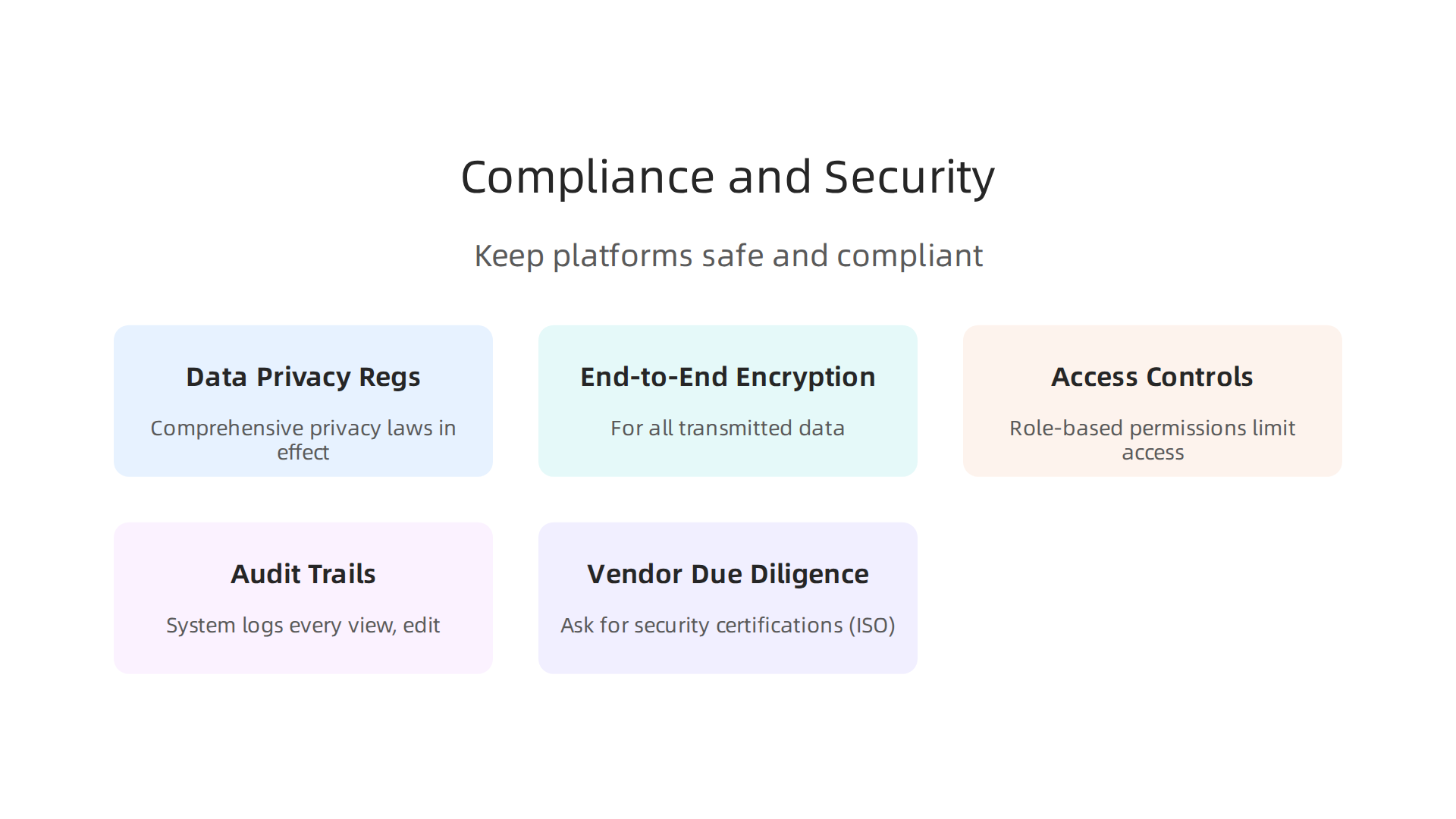
In 2026, twenty states now have comprehensive privacy laws in effect, with new laws in Indiana, Kentucky, and Rhode Island taking effect on January 1. California continues to lead with updated regulations that require formal risk assessments and cybersecurity audits for certain businesses. These rules apply directly to any legal tech platform that collects consumer data.
On the global side, GDPR in Europe and LGPD in Brazil set high standards for data handling. If your platform serves clients in those regions, you must follow their rules too. That means getting clear consent before collecting data, letting users access and delete their information easily, and reporting breaches quickly.
The key takeaway? Know which laws apply to your practice. A firm handling multi-state cases needs to comply with multiple frameworks at once. As the 2026 Data Privacy Forecast explains, data privacy is no longer a nice-to-have differentiator. It is the baseline expectation.
Cybersecurity Measures That Build Trust
Clients trust you with their biggest secrets. That trust depends on strong security.
At a minimum, your interactive platform needs end-to-end encryption for all transmitted data. Whether a client uploads a contract or sends a secure message, the data should be unreadable to anyone except the intended recipient.
Access controls matter just as much. Not everyone in your firm needs access to every client file. Role-based permissions let you limit who sees what. Paralegals see case documents. Partners see strategy notes. No one sees irrelevant data.
Audit trails create accountability. Every time someone views, edits, or downloads a file, the system logs it. If a breach happens, you can trace exactly what occurred and when. This protects both your firm and your clients.
As new state laws in places like Washington and Nevada establish standalone frameworks for consumer health data, and California’s Delete Act introduces centralized deletion requests through the Data Rights and Options Portal, having these security measures in place is non-negotiable.
Vendor Due Diligence: Pick Partners Carefully
Most legal tech platforms rely on third-party vendors for hosting, storage, analytics, and more. Every vendor is a potential weak point.
Before signing a contract, ask for proof of security certifications. ISO 27001 certification shows a vendor follows international best practices for information security management. SOC 2 Type 2 reports verify that a vendor maintains strict controls over data privacy and security over time.
Also review their incident response protocol. How fast do they detect a breach? What do they do next? Do they notify clients immediately? A vendor that takes hours or days to respond to a security incident is a risk you cannot afford.
Legal tech providers that prioritize compliance make this information easy to find. If a vendor is vague about their security practices, walk away. Your clients deserve better.
For a practical look at how firms defend sensitive legal data from everyday threats like phishing attacks, check out how law firms defend legal data against phishing emails.
Bringing It All Together
Compliance and security are not optional extras for a smart content interactive legal platform. They are the foundation. Without them, even the most advanced AI tools will fail to earn client trust.
Stay current on regulations. Encrypt everything. Control access. Vet your vendors. And consider subscribing to a trusted source for daily updates on how technology and compliance intersect in the legal field. The Deep View Newsletter delivers clear daily AI updates that help you stay ahead of these fast-moving changes.
A secure, compliant platform is a platform your clients will actually want to use. Get the basics right, and everything else gets easier.
Data Privacy Regulations and Legal Tech
Building on the framework above, let us look at the specific privacy rules that directly shape how a smart content interactive legal platform must handle client data.
First, data minimization is now a legal requirement in many states. You can only collect and keep the data you truly need for a specific purpose. If you do not need a client’s home address to give legal advice, do not ask for it. And you must get clear consent before you process any personal data. That means no pre-checked boxes or buried disclosures. Your consent form must be easy to understand and easy to withdraw.
The right to deletion is another major rule. When a client asks you to erase their data, you need a system to make that happen fast. Laws like California’s CCPA and the new 2026 regulations in Indiana, Kentucky, and Rhode Island all enforce this right. As the How 2026 Will Reshape Data Privacy and Cybersecurity report explains, these updates formalize obligations around privacy risk assessments and accountability structures.
Second, if your platform serves clients across borders, you need cross-border data transfer mechanisms. Standard Contractual Clauses are the most common tool for moving data from the EU or Brazil to the US securely and lawfully. Your platform should support these agreements automatically.
Third, AI processing of client data can trigger extra legal obligations. Many state laws now treat automated decision-making as a higher-risk activity. The California Privacy Protection Agency requires formal risk assessments for AI use cases that could harm consumers. This means your smart content interactive legal platform must document every way it uses AI to process client information. For a deeper look at safe AI integration, check out our guide on AI contract analysis for legal teams.
Following these rules protects your clients and keeps your platform compliant.
Cybersecurity Best Practices for Interactive Platforms
After you set up the right privacy rules, you must protect your platform against breaches. Here are the baseline security practices every smart content interactive legal platform needs.
End-to-end encryption. All data moving between your clients and your servers must be encrypted. This means even if someone intercepts the data, they cannot read it. Use TLS 1.3 and encrypt data at rest too.
Role-based access control. Not everyone on your team needs to see everything. A junior paralegal should not have the same access as a partner. Set permissions by role, and use strong authentication like OAuth 2.0. The Open Dental API integration guide explains how to implement role-based access control and comprehensive audit trails for interactive systems.
Regular penetration testing. Hire ethical hackers to test your system at least once a year. They will find weak spots before real attackers do. Fix them quickly.
Incident response plans. Have a written plan for what to do when a breach happens. Test it with your team. And let your clients know you can share the plan if they ask. Transparency builds trust.
Client portal security. Your client portal should let users set granular permissions. They should be able to see exactly who accessed their data and when. Activity logs are non-negotiable. For more on keeping client data safe, read our guide on how law firms defend legal data against phishing emails.
Building these practices into your platform from the start keeps your clients safe and your firm compliant. To stay informed about the latest AI tools that can strengthen your security posture, subscribe to The AI Newsletter Worth Reading.
Integration and Change Management: Adopting Smart Content Solutions
You have chosen a smart content interactive legal platform. Now the real work begins. Getting the platform to talk to your existing tools is the first big hurdle.
Most law firms already use case management software, a CRM, and a document management system. Your new smart content platform must fit right in. If it does not, you end up with duplicate data entry and frustrated staff.
API Integration Is the Backbone
The key to smooth connections is API integration. Your platform should offer APIs that let it exchange data with your other systems. This way, when a case status changes in your case management tool, your smart content platform updates automatically. No manual copying.
Adopting API integration best practices makes this process reliable. Use standard protocols and set up proper error handling. Test everything in a staging environment before going live. This prevents data loss and keeps your workflows running.
When you evaluate legal tech providers, ask about their API documentation. Good providers make integration easy. Look for platforms that offer webhooks for real-time updates rather than slow polling methods.
Change Management Matters More Than Tech
Here is the thing many firms miss. The technology is only half the battle. The other half is getting your people to use it.
Change management addresses the human side. Your lawyers and staff have their own ways of working. Asking them to switch to a new smart content interactive legal system can cause resistance.
You need a clear plan:
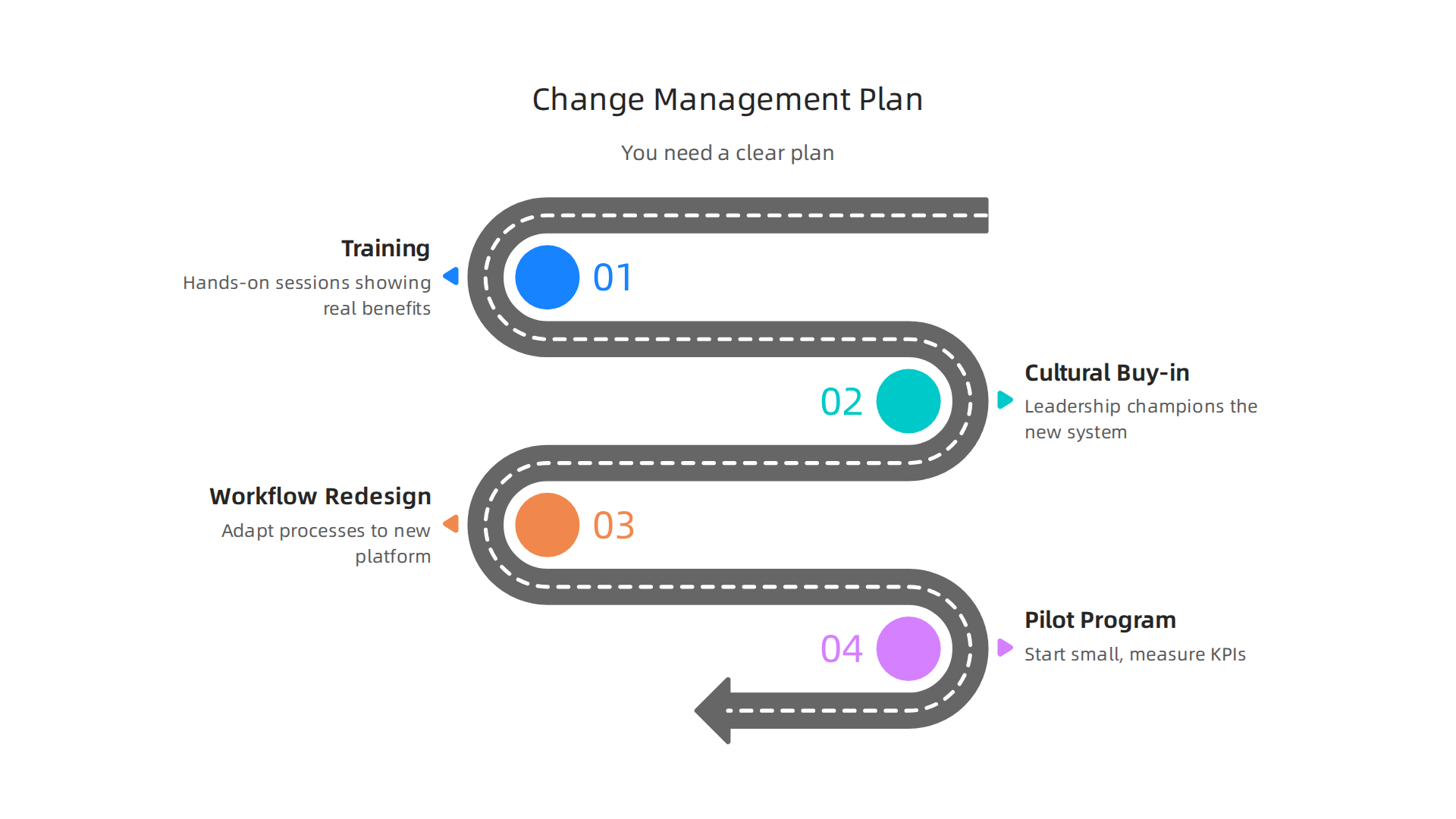
- Training – Run hands-on sessions that show real benefits. Do not just hand out a manual.
- Cultural buy-in – Get a partner or senior associate to champion the new system. When leadership uses it, others follow.
- Workflow redesign – Do not just drop the new platform on top of old processes. Redesign workflows to take advantage of what the smart content platform can do.
Start Small with a Pilot Program
You do not have to roll out to the whole firm at once. Pick one practice area or one team. Run a pilot for 60 to 90 days.
Set clear KPIs before you start. Measure things like time saved on document drafting, error reduction, or client satisfaction scores. When the pilot team sees real results, they become your best advocates.
Use those early wins to build organizational buy-in. Show the data at firm meetings. Let the pilot team share their experience.
For more on how other firms successfully adopt new technology, read about how leading law firms embrace technology in 2026.
Remember, integration and change management go hand in hand. A well-integrated platform with a thoughtful adoption plan will deliver the efficiency you expected from your smart content solution.
API Integration Strategies
Now let’s get into the technical side of making your smart content interactive legal platform work with your existing tools. The most common approach is using RESTful APIs. These allow your smart content tools to pull data directly from practice management and accounting systems.
Most modern platforms use RESTful APIs because they are simple and reliable. For example, when a client pays an invoice in your accounting software, the smart content interactive legal platform can update its records instantly, no manual entry needed. Following API integration best practices for modern enterprises helps you build these connections securely.
Pre-Built Connectors Save Time
Many legal tech providers offer pre-built connectors for popular platforms like Clio, NetDocuments, and iManage. These connectors handle the heavy lifting so you do not have to write complex code from scratch. If your firm uses Clio law management software, a pre-built connector can cut implementation time from weeks to days.
Custom Middleware for Legacy Systems
What if you are stuck with an older system that does not support modern APIs? That is where custom middleware comes in. Middleware acts as a bridge, translating data between your legacy system and the smart content platform. It takes more work upfront, but it keeps all your data flowing together.
For more on how modern tools fit into a law firm’s tech stack, check out this overview of AI contract analysis tools and their integration benefits.
As you plan your integration strategy, staying informed on the latest legal tech trends helps. Subscribe to The AI Newsletter Worth Reading for clear daily updates on how AI and automation are changing legal work.
Training and User Adoption
After you connect your smart content interactive legal platform, the real work begins. Your team needs to know how to use it. Without good training, even the best tools collect dust.
Start with role-specific training. Partners care about billable hours and client outcomes. Associates want to draft faster. Paralegals focus on workflow efficiency. Tailor the training so each group sees how the smart content interactive legal system makes their daily work easier. Many top legal tech providers, such as Cetient legal AI, offer specialized training modules for different roles.
Gamification and internal champions help speed up adoption. Pick a few enthusiastic team members to become power users. They can answer questions and celebrate wins. Leaderboards or small rewards keep the process fun.
Set up continuous feedback loops. Ask your team what works and what does not. Use that feedback to improve both the tool and the training. This approach matches advice from experts who emphasize that investing in legal AI adoption is critical for getting real ROI.
As roles keep changing, understanding how technology reshapes the attorney role helps everyone adapt faster. The key is to keep learning and improving together.
Evaluating ROI: Key Metrics for Legal Tech Investments
After your team learns the smart content interactive legal system, the big question is: Did it pay off? You need to measure the return on investment. But ROI in legal tech is not just about dollars saved. It also includes how happy your clients are and how much risk you reduce.
Start with quantitative metrics. Track hours saved per document or per matter. For example, if your team used to spend four hours drafting a standard brief and now spends one hour, that is a clear win. Measure how many matters each lawyer can handle now compared to before. Many firms use tools like Clio law management software to track these numbers automatically. The How Law Firms Measure ROI in Legal AI Implementation guide suggests benchmarking your current time first. Measure your drafting cycles, client response times, and administrative velocity before you implement the tool. Then compare after a few months.
Do not forget qualitative metrics. Survey your lawyers and paralegals. Are they less stressed? Do they feel more confident in their work? Also survey clients. Faster responses and fewer errors lead to better client satisfaction. A higher Net Promoter Score (NPS) often means more referrals and repeat business. You can read about how leading law firms Mintz, Morgan, Rafferty, and Rimon embrace technology to see how they balance speed with quality.
Risk reduction is another key metric. A smart content interactive legal system can catch errors in contracts or compliance documents before they cause trouble. Track the number of errors caught by the system versus manual reviews. Fewer mistakes mean lower malpractice risk and less time fixing problems.
Finally, benchmark against similar firms. If your firm handles 50 more matters per month after adopting a legal tech provider like Cetient legal AI, compare that to industry averages. Use data from your CRM or practice management software. This helps you see if your results are strong or just average.
To keep improving your legal tech strategy, you need to stay informed about new tools and trends. Consider subscribing to The AI Newsletter Worth Reading for clear daily updates on artificial intelligence that can help you make smarter investment decisions. The more you know, the better your ROI will be.
Cost-Benefit Analysis of Smart Content Platforms
Before you buy a smart content interactive legal platform, you need to weigh the costs against the benefits. It is not just about the price tag. You have to think about what you gain and how fast you can break even.
What you pay upfront:
- Licensing fees: Most platforms charge a monthly or annual subscription. Check if the price includes all features or if extras cost more.
- Implementation costs: Getting the system set up, migrating your templates, and integrating with tools like Clio law management software can take time and money.
- Training your team: Your lawyers and paralegals need to learn the new system. That may mean a few slower weeks while everyone gets comfortable.
- Ongoing costs: Maintenance, updates, and support are usually part of the subscription. But some vendors charge extra for premium support.
What you get back:
- Saved billable hours: Your team can draft documents much faster. A brief that used to take four hours might now take one. That is three extra hours per matter.
- Fewer errors: Smart content tools catch typos, missing clauses, and consistency issues. Less rework means lower stress and fewer malpractice risks.
- Faster client turnaround: Clients get their contracts and legal summaries sooner. That leads to better satisfaction and more referrals.
How to calculate break-even:
Run a pilot for one month. Track the hours saved and multiply them by your average billing rate. Subtract the monthly cost of the platform. If the number is positive, you are already ahead. A deeper look at ROI metrics for document automation shows that even small firms can see a return within three months.
For a real-world example of how law firms use smart content tools, check out this guide on AI contract analysis for legal teams. It shows how one platform turned cost into clear value.
Performance Benchmarks and Industry Comparisons
So you added up costs and benefits. But how do you know if your smart content interactive legal platform is keeping up with the field? That is where performance benchmarks come in.
Industry groups like ALM and ILTA publish reports that show what good looks like. You can find data on document generation speed, client portal engagement rates, and error rates. These numbers let you compare your platform against similar practices. A solo firm should not measure itself against a global firm. Match your size and practice area for a fair comparison.
Start by tracking a few key indicators. How fast does your team draft a standard contract now? What is your error rate per document? How often do clients log into the portal to check status? Then check those numbers against published reports. One strong method is to establish a baseline and track time savings before and after you adopt the new system.
Industry comparisons also help you spot weak points. If your draft speed is slower than firms your size, you may need better training or a different tool. If client portal engagement is low, your interface might be confusing.
For a broader view of how top firms rank and what sets them apart, read about why the Am Law 200 ranking matters for your law firm’s growth. It shows how benchmarks drive smarter technology choices.
To keep up with the latest benchmarks and best practices in legal tech, consider The AI Newsletter Worth Reading. It delivers clear daily updates so you never miss a shift in the industry.
Summary
This article explains how smart content and interactive legal tools transform modern law firms by delivering personalized, data-driven client experiences and automating repetitive work. It covers what smart content is, the core features that power it (dynamic document assembly, clause libraries, AI extraction), and practical examples across international firms, in‑house teams, and boutique practices. You will learn how client portals, self‑service forms, and internal AI knowledge bases improve efficiency and client trust, while predictive analytics and NLG speed drafting and anticipate client needs. The guide also walks through compliance and cybersecurity requirements, vendor due diligence, API integration best practices, and change management tactics to ensure adoption. Finally, it shows how to pilot solutions, measure ROI with concrete KPIs, and avoid common implementation pitfalls so your firm can adopt smart content without unnecessary cost or risk.