
Compare the Top Website Building Platforms for Law Firms in 2026

Introduction: Why Your Law Firm’s Website Is a Strategic Asset
Your law firm’s website is more than an online business card. In 2026, it’s the digital front door where most potential clients form their first impression of your firm. And those first impressions matter. According to legal sector marketing statistics for 2026, 96% of people with legal problems start with an online search. The average client visits three to four websites before contacting an attorney. Clients increasingly treat your site as their first meaningful interaction with your firm, not just a place to find a phone number.
The legal industry is digitizing fast. A modern, secure, and SEO-optimized website is no longer optional. It directly impacts client trust, retention, and your ability to compete. But building the right site means more than picking a template. You need to balance cost, compliance, scalability, and design flexibility. The platform you choose shapes everything from loading speed to data security and client intake.
If you are unsure where to start, understanding why bad law firm websites drive clients away can help you avoid common pitfalls. As you evaluate your options, staying informed about emerging legal tech trends is equally important. That is why we recommend The AI Newsletter Worth Reading for clear daily updates that keep your firm ahead of the curve.
In this guide, we will walk you through the top website building platforms for law firms in 2026, comparing features, pricing, and compliance tools to help you make the right choice.
The Role of a Website in Modern Law Firm Success
Your law firm website does more than just exist. In 2026, it does the heavy lifting of building trust before a client ever picks up the phone. Clients do not just browse your site for contact details. They study it to decide if you are the right lawyer for their problem.

The latest research on What Clients Want from Law Firms in 2026 shows that clients expect to see clear service descriptions, cost estimates, direct contact details, and lawyer bios. They also want proof of credibility. Testimonials, case examples, and educational articles rank high on the list. When your site delivers these things clearly, clients feel confident reaching out.
But here is the reality. If your site loads slowly or feels hard to use, people leave. 69% of visitors abandon a law firm website that loads slowly on mobile. That is a massive loss of potential cases. A fast, mobile-friendly site is not a nice extra. It is a basic requirement in 2026.
Beyond speed, a well-designed site sets you apart from other firms. The best law firm websites in 2026 use trust-centered design. That means putting client problems first instead of listing your awards. It means using real photos of your team, not stock images. And it means writing content that shows you understand what your clients are going through.
So how do you turn a website into a client-generating machine? Content marketing and social proof are key. Firms that post regular educational articles get 434% more indexed pages and 97% more backlinks. That helps you show up in Google searches and in AI answers. Client testimonials also matter. One study found that firms with 25 or more Google Reviews get nearly 5 times more organic clicks than firms with fewer reviews.
This shift means your website is now a core part of your firm’s identity. It reflects your values, your expertise, and how you treat people. If you are still thinking of it as a digital brochure, it is time to change your mindset. Understanding how technology reshapes the attorney role in 2026 can help you see the bigger picture of what clients now expect from modern legal services.
The firms that win are the ones that treat their website as a living tool for building relationships. They focus on clarity, speed, and proof of results. And that starts with choosing the right building platform.
Essential Features of a Law Firm Website Platform
So which website building platforms can actually deliver everything your firm needs? Not all builders are created equal. Some look great out of the box but fall short when your practice grows. Here are the non-negotiable features your platform must include.
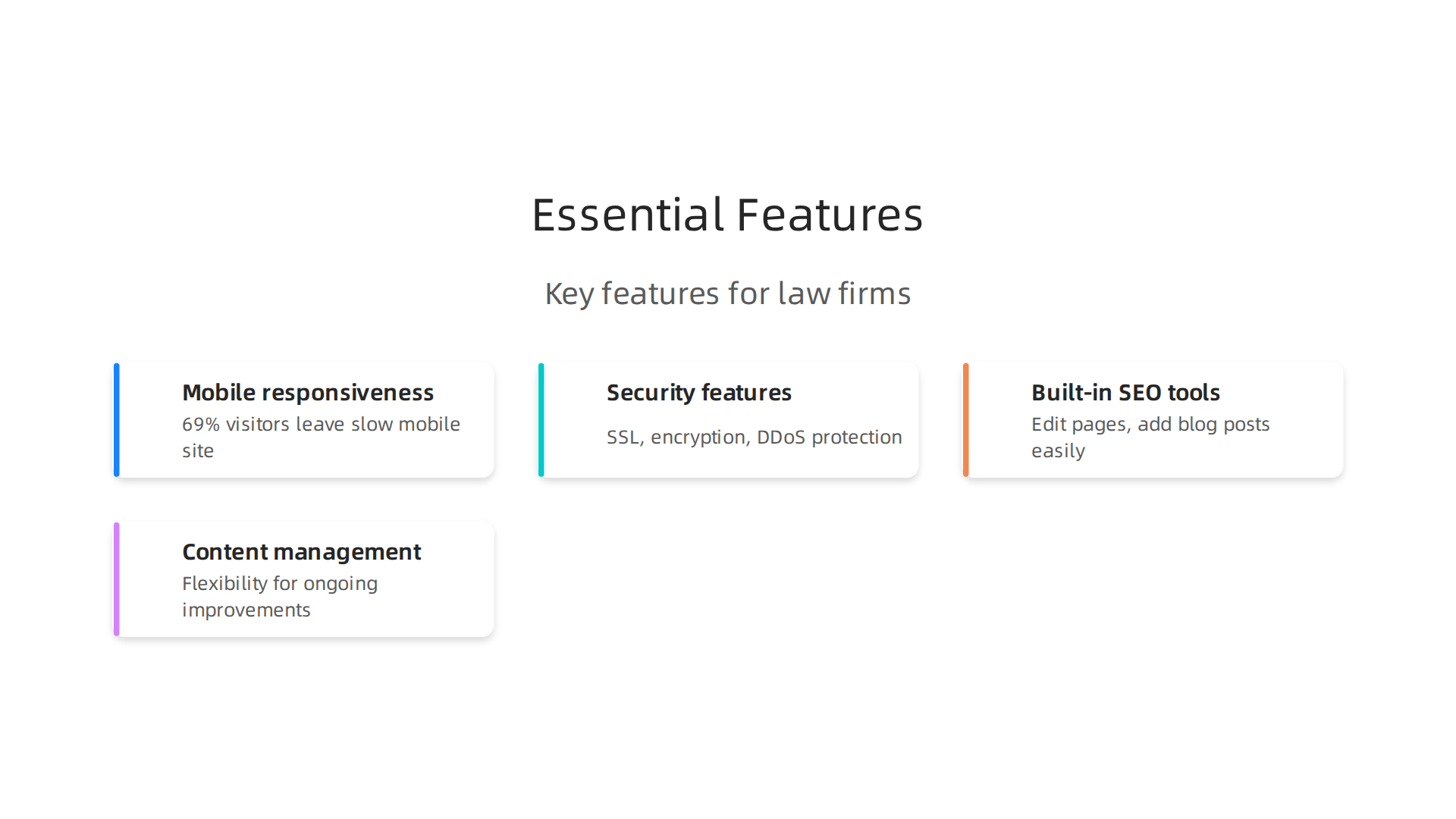
Mobile responsiveness and speed come first. 69% of visitors leave a slow mobile site, as we covered. But even fast builders can differ. A detailed WordPress vs Wix vs Squarespace 2026 performance comparison shows that WordPress offers unlimited SEO control and better performance at scale, while simpler builders like Wix and Squarespace are fast to launch but have lower ceilings for growth. Your platform should let you optimize images, use caching, and choose a hosting provider that prioritizes speed.
Security features are critical. Your clients trust you with sensitive information. SSL certificates, data encryption, and DDoS protection are not optional. You need a platform that handles security updates automatically or gives you control to lock things down. If you handle client data through contact forms or case portals, understanding how law firms defend legal data against phishing emails can help you choose a platform with strong built-in protections.
Built-in SEO tools and content management flexibility let you keep improving. You need to edit pages without a developer. You need to add blog posts, practice area pages, and testimonial sections easily. The same comparison highlights that WordPress gives unlimited SEO control, while Wix and Squarespace handle basic SEO well but limit advanced customizations. Analytics integration (Google Analytics, Search Console) is also essential so you can track which pages bring in clients and which need work.
Your platform choice is a strategic decision. The right one grows with your practice and saves you time. To stay ahead on which tools and trends matter for your firm in 2026, get clear daily updates from The AI Newsletter Worth Reading. It keeps you informed so your digital strategy stays sharp.
In-Depth Comparison of Leading Website Building Platforms
Now that you know the essential features, let’s compare the top website building platforms side by side.
Your choice will affect how much time you spend on maintenance, how easily you can grow, and how well your site ranks in search results.
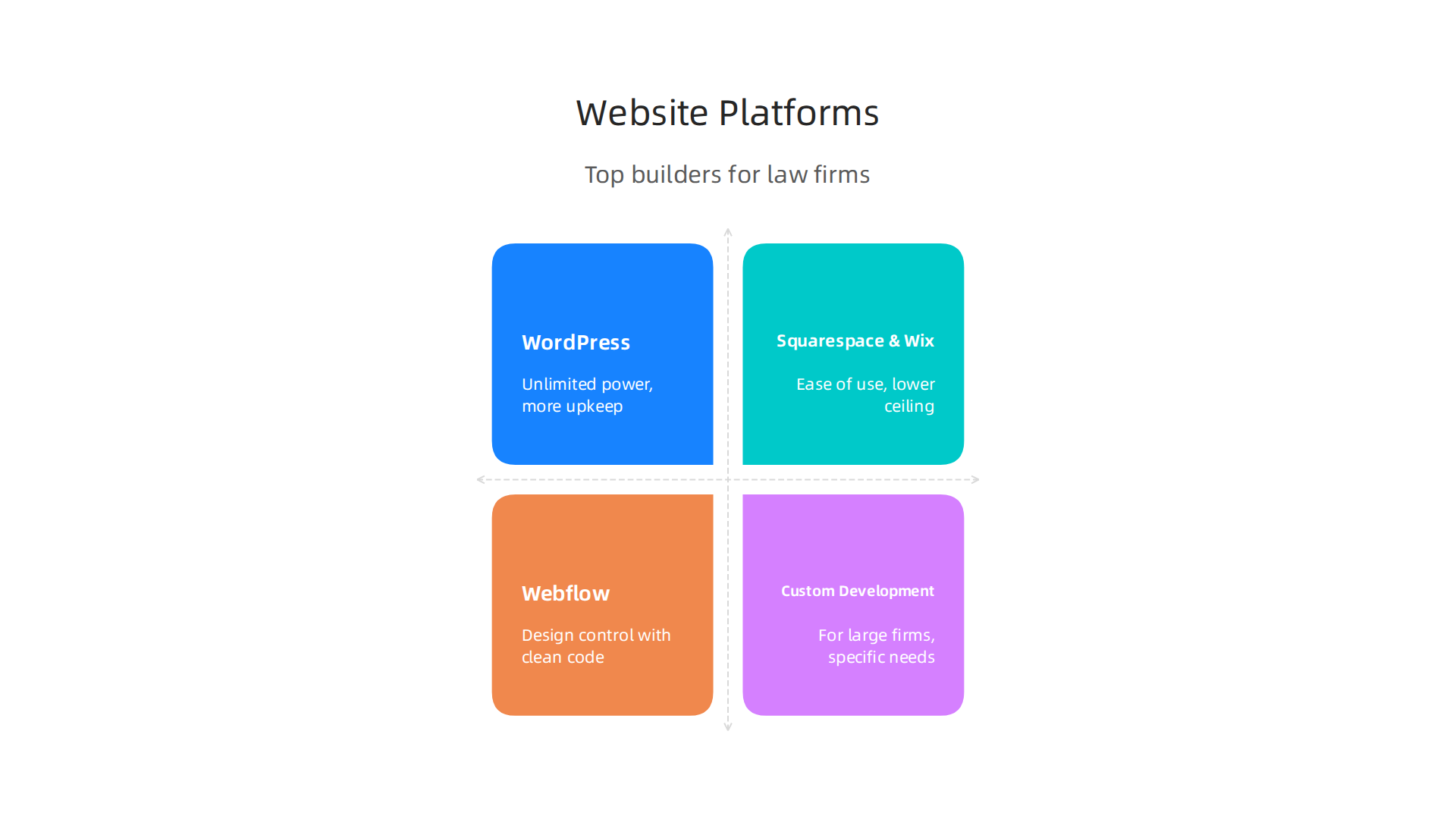
WordPress: Unlimited power, more upkeep. WordPress is the most flexible platform on the market. You own everything, your content, your data, your design. With thousands of plugins and themes, you can build any type of law firm site. SEO control is unmatched. You can optimize every meta tag, create custom taxonomies for practice areas, and integrate advanced analytics.
But this power comes with responsibility. You need to handle hosting, security updates, backups, and performance optimization yourself or pay a developer. The Forbes Advisor Squarespace vs WordPress 2026 comparison points out that WordPress itself is free, but you pay for hosting, a domain, SSL, and premium plugins. For a busy law firm, this technical overhead can be a real cost.
WordPress is best for firms that want long-term scalability and have the budget for occasional developer help. If you plan to publish lots of content and rank for competitive keywords, this is the strongest choice.
Squarespace and Wix: Ease of use, lower ceiling. These all-in-one platforms include hosting, templates, and basic SEO tools in one monthly fee. You can launch a professional-looking site in a day or two without touching code. For a solo practitioner or small firm starting out, that simplicity is valuable.
The trade-off is scalability. As your firm grows, you may hit limits. Customization is restricted to what the platform allows. Advanced SEO features like custom taxonomies, schema markup, and detailed analytics dashboards are harder to achieve. The best web builders 2026 comparison shows that Squarespace and Wix score well on speed to launch and ease of use, but their SEO ceiling is rated as basic or good for local. If you plan to build a content-driven site with many pages, you might outgrow these platforms quickly.
Webflow: Design control with clean code. Webflow sits between the simplicity of Squarespace and the flexibility of WordPress. It generates clean semantic HTML and offers full CSS control without writing code. That makes it appealing for design-heavy marketing sites.
However, Webflow has a steeper learning curve. Its plugin ecosystem and multilingual support are not as strong as WordPress. Pricing at scale is higher. According to the Squarespace blog on Webflow alternatives, Webflow includes built-in CMS and hosting, but you pay more as your traffic grows. It works best for firms that prioritize design and have a designer on staff or budget.
Custom development: For large firms with specific needs. If your firm requires a portal for client intake, integration with case management software, or complex forms, a custom-built site may be the right path. You get total control over every aspect, from code to hosting. But the cost is high, and ongoing maintenance requires a dedicated team.
For most firms, one of the four options above will serve you well. The best platform depends on your size, budget, and long-term goals.
Before you decide, also consider what makes a site truly effective. Learn from why bad law firm websites drive clients away so you avoid common mistakes that hurt credibility regardless of your platform choice.
Local SEO and Client Acquisition Through Your Law Firm Website
Now that you have chosen your website platform, the real work begins. You need to make sure people in your area can actually find you online. Most potential clients start their search for legal help on the internet, and they are almost always looking for a lawyer nearby.
The data backs this up strongly. A recent study on what clients want from law firms in 2026 found that a strong website, positive online reviews, and good search visibility now carry almost as much weight as traditional word of mouth. Clients under 45 especially treat a law firm’s website as their first real interaction with the firm.
So how do you make sure your site shows up when someone searches for "divorce lawyer in Denver" or "personal injury attorney near me"?
Start with your Google Business Profile. This is the single most important tool for local visibility. A complete and accurate profile makes your firm 70% more likely to receive visits and 50% more likely to be contacted. Fill out every section. Add real photos of your team. Pick the right primary category, like "Personal Injury Attorney" instead of just "Lawyer." And ask happy clients for reviews consistently. Getting five new 5-star reviews every month builds trust faster than having a bunch of old ones.
Structure your website for local search. Each city or neighborhood you serve needs its own dedicated page. Do not create thin pages that just swap out the city name. Each page should include local landmarks, directions from local highways, and success stories tied to that area’s court system. You can find more detail in these proven local SEO strategies for law firms that cover location pages and keyword placement.
Use schema markup to help search engines understand your firm. Local business schema and Attorney Schema tell Google your name, address, phone number, practice areas, and business hours in a language it can read instantly. This helps you show up in the local map pack and in AI-generated search results.
Get listed in local directories. Your firm should appear consistently on sites like Yelp, Avvo, Justia, and your local bar association directory. Make sure your name, address, and phone number match exactly across every listing. Even small inconsistencies can hurt your rankings.
Reviews are your strongest trust signal. In 2026, 84% of potential clients read online reviews before choosing an attorney. Firms with 25 or more Google Reviews get nearly five times more organic clicks than firms with fewer than five. Answer every review, especially negative ones, because one unanswered negative review can cost you up to 22% of potential clients.
Local SEO is not a one-time task. It takes steady effort, but the payoff is real, consistent client calls from people who are already looking for your services.
For law firms that want to stay ahead, understanding how AI is reshaping search visibility is becoming just as important. The Deep View Newsletter delivers clear daily updates on AI trends that affect legal marketing and client acquisition.
Compliance, Ethics, and Data Security Considerations
You spent hours getting your website right. Great design, clear practice area pages, strong reviews. But one missing disclaimer or a single security slip can land you in front of your state bar. Law firms face stricter rules than almost any other business online. Ignoring them is not an option.

Bar association rules are the starting point. The ABA Model Rules of Professional Conduct, especially Rules 7.1 through 7.4, set clear limits. You cannot make false or misleading claims. You cannot guarantee case results or imply that past wins mean future success. Every page of your site must include the name and office address of at least one lawyer responsible for the content. Client testimonials are allowed in most states, but they must be truthful and never create unrealistic expectations. A detailed overview of these legal advertising guidelines will help you avoid the most common pitfalls.
Data protection regulations add another layer. If you serve clients in California or any EU or UK jurisdiction, you need a clear privacy policy and a working cookie consent mechanism. The California Consumer Privacy Act (CCPA) gives consumers the right to know what data you collect and to request deletion. Even if you never leave the U.S., having a privacy policy builds trust and shows you take client confidentiality seriously.
Security is not optional. It is mandatory. Your website must have an SSL certificate to encrypt data between the browser and your server. Contact forms should use encryption, not plain text email. Regular automated backups protect client data if something goes wrong. Phishing attacks target law firms constantly, and a single leaked client file can destroy your reputation. Learn how other practices handle defending legal data against phishing attacks to avoid becoming a headline.
Better yet, make staying informed a habit. Compliance rules and security threats change fast. Subscribing to a daily newsletter that covers AI, privacy, and legal tech trends, like The AI Newsletter Worth Reading, helps you catch new requirements before they become problems.
Your website is your digital storefront. Make sure it follows the rules, protects client data, and earns trust from the very first click.
Cost Analysis and Return on Investment for Law Firm Websites
You found the perfect template. The colors match your brand. The layout looks clean. But before you click buy, let’s talk about the real cost. A law firm website is not a one-time purchase. It’s an ongoing investment. Understanding where the money goes and how to measure what you get back is the difference between a site that pays for itself and one that drains your budget.
Breaking down the total cost. Your initial build is just the start. Here’s what you should budget for:
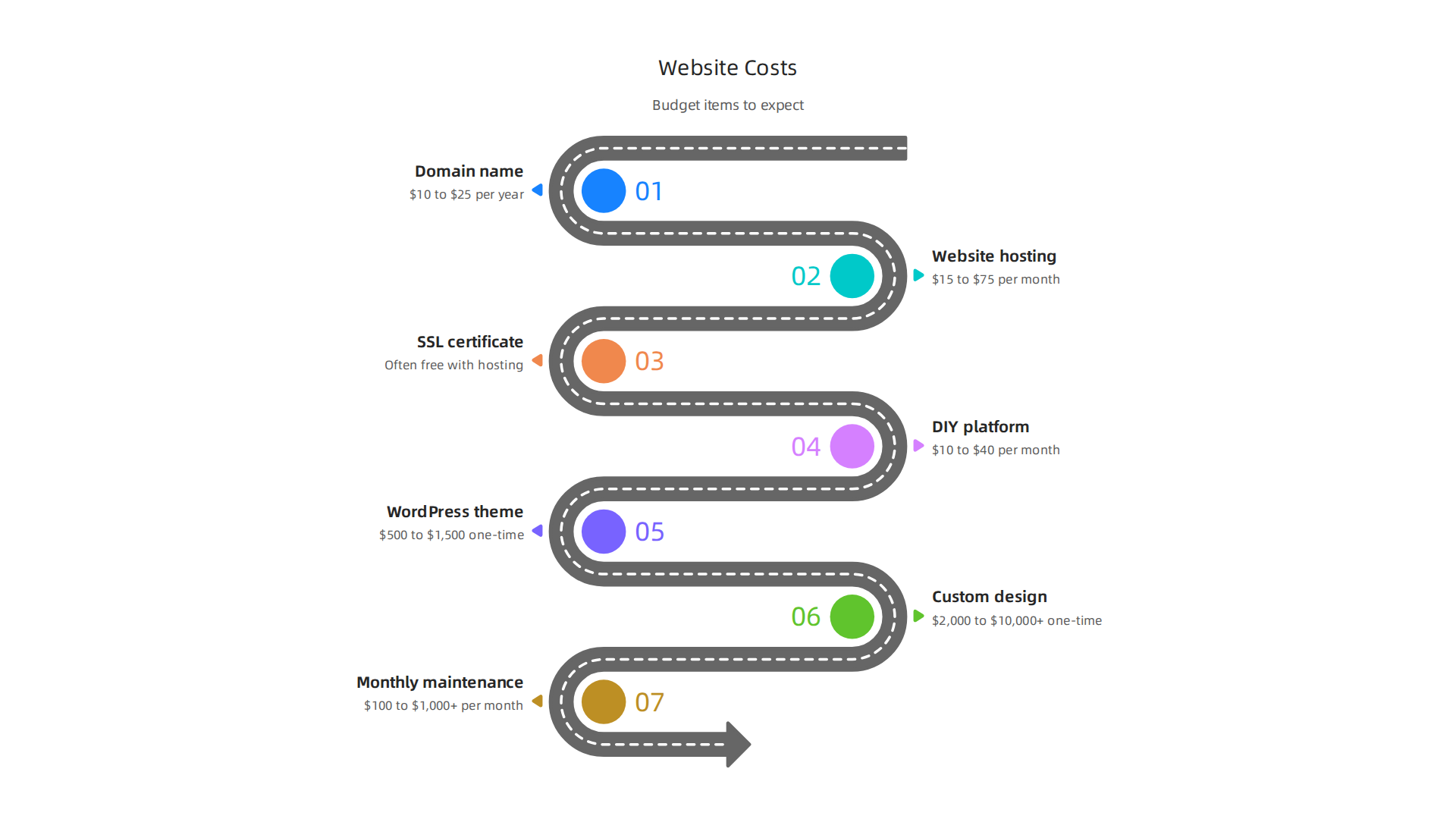
| Cost Item | Typical Range |
|---|---|
| Domain name | $10 to $25 per year |
| Website hosting | $15 to $75 per month |
| SSL certificate | Often free with hosting |
| DIY platform (Squarespace, Wix) | $10 to $40 per month |
| WordPress with premium theme | $500 to $1,500 one-time plus hosting |
| Custom professional design | $2,000 to $10,000+ one-time |
| Monthly maintenance and SEO | $100 to $1,000+ per month |
For a solo attorney, a realistic first-year spend lands between $2,500 and $5,000 if you use a template. Larger firms with custom builds often invest $10,000 to $35,000 or more. A detailed law firm startup costs guide from Talkroute breaks down these numbers for 2026, including domain, hosting, and design options.
But here’s the part most lawyers skip: ongoing monthly costs. Your site needs security updates, content refreshes, and basic SEO work to stay visible. The attorney website pricing guide from LegalPeel shows that monthly attorney web costs typically run $100 to $1,000 depending on whether you handle maintenance yourself or outsource it.
Measuring return on investment (ROI). A $5,000 website that brings in ten new clients at $2,000 each has a clear win. But how do you track that? Start with three numbers:
- Cost per lead. Divide your monthly website spend by the number of new leads from your site.
- Client acquisition cost. Divide total website investment by new clients gained from the site.
- Time savings. Compare hours spent manually handling intake versus using a contact form and CRM.
For mid-sized firms, Magnify Lab’s law firm website cost guide shows an example where a £37,800 first-year investment (build, maintenance, and SEO) generated enough leads at an average matter value of £2,000 to deliver strong positive ROI. The key is consistent tracking.
DIY versus custom: which gives better long-term value? Website building platforms like Squarespace and Wix lower upfront costs. You can launch for under $500. But they limit customization, SEO control, and scalability. A WordPress site with a quality theme or a fully custom build costs more upfront but lets you grow. If you plan to add practice areas, blog content, or advanced intake forms later, the extra investment pays off. Many firms find that poor design drives clients away. Reading about why bad law firm websites damage credibility can help you avoid costly redesigns down the road.
The bottom line: a smart website investment is one you can measure. Track your leads, your conversion rate, and your cost per client every month. Adjust as you learn.
Staying on top of legal tech trends helps you make better spending decisions. The AI Newsletter Worth Reading delivers daily updates on AI, privacy, and legal tech tools so you never miss a cost-saving innovation.
Steps to Successfully Migrate or Launch Your Law Firm Website
You have your budget clear. You know what ROI looks like. Now comes the actual move. Whether you are migrating from an old site or launching your first one, a structured plan keeps everything smooth.

Skipping steps costs you rankings, traffic, and potential clients.
Start with a content audit. Before you switch platforms, know exactly what you already have. List every page, blog post, and downloadable file. Note which pages bring in traffic and which ones are outdated. Remove anything that hurts your credibility. This audit also helps you pick the right website building platforms for your needs. A content-heavy firm needs different tools than a solo practice with five pages.
Choose your platform carefully. The platform you pick affects everything from SEO control to how easily you can add features later. Look at website examples from other firms to see what is possible. Top law firm websites in 2026 show that clean navigation and fast load times matter more than flashy graphics. A good platform lets you scale without rebuilding from scratch.
Set up a staging environment. Never make changes on your live site. A staging site is a private copy where you test everything first. Check that all pages load correctly, forms submit properly, and internal links work. This step prevents broken pages that hurt your user experience and search rankings.
Plan your redirects. If you are migrating, old URLs must redirect to new ones. One broken link can send a potential client to a 404 error instead of your practice area page. Map every old URL to its new home before you flip the switch.
Monitor after launch. The work does not stop when the site goes live. Watch your traffic, form submissions, and page load speeds for the first few weeks. Keep an eye on security too. Law firms are prime targets for phishing and data breaches. Reading about how law firms defend legal data against phishing emails helps you set up proper protection from day one.
Post-launch monitoring ties directly into your marketing strategies for small businesses. Track what works, adjust what does not, and keep improving. A website launch is just the beginning of your online growth.
Summary
This guide explains how to choose and run a law firm website in 2026 so your site becomes a reliable source of clients rather than a digital brochure. It compares leading platforms (WordPress, Webflow, Squarespace, Wix and custom builds), lists non-negotiable features like mobile speed, security, and SEO control, and shows how those choices affect scalability, maintenance, and cost. You’ll also get practical local SEO steps (Google Business Profile, location pages, schema), a compliance checklist driven by bar rules and privacy laws, and a realistic cost/ROI framework to measure performance. Finally, the guide walks through a safe migration and post-launch plan so you protect rankings, client data, and momentum after going live. Read it to pick the right platform for your size and goals, reduce common mistakes, and start converting web visitors into clients consistently.