
Iris Law 2026 AI Contract Analysis for Legal Teams

Introduction: Why Iris Law Matters Now
The legal world is changing fast. In 2026, artificial intelligence is no longer just a nice-to-have for law firms and legal departments.

It has become a baseline tool. According to the 2026 Future Ready Lawyer Survey, over 90% of legal professionals now use at least one AI tool in their daily work. The global legal AI software market is valued at USD 5.21 billion in 2026 and is expected to keep growing fast.
This is where iris law comes in. Iris law represents a new generation of contract and document analysis tools designed for modern legal teams. It uses AI to help lawyers review agreements faster, spot hidden risks, and stay compliant with both common law and international law standards. Instead of spending hours on manual review, legal professionals can focus on the strategic advisory work that truly moves the needle.
But here is the challenge. Legal professionals face mounting pressure to do more with less. You need to improve efficiency while managing compliance and risk. With so many options on the market, how do you know which tool fits your specific needs? That is why understanding the broader landscape matters. Whether you are learning about how legal roles are evolving or evaluating new technology, staying informed helps you make smarter decisions.
This article gives you an unbiased, research-driven overview of iris law. Our goal is simple. We want to help you decide if this tool is the right fit for your firm or legal department.
Want to stay ahead of the curve? Subscribe Free to The Deep View Newsletter for clear daily AI insights tailored for legal professionals.
What Is Iris Law? Core Capabilities and Technology
So, what exactly is iris law? Simply put, it is a specialized AI platform built to handle the heavy lifting of contract review, due diligence, and legal document analysis. Whether your work falls under common law or international law frameworks, the core challenge stays the same. You have too many documents and not enough time to review every single line manually.
Iris law solves this problem directly. It uses natural language processing (NLP) and machine learning to work through your documents at high speed. The technology does not just scan for keywords. It understands context. This means iris law can automatically extract important clauses, flag potentially risky language, and generate clear summaries that save you hours of work. According to the 2026 guide on AI for legal documents from Sirion.ai, this type of technology is revolutionizing document management by automating critical tasks and minimizing manual effort.
How does it actually help you day to day? Think about a standard contract review. Instead of reading a 100-page agreement line by line, you get a dashboard showing exactly what matters. AI contract review tools use machine learning to analyze contracts and flag risks, which frees you up to focus on strategy and negotiation. The platform is also designed to recognize the specific language and obligations found in different legal systems, making it useful for cross-border work.
A major strength of iris law is its ability to fit into your existing workflow. It connects with popular document management systems and e-discovery platforms. What separates successful AI adoption from failed pilots is often how well the tool integrates with existing systems. For legal professionals wondering how this impacts their specific role, understanding these tools is becoming just as important as understanding the law itself. We explored how these changes are shaping the profession in our look at the evolving role of the modern lawyer.
The legal tech companies list keeps growing every year. But tools like iris law stand out by focusing specifically on the real needs of legal teams in 2026. Knowing what iris law can do is the first step. The next step is understanding how to choose the right tool for your specific practice area.
Want to stay updated on which AI tools actually deliver results for legal teams? Subscribe Free to The Deep View Newsletter for clear daily insights tailored to legal professionals.
The State of Legal AI Adoption in 2026
The legal field is adopting AI faster than many predicted. In 2026, this is not just a trend. It is the new normal for a large part of the industry.

The numbers tell a simple story. According to the 2026 Future Ready Lawyer Survey from Wolters Kluwer, over 90% of legal professionals now use at least one AI tool in their daily work. The 2026 Legal Industry Report from 8am found that 69% use general-purpose AI tools for their tasks. For law firms specifically, the 2026 Legal Tech & AI Outlook from U.S. Legal Support reports that 42% are now using AI technologies. That is a big jump from just 26% in 2024.
This shift is powered by serious investment. The global legal AI software market is valued at $5.21 billion in 2026, according to Fortune Business Insights. Another report from SNS Insider projects it will reach $8.29 billion by 2035. This growing market explains why tools like iris law are gaining so much attention. As the legal tech companies list gets longer each year, platforms that solve real problems stand out. That is exactly what iris law does with its focus on practical contract analytics and document review.
But adoption does not mean everything is easy. Many teams struggle to fit these tools into their current systems. Measuring return on investment (ROI) is another common headache. A 2026 report on the state of the US legal market from Thomson Reuters highlights how corporate legal departments are using AI to change the way they work with outside firms. However, the real value comes from shifting focus. As the An AI and Legal Tech Forecast for 2026 from Relativity explains, law firms need to move from doing manual review to providing stronger strategic advice. This change requires the right tools and the right training.
For anyone wondering how this affects their daily job, staying informed is key. Understanding the market helps you make better choices. We explored how these shifts are creating new career paths in our analysis of the employment lawyer career in 2026.
The market is moving fast. Do not get left behind. Get Free Updates from The Deep View Newsletter for simple, daily insights on AI and legal tech.
Key Pain Points Driving Interest in Iris Law
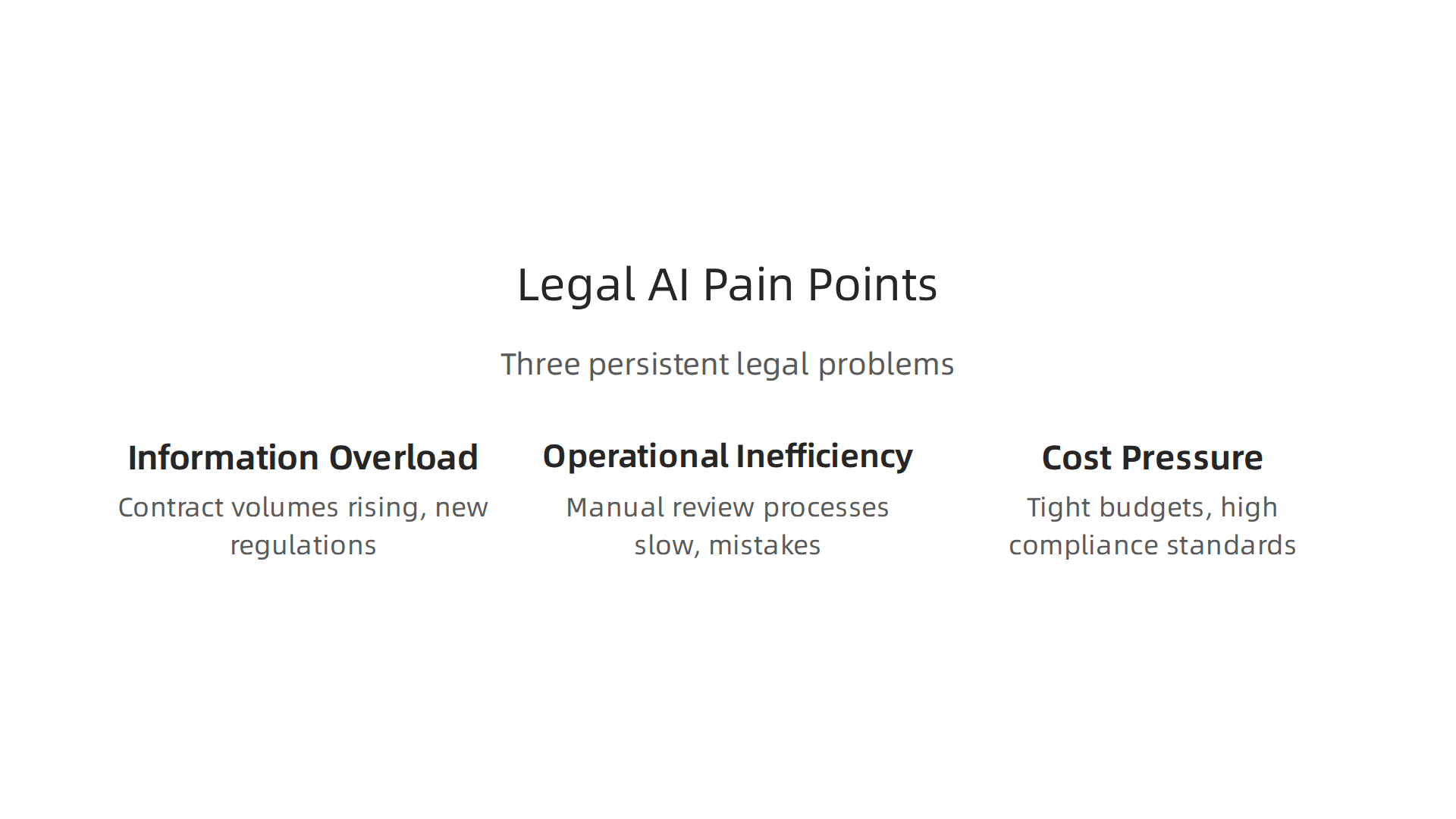
So why are so many legal teams looking at tools like iris law right now? The answer comes down to three big problems that just will not go away.
Problem 1: Information Overload
Here is the reality in 2026. Contract volumes keep rising. New regulations pop up all the time. And your team has to track everything across multiple jurisdictions including common law and international law frameworks.
The HR.com State of Legal and Compliance 2026 report found something surprising. Only 32% of organizations take a proactive approach to employment law compliance. Yet 61% say they are fully compliant. That gap shows a big problem. Many teams think they have things under control, but they are missing important updates.
When you try to track everything manually, things slip through the cracks. The V-Comply guide on compliance frustrations explains how clear workflows and automation can improve tracking. That is exactly where iris law steps in. It helps you sort through the noise and focus on what actually matters.
Problem 2: Operational Inefficiency
Manual review processes are still too common. Teams spend hours reading contracts line by line, searching for key clauses, and checking for risks. This is slow and boring work. It also leads to mistakes.
A Hyperstart analysis of legal operations in 2026 suggests teams should "conduct a thorough assessment of your legal department’s current operations to identify areas of inefficiency, bottlenecks, and frustration." That sounds simple. But finding those bottlenecks is hard when you are stuck in the middle of them.
The Ironclad guide to legal operations points out that without technology to automate contract intake, teams face slow turnaround times. Outdated systems make everything worse. When you look at the legal tech companies list today, you see many tools that promise to fix this. But iris law focuses specifically on the document review and contract analytics part, which is where most teams waste the most time.
Problem 3: Cost Pressure
Budgets are tight. Leaders want to cut costs while keeping compliance standards high. That is a tough balance.
The Wolters Kluwer legal ops trends report for 2026 shows how AI adoption is helping in-house teams become more efficient. But you cannot just buy a tool and hope for the best. You need something that actually fits your workflow.
For professionals navigating these pressures, understanding how technology reshapes roles is important. We covered how these shifts affect career paths in our look at the employment lawyer career in 2026.
The good news? Tools like iris law address all three problems at once. They reduce information overload through smart sorting. They speed up manual tasks through automation. And they help you cut costs by freeing up your team for higher-value work.
Want to stay on top of how AI is changing legal work? Get Free Updates from The Deep View Newsletter for clear daily insights.
How Iris Law Addresses These Pain Points
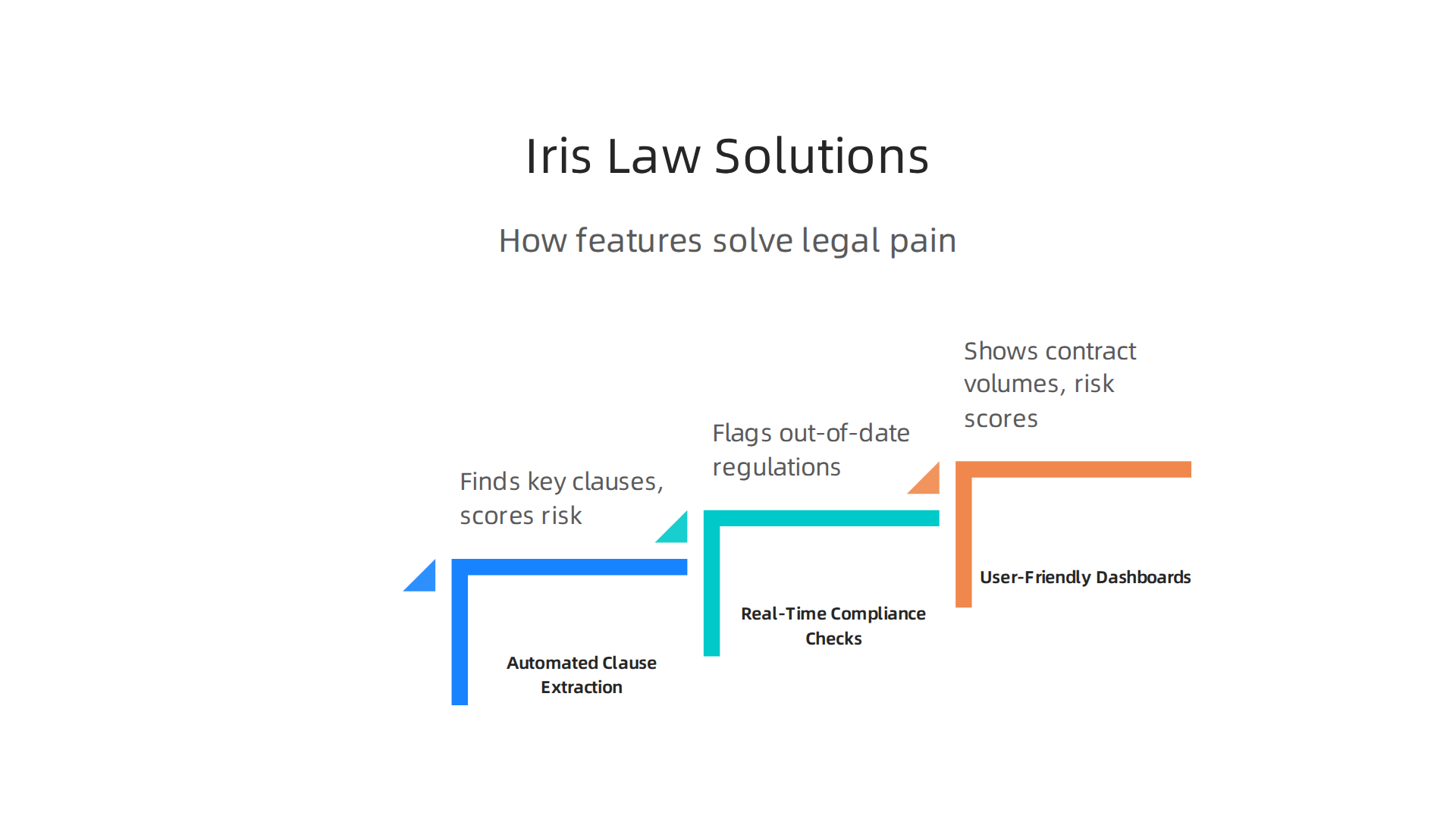
So we have covered the big headaches. Information overload. Slow manual work. Tight budgets. Now let’s look at how iris law actually solves them. The tool is built with three specific features that match each problem head on.
Automated Clause Extraction and Risk Scoring
Remember the information overload problem? You have stacks of contracts, and finding the risky clauses takes forever. Iris law changes that with automated clause extraction.
Here is how it works. You upload a contract, and the system reads it in seconds. It finds key clauses like indemnification, termination, and liability limits. Then it scores each one for risk level. This alone cuts manual review time by a huge margin. Instead of spending hours scanning pages, you focus only on the parts that need attention.
The Brightflag guide to legal operations optimization says your goal is to "gather as much information as possible on pain points and inefficiencies" within your team. Iris law does that gathering for you, automatically. The result is less noise and more clarity.
Real-Time Compliance Checks
The second pain point was operational inefficiency. Teams waste time double checking if contracts follow the latest rules. Iris law solves this with real time compliance checks.
It connects to regulatory databases for both common law and international law systems. As soon as a new regulation drops, the tool scans your existing contracts and flags anything that might be out of date. You do not have to wait for a manual audit.
The V-Comply article on compliance frustrations explains that automation and clear workflows improve tracking and reporting efficiency. That is exactly what iris law delivers. It helps you stay proactive instead of reactive. And when you compare it against other options on the legal tech companies list, this real time checking is a standout feature.
User-Friendly Dashboards for Legal Ops Teams
The third pain point was cost pressure. You need to do more with less. Iris law helps by giving your legal ops team a clear dashboard that shows actionable insights.
Instead of digging through spreadsheets or asking someone for a status update, you see everything in one place. Contract volumes. Risk scores. Compliance gaps. All updated automatically. Teams can spot trends early and make smart decisions about where to focus resources.
The Hyperstart analysis of legal operations in 2026 recommends conducting a "thorough assessment of your legal department’s current operations to identify areas of inefficiency, bottlenecks, and frustration." Iris law makes that assessment simple. The dashboards do the heavy lifting so you can act fast.
These features feed directly into the bigger picture of improving team performance. If you are curious how these changes affect roles and compensation, check out our breakdown of the criminal lawyer salary in 2026 for real benchmarks.
Putting It All Together
Iris law does not just throw automation at your problems. It targets each pain point with a specific solution. Less manual review. Faster compliance updates. Clearer data. That is how you reduce information overload, speed up operations, and cut costs all at once.
Have you tried iris law in your own workflow? We would love to hear your experience. Contact the Team and share your story.
Primary Use Cases for Iris Law
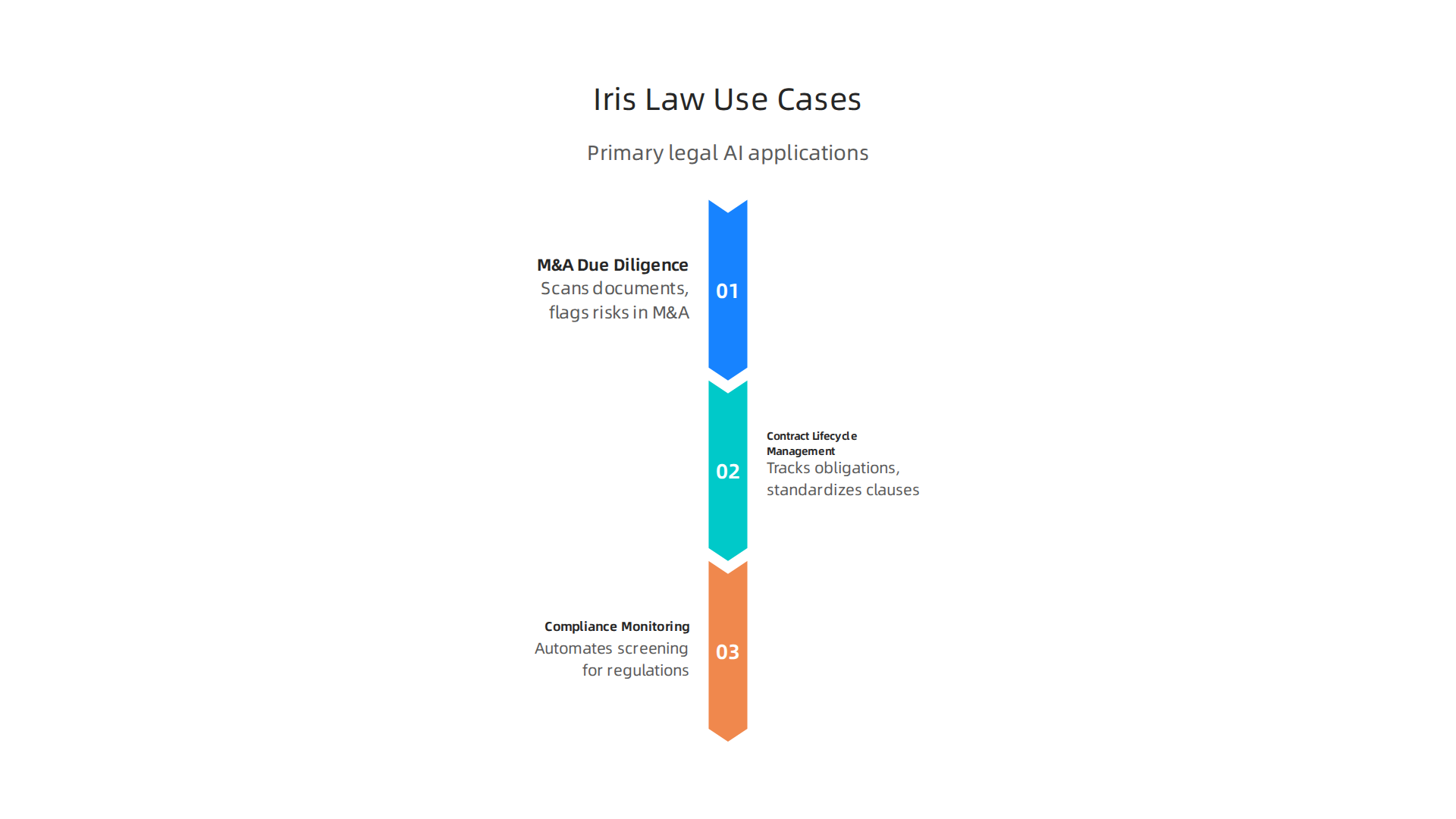
The features we just covered are not just theory. They solve real problems in real legal workflows. Let us look at three primary use cases where iris law makes the biggest difference.
Due Diligence in M&A Transactions
Mergers and acquisitions involve mountains of documents. Thousands of contracts. Dozens of parties. Manual review can take weeks. Iris law cuts that down to hours.
The tool scans every document automatically. It flags risky clauses, missing signatures, and unusual liability terms in seconds. Instead of having five associates read the same 400 page contract, one person reviews the flagged highlights. This speed matters when you are competing for a deal. The AI revolution in legal document management, as covered in the Sirion guide on AI for legal documents, shows how automation minimizes manual effort while keeping accuracy high.
Iris law becomes your first pass on due diligence. You spot problems before you commit. That saves money, time, and headaches.
Contract Lifecycle Management
Contracts do not end after signing. You need to track obligations, enforce terms, and renew on time. Many teams lose track of clause standardization or miss critical deadlines.
Iris law solves this with obligation tracking and clause standardization. It reads each contract, extracts key commitments, and creates a clear timeline of what needs to happen and when. The system also helps you keep contract language consistent across your entire portfolio. This is especially useful when you handle employment contracts, vendor agreements, and service contracts from a single dashboard. For a deeper look at how legal roles are evolving with tools like iris law, read our analysis of the employment lawyer career in 2026.
The Spellbook review of AI contract review tools confirms that modern tools use machine learning to automate clause detection and flag risks. Iris law brings that power straight to your contract library.
Compliance Monitoring
Keeping up with regulations like GDPR, CCPA, or local data laws is a constant battle. Rules change fast. Manual audits are slow and expensive.
Iris law automates compliance screening. It connects to regulatory databases for both common law and international law systems. When a new rule drops, the tool scans your existing contracts and flags anything that might violate the update. This includes data processing clauses, consent language, and cross border transfer terms.
The 2026 guide from GC AI on contract review highlights that in house counsel need platforms that measure ROI and keep up with regulatory changes. Iris law does exactly that. It turns compliance from a reactive scramble into a proactive routine.
How These Use Cases Fit Your Team
Each of these scenarios matches a common pain point. M&A due diligence fights information overload. Contract lifecycle management fights operational inefficiency. Compliance monitoring fights risk and cost pressure.
Iris law is designed to handle all three. Whether you work in a large law firm or a corporate legal department, these use cases show how the tool pays for itself quickly.
Want to stay ahead of legal tech trends like these? Subscribe Free to The Deep View Newsletter for clear daily AI updates that help you make smarter decisions.
Implementation and Integration Best Practices
The use cases we just covered show how iris law can transform due diligence, contract management, and compliance. But knowing what the tool does is only half the story. Getting it set up correctly is where the real payoff happens.

Here are the best practices that separate a smooth deployment from a messy one.
Align with Your Existing IT Infrastructure
Iris law is powerful, but it is not a magic wand you just plug in. You need to think about how it fits your current systems. Start by mapping your existing workflows. Where do documents live? What tools does your team already use? How do data permissions work?
For example, many firms run on document management platforms like iManage or NetDocuments. Iris law should connect directly to these systems so you do not have to export and re-upload files. This reduces manual work and keeps your source of truth intact.
Security is another big piece. When you bring an AI tool into your legal tech stack, you must ensure it meets your firm’s data protection standards. The need for proper access controls and data handling is a core principle of SOC 2 compliance, which helps AI companies protect sensitive information and build trust. As the EisnerAmper guide on SOC 2 compliance for AI companies explains, this framework focuses on security, availability, and confidentiality. Iris law should integrate with your identity management and single sign-on systems to maintain those controls.
You also want to consider how the tool interacts with e-discovery platforms. If your team uses Relativity or Everlaw, iris law should be able to send flagged clauses and risk analysis results directly into those environments. A seamless flow between review, analysis, and production saves hours of rework.
Invest in Training and Change Management
The best technology in the world fails if no one uses it. I have seen legal teams buy expensive tools and then let them gather dust because people stuck to old habits. Do not let that happen.
Start with a small pilot group. Pick a few power users who are curious about automation. Let them test iris law on real workflows. Capture their feedback and show quick wins. When a contract that used to take three hours is reviewed in twenty minutes, word spreads fast.
Training cannot be a one-time webinar. Offer ongoing drop-in sessions, create cheat sheets, and assign a champion who can answer questions. This kind of change management is critical because roles evolve when AI enters the picture. For a deeper look at how legal professionals are adapting to these shifts, read our analysis of the employment lawyer career in 2026. That article shows how the day-to-day work changes when automation handles the repetitive tasks.
Also, set clear expectations. Help your team understand that iris law is not here to replace them. It handles the grunt work so they can focus on strategy, negotiation, and client relationships.
Integrate with Document Management and E-Discovery Tools
We already mentioned iManage and NetDocuments, but integration goes deeper than just file access. You want iris law to read every contract in your repository, not just the ones you manually upload. That means setting up folder monitoring and automated ingestion.
For e-discovery, the connection should work both ways. When a new matter arises, iris law can scan relevant documents in your review tool and flag key terms, risk clauses, or compliance gaps. The analysis results should then appear inside the e-discovery platform so your reviewers do not have to switch between screens.
Integration success also depends on how well iris law handles different legal traditions. The tool supports both common law and international law systems. That means documents from the United States, the United Kingdom, and the European Union can all be processed with the same accuracy. Your compliance team can use iris law to apply frameworks like the NIST AI RMF or ISO/IEC 42001, as highlighted in this overview of AI compliance requirements from IS Partners. This makes integration efforts pay off across multiple jurisdictions.
Moving Forward with Confidence
Implementation done right leads to immediate ROI. You shorten review cycles, reduce risk exposure, and free your team for higher-value work. But rushing the setup or skipping user training will waste your investment.
If you are planning your rollout and want practical advice from peers who have been through it, we can help. Have a specific integration question or a tip to share? Get in touch with us. Contact the Team and our editorial team will connect you with resources and insights to make your iris law deployment a success.
Compliance, Security, and Regulatory Considerations
You have done the hard work of setting up iris law. The integrations are working. Your team is trained. But there is one big question that keeps legal professionals up at night: Is my data safe?
That question matters more than ever in 2026. AI tools like iris law handle sensitive client documents, contract terms, and compliance data. If your firm deals with common law or international law matters, the stakes get even higher. One data leak can destroy trust and trigger serious legal consequences.
Here is what you need to know about compliance and security when using iris law.
Security Certifications Are Non-Negotiable
First, check the certifications. Any legal AI tool you bring into your stack should have SOC 2 compliance. This is not optional. The EisnerAmper guide on SOC 2 compliance for AI companies explains that this framework focuses on security, availability, and confidentiality. It is the gold standard for data protection in legal tech.
Iris law also needs to align with other key frameworks. Standards like ISO/IEC 42001 and the NIST AI RMF help ensure that AI tools are both secure and trustworthy. This overview from IS Partners shows how these frameworks work together across different industries.
For a deeper look at what SOC reports actually mean for your purchasing decisions, check out this guide on SOC 2 bridge letters from Iris AI. It explains how to verify that a vendor is truly compliant.
Encryption and Access Controls Protect Client Data
Certifications are great, but the real protection happens at the technical level. Iris law should use strong encryption both when data is stored and when it moves between systems.
Access controls are just as important. Not every team member needs to see every document. Role-based permissions make sure that only authorized users can view, edit, or export sensitive information. In 2026, legal hold processes must also cover AI tools. This article on AI security best practices from JD Supra explains how retention and deletion policies should work for AI systems.
AI’s Role in Regulatory Compliance
Here is where iris law really shines. It can automate compliance audits for regulations like GDPR, HIPAA, and the emerging AI laws of 2026. But automation needs validation. You cannot just trust the output blindly.
The regulatory landscape in 2026 is complex. Federal and state AI laws may conflict, leaving businesses in a tricky spot. This AI regulation survival guide from Kiteworks breaks down what those conflicts mean for compliance teams.
To navigate these waters, many firms are turning to structured frameworks. The Vanta AI compliance guide for 2026 covers the EU AI Act and other major standards. When iris law applies these frameworks to your contracts and policies, you need to audit the results regularly. Validation is the key.
What This Means for Your Team
Do not let compliance concerns stop you from adopting iris law. The tool is built to handle sensitive legal work. But you have to do your part. Verify its certifications. Set up proper access controls. And regularly check that the AI outputs match your regulatory requirements.
Staying on top of these security and compliance topics can feel overwhelming. But you do not have to do it alone.
Get clear daily AI updates from a trusted source. Subscribe Free to The Deep View Newsletter and keep your knowledge current.
Comparative Analysis: Iris Law vs. Other Legal AI Platforms
You already know that security is a must. But once you have checked that iris law meets your compliance needs, the next question is: How does it compare to the other tools out there?
The legal AI space in 2026 is crowded. Platforms like Kira, Luminance, and Harvey AI all compete for your business in the contract analytics space. A recent survey of which legal AI tools law firms are actually using showed that many firms are testing multiple options. Few have settled on a single standard yet. This makes doing your own comparison very important.
So how does iris law fit into this picture?
The answer depends on your firm’s specific needs.
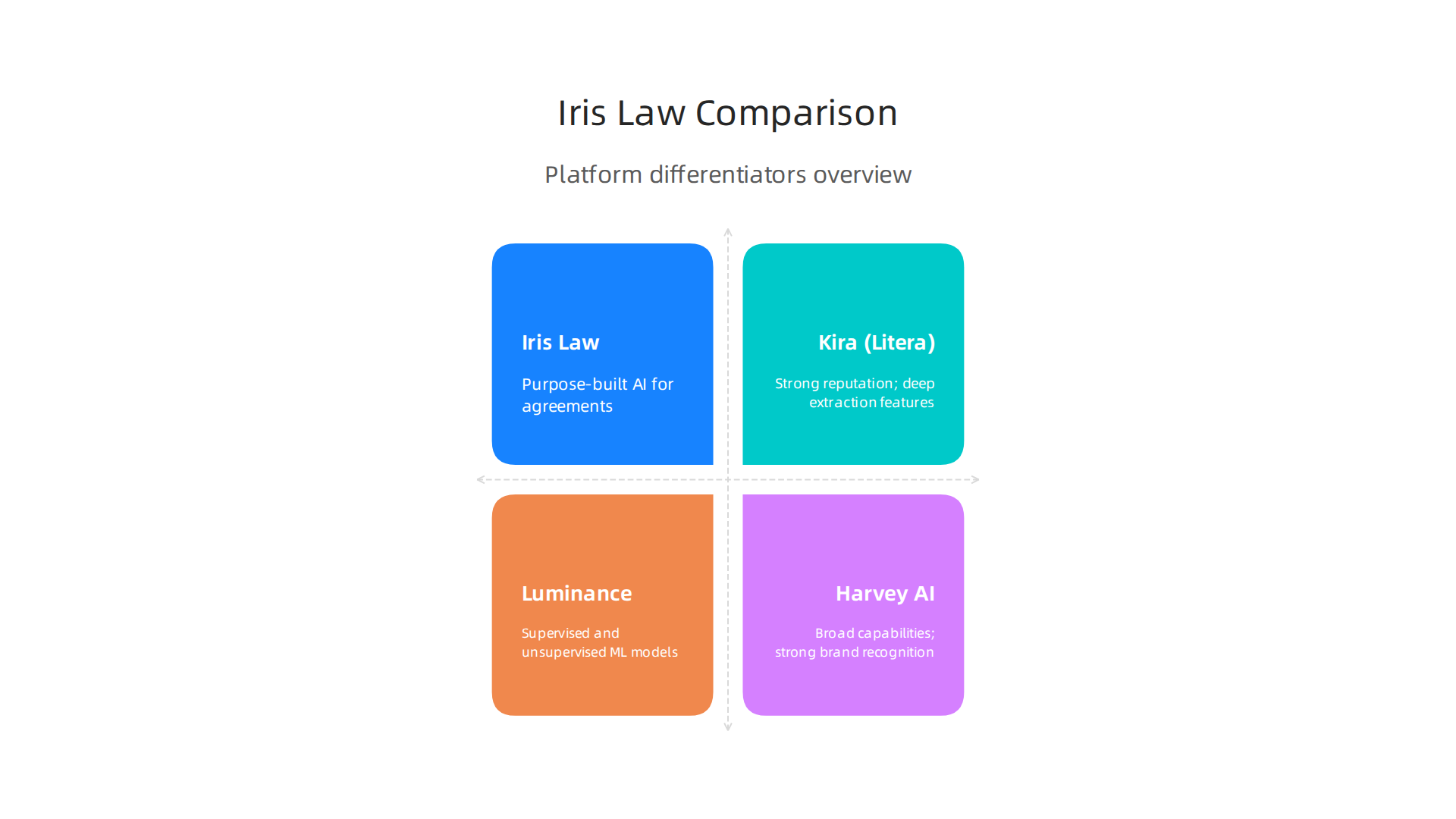
Here is a breakdown of the main differences.
Proprietary Models and Training Data
Iris law was built for the agreement lifecycle. According to a comparison of legal AI software, it is "a legal-focused AI engine trained specifically on contract data." This narrow focus can be a big strength if your team does a lot of contract review.
Kira, now part of Litera, is known for due diligence. It is good at clause extraction and comparison. But some users say its interface feels harder to use than newer tools.
Luminance uses a mix of supervised and unsupervised machine learning. This works well for very large document reviews. However, it may take more time to learn.
Harvey AI is a generalist platform. It does many things well, from research to drafting. But a guide to evaluating legal AI tools in 2026 points out that generic tools may not serve specialized needs as well as purpose-built ones.
Ease of Use and Deployment
A big pain point for legal tech buyers is getting the team to actually use the tool. A solicitor’s guide to the best legal AI tools in 2026 notes that most legal AI is built for "a large firm with deep pockets and a dedicated IT team."
Iris law aims to change that. Its interface is designed for simple onboarding. Whether you work in common law or international law, the platform tries to fit your workflow instead of forcing you to change.
Pricing Flexibility
Let’s talk about cost. Harvey AI can cost over $1,200 per seat per month. For a team of 20, that is nearly $288,000 per year, as shown in this AI contract review ROI analysis. Kira tends to be cheaper, but pricing is not always clear.
Iris law positions itself differently. It aims for flexible pricing that scales with your team size. This makes it a good fit for firms that are not part of the typical legal tech companies list dominated by large enterprises.
Quick Comparison Table
| Platform | Best For | Key Differentiator | Pricing Model |
|---|---|---|---|
| iris law | Contract management and review | Purpose-built AI for agreements; easy onboarding | Flexible, transparent tiers |
| Kira (Litera) | Due diligence and clause extraction | Strong reputation; deep extraction features | Per project or subscription |
| Luminance | Large-scale document analysis | Supervised and unsupervised ML models | Enterprise licensing |
| Harvey AI | General legal tasks and research | Broad capabilities; strong brand recognition | High per-seat subscription |
Choosing the Right Tool for Your Team
The best choice depends on your practice area and firm size. If you handle mostly contract work, a specialized tool like iris law may give you better results from the start. If you work across many different areas of law, a generalist tool might be worth the higher price.
Understanding these differences helps you make a smarter decision. For more context on how these tools fit different legal careers, read our guide on the employment lawyer career in 2026 and how technology shapes the role.
Stay Ahead of the Tech Curve
The legal AI market is moving fast. New features and competitors appear all the time. Do not fall behind.
Subscribe Free to The Deep View Newsletter and get clear, daily AI updates that help you compare tools like iris law with confidence.
Summary
This article gives a practical, research-driven overview of iris law, an AI platform built to speed contract review, extract clauses, score risk, and automate compliance checks across common law and international frameworks. It explains core capabilities—NLP-driven clause extraction, real-time regulatory scans, and user-friendly dashboards—and shows how those features address three main pain points: information overload, operational inefficiency, and cost pressure. You’ll see the primary use cases (M&A due diligence, contract lifecycle management, and compliance monitoring), best practices for implementation and integration with systems like iManage and Relativity, and the security and regulatory checks you must perform. The piece also offers a comparative look at competitors, pricing considerations, and rollout tips to maximize adoption and ROI. After reading, legal teams will understand whether iris law fits their workflows, how to deploy it safely, and how to measure the benefits in time and risk reduction.