
Malpractice Attorney Role in 2026 Duties Challenges and Legal Tech Trends

The legal world is huge. And not every lawyer does the same thing. Some focus on helping people start a business. Others handle fights between companies. And some step in when another attorney makes a serious mistake. That last group is the malpractice attorney. Their job is one of the most misunderstood and most important areas of law.

If you work in legal tech, you probably build tools for lawyers. But here’s the thing: a state attorney who handles traffic tickets needs completely different software than a lawyer for business dispute who manages contracts. When you do not understand these differences, your product might miss the mark. You could spend months building features nobody uses. That hurts your growth and your reputation.
This article will help you see the full landscape of attorney specialties. We will zoom in on the malpractice attorney in particular. You will learn what they actually do day to day, how they adopt new technology, what compliance rules trip them up, and where the profession is heading in 2026. By the end, you will know exactly how to tailor your tools to the lawyers who need them most.
Want to keep learning about the legal tech trends shaping this year? Subscribe to The AI Newsletter Worth Reading for quick daily updates you can actually use.

And if you are curious about how malpractice lawyers differ from other litigators, check out our guide on malpractice lawyer vs litigation lawyer.
The Landscape of Attorney Specialties: Why It Matters for Legal Tech
If you build legal tech, you might think all lawyers need the same tools. But that could not be further from the truth. The legal profession is made up of dozens of different specialties, and each one comes with its own workflows, compliance rules, and pain points.
Think about it this way. A state attorney who prosecutes criminal cases has completely different needs than a family lawyer handling divorces. An entity formation attorney who helps startups register their LLCs needs tools for document templates and state filings. A lawyer for business dispute who handles contract arguments needs robust document review platforms. And a malpractice attorney who sues other lawyers needs specialized case management software to track complicated evidence and statute deadlines. These aren’t small differences. They change everything about how a lawyer practices.
Here is a quick look at the major categories you should know:
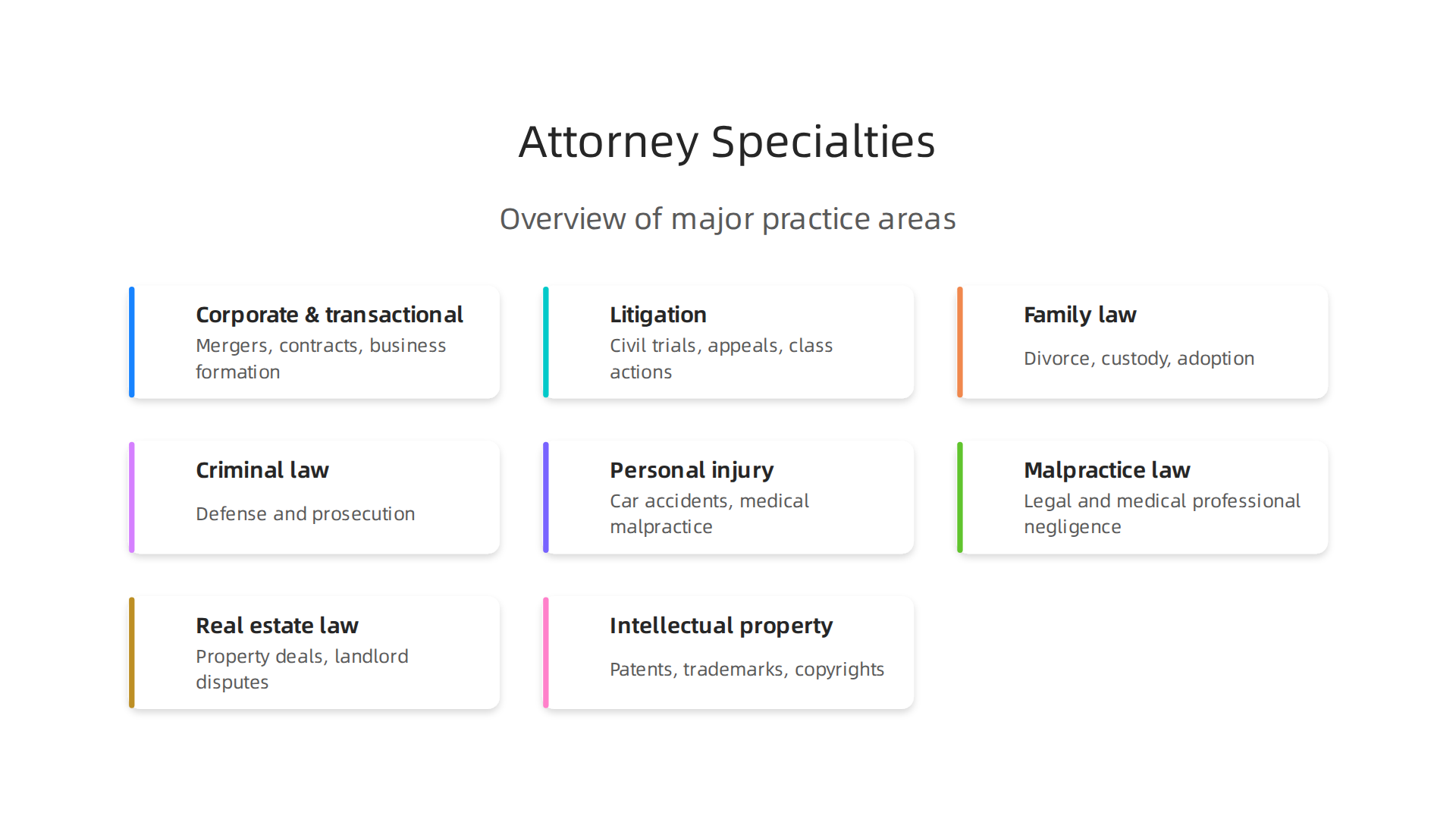
- Corporate and transactional law – Mergers, contracts, business formation
- Litigation – Civil trials, appeals, class actions
- Family law – Divorce, custody, adoption
- Criminal law – Defense and prosecution
- Personal injury – Car accidents, medical malpractice
- Malpractice law – Legal and medical professional negligence
- Real estate law – Property deals, landlord disputes
- Intellectual property law – Patents, trademarks, copyrights
There are about 1.3 million lawyers practicing in the United States. According to the latest lawyer demographics in 2026, nearly 60 percent are male, and the largest age group is 35 to 44 years old. Salary also varies wildly by specialty. Corporate lawyers earn around $190,000 on average, while public defenders bring in roughly $85,000 to $110,000.
Why does all this matter for you? When you build legal tech without understanding these differences, you risk creating a product that feels generic and misses the mark. A tool designed for a transactional lawyer may be useless for a litigator. Your go-to-market strategy also suffers if you target all lawyers instead of the specific specialty that fits your product. Knowing your audience saves you time, money, and disappointment.
To explore how different legal roles are adapting to new tools, check out this article on how technology reshapes the attorney role. It gives a broader picture of where the profession is heading.
In the next section, we will zoom in on one specialty that is especially misunderstood: the malpractice attorney. You will learn exactly what they do and how to build tech that actually helps them.
Deep Dive: The Malpractice Attorney Role and Unique Challenges
Now let’s look closely at one specialty that most people misunderstand: the malpractice attorney. This lawyer does not just handle one type of case. They work across many professions, including medical, legal, accounting, and even architecture.

In simple terms, a malpractice attorney helps clients who have been harmed by a professional who failed to do their job correctly.
According to a definition from a malpractice law firm, what a malpractice attorney does starts with evaluating whether the professional broke the standard of care. If a doctor misdiagnoses a patient or a lawyer misses a filing deadline, the malpractice attorney steps in to investigate.
Key Responsibilities
These lawyers have a big list of daily tasks:
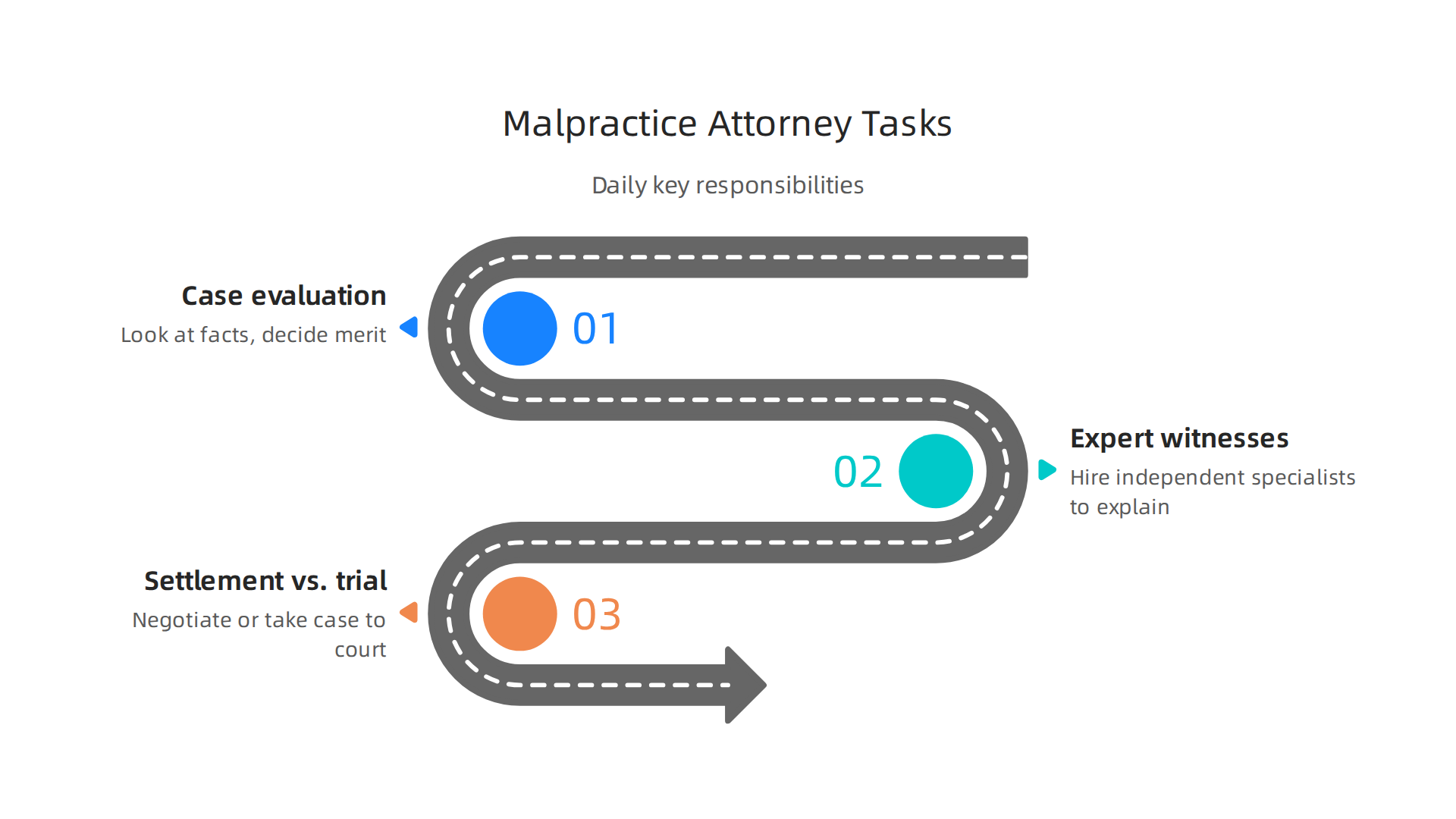
- Case evaluation: They look at the facts and decide if the case has merit.
- Expert witness coordination: They hire independent doctors, accountants, or other specialists to explain how the professional failed.
- Settlement vs. trial strategy: They negotiate with insurance companies and defense attorneys, and if no fair offer comes, they take the case to court.
The work does not stop there. Malpractice attorneys also gather and preserve evidence like medical records and witness statements, calculate damages, and file all paperwork before strict deadlines.
Unique Challenges
This specialty comes with major hurdles that make it different from other legal fields.
- High evidence burden: Proving negligence requires mountains of records and expert testimony. One missing document can sink a case.
- Statute of limitations: Deadlines are tight and vary by state. For example, medical malpractice claims in New York have a two and a half year limit. Miss that window and the client loses everything.
- Reputation risk for defendant attorneys: When one lawyer sues another for legal malpractice, it gets messy fast. The defendant lawyer’s career and reputation are on the line.
Because malpractice cases are so complex and fact-heavy, the right technology can make a huge difference. Tools that help organize evidence, track deadlines, and manage expert communication are essential for these attorneys.
If you want to see how a malpractice lawyer differs from a regular litigation lawyer, check out this detailed malpractice lawyer vs litigation lawyer comparison.
And for legal professionals who want to stay on top of the latest tech tools that can help with evidence management and case strategy, consider getting clear daily AI updates from The Deep View Newsletter. It keeps you informed without the noise.
Duties and Key Responsibilities
Every case starts with careful screening. The malpractice attorney must decide if the case has merit by reviewing records and checking if the professional broke the standard of care. As explained by a law firm covering the medical malpractice lawyer’s role in evaluating cases, the lawyer must show that the deviation caused harm.
Next comes discovery and expert retention. The attorney gathers evidence, requests documents, and hires independent experts like doctors or accountants. These experts define the standard of care and explain how it was breached.
Finally, the attorney handles negotiation or litigation. They send demand letters, negotiate with insurers, and if no fair settlement comes, take the case to trial. Malpractice trials require clear presentation of complex professional standards.
Modern tools help attorneys manage evidence and deadlines. Many use technology to stay organized, and checking an attorney’s background can prevent issues. For example, verifying credentials through a Texas bar attorney search is a smart step for any client or firm.
Common Types of Malpractice Cases
Malpractice can happen in almost any profession where a trusted expert must follow a standard of care. But three types show up most often in real life.

Medical malpractice is the most widespread. It includes surgical errors, misdiagnosis, birth injuries, medication mistakes, and hospital negligence. A malpractice attorney handling these cases works with independent medical experts to show how a healthcare provider failed the patient. Many cases also involve nursing home negligence or defective medical devices, as noted in a breakdown of common medical malpractice case areas.
Legal malpractice happens when an attorney fails a client. Common examples are missing a filing deadline, having a conflict of interest, or giving inadequate representation that costs the client money. Experienced legal malpractice attorneys review whether the lawyer’s mistake directly caused financial harm.
Other professional malpractice covers accounting errors, engineering failures, and bad advice from financial advisors. CPAs, architects, and consultants all have professional standards they must meet. The deadlines and rules for each type of professional malpractice vary by state, so acting quickly matters.
If you are unsure whether your situation involves malpractice or some other legal dispute, it helps to understand the difference between a malpractice lawyer vs litigation lawyer before choosing who to call.
No matter the field, proving any claim requires showing that a professional’s mistake caused real harm. That is why a skilled malpractice attorney is so important for evaluating your specific case.
How Legal Tech Is Reshaping Malpractice Law Practice
The way a malpractice attorney works today looks nothing like it did even five years ago.

Technology is changing how cases get built, reviewed, and won. For lawyers who handle medical, legal, or other professional negligence claims, these changes matter a lot.
Adoption Trends in Malpractice Law
More firms are using e‑discovery tools, case management software, and AI‑assisted document review. According to the 11 legal technology trends for 2026, AI can now summarize depositions in seconds and surface key evidence that used to take weeks to find. Tools like these let attorneys upload an entire case folder and get instant cross‑checking of witness statements, expert testimony, and medical records.
Impact on Efficiency and Outcomes
Speed is just one benefit. AI also helps a malpractice attorney predict case outcomes better. Platforms that analyze past case histories and court data give lawyers a clearer picture of how a judge might rule or what a fair settlement looks like. One boutique litigation firm reported saving over eight hours per week on first‑pass file review using AI, as noted in a case study on AI case management software. That time goes straight back into building stronger arguments for clients.
Challenges Still in the Way
But adopting legal tech isn’t all smooth.
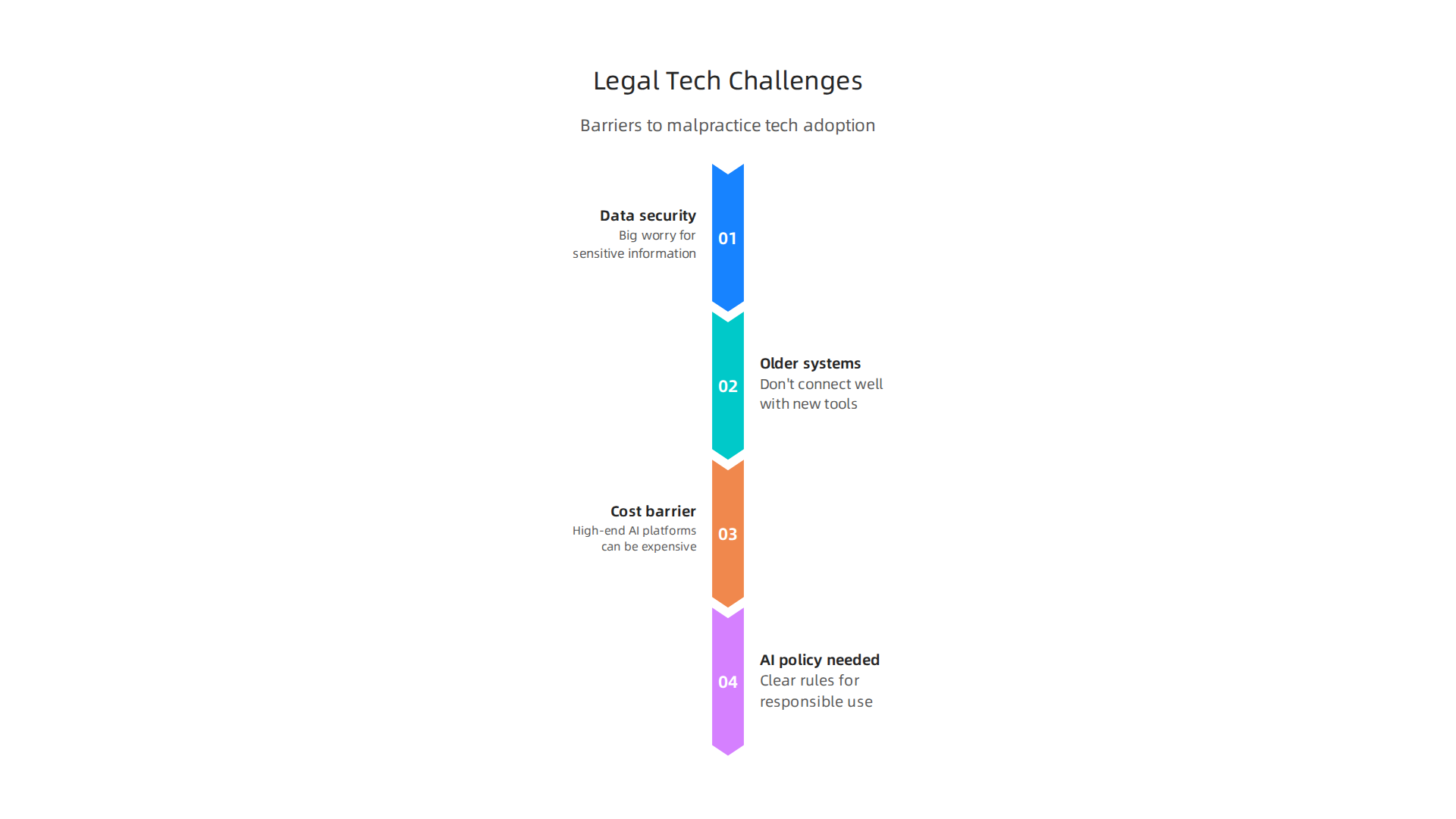
Data security is a big worry. Many firms still run on older systems that don’t connect well with new tools. And for smaller practices, the cost of high‑end AI platforms can be a real barrier. Every firm also needs a clear policy on how to use AI responsibly. The NC Bar Association guide on AI policy stresses that a “human in the loop” is non‑negotiable, meaning a lawyer must always verify what the machine produces.
Staying Ahead as a Modern Practitioner
For a malpractice attorney, staying updated on these tools isn’t optional anymore. Clients expect faster, more accurate service. Firms that lag behind risk losing cases and credibility. If you want to understand how technology reshapes the attorney role, following reliable legal tech coverage can help.
And if you want clear, daily updates on AI and legal tech without the hype, check out The AI Newsletter Worth Reading. It gives you practical insights to keep your practice sharp in 2026.
Case Management Tools for Malpractice Firms
For a malpractice attorney, case management software must do more than track court dates. It needs features built for the unique demands of negligence claims. A good platform includes statute of limitations tracking so you never miss a filing deadline. It also connects to expert witness databases and integrates medical record systems, cutting down the hours spent on manual chart review.
Tools like legal case management software for attorneys give firms these capabilities in one dashboard. Users report big time savings. According to a roundup of AI tools for lawyers in 2026, litigation platforms now analyze past case data to predict outcomes and flag risks. That kind of insight helps a malpractice attorney settle faster or prepare stronger arguments.
The return on investment is clear. Firms that adopt these tools see fewer missed deadlines and faster case turnaround. One report on law firm technology in 2026 found that 58% of legal teams report increased efficiency after using AI powered case management software.
If you want to learn more about the different roles, check out this comparison of malpractice lawyer vs litigation lawyer.
AI and Advanced Analytics in Malpractice Litigation
One of the biggest time sinks in any malpractice attorney‘s caseload is drowning in medical records. AI tools now use natural language processing to read through thousands of pages of medical records in minutes. They can pull out key facts, flag inconsistencies, and even compare expert testimony to those records. For example, AI tools for medical record retrieval generate medical chronologies and draft demand letters automatically. This alone can save hours on each case.
Predictive analytics takes malpractice litigation a step further. These systems look at past case data to guess how a current case might end. They estimate a fair settlement value and suggest whether to settle or go to trial. According to a 2026 report on AI use cases in the legal industry, firms now use predictive analytics to assess case risks and refine their strategies. For a malpractice attorney, this means more confident decisions and better outcomes for clients.
But using AI in sensitive malpractice cases comes with ethical duties. The lawyer is always responsible for the final work. AI tools are helpers, not replacements. You need a clear AI use policy for law firms that sets rules on data privacy, client consent, and verifying every AI output. As technology continues to reshape the attorney role, staying informed is key.
To get clear daily AI updates from The Deep View Newsletter, subscribe to The AI Newsletter Worth Reading.
Key Differences Between Malpractice Attorneys and Other Civil Litigators
Not all civil cases are the same. A malpractice attorney works in a world that looks very different from a personal injury lawyer or a general commercial litigator. The rules, the evidence, and even the way insurance companies play a role are all unique.
Here is what sets a malpractice case apart.
Higher standards for expert testimony. In most personal injury cases, you might need one expert to talk about the injury. In a malpractice case, you almost always need at least two: one to set the standard of care and another to show how the defendant broke it. That expert testimony is required by law in many states. Without it, your case can be thrown out before it even starts. A general commercial litigator rarely has to meet this bar.
Insurance carrier involvement changes everything. When you sue a doctor or hospital, the insurance company for that healthcare provider usually hires the defense. That means a team of experienced defense attorneys with deep pockets and a playbook for dragging cases out. The insurance adjuster also decides whether to settle or fight. That is very different from a business dispute where two companies argue over a contract. In those cases, the lawyer for business dispute often negotiates directly with the other side’s attorney, not with a claims adjuster.
Higher stakes and longer timelines. Malpractice cases cost more to pursue because you need expensive experts, medical record reviews, and often a longer discovery phase. A state attorney handling a routine negligence case might resolve it in a few months. A malpractice case can take two years or more. According to the Occupational Outlook Handbook for lawyers, about 859,000 lawyers worked in the U.S. in 2023, but only a small fraction focus on medical malpractice. That specialty comes with a steep learning curve.
If you are trying to decide whether your case needs a malpractice specialist versus a general litigator, it helps to understand these differences. You can learn more about the differences between malpractice lawyers and litigation lawyers to make a smarter choice.
Specialization and Expertise Requirements
Becoming a malpractice attorney is not something you can do right out of law school. It takes extra training, ongoing education, and a deep understanding of medicine that most general lawyers never need.
Board certification matters. Many states offer certification for legal specialists. To earn it, a malpractice attorney must pass a separate exam, show years of experience in the field, and get recommendations from other lawyers and judges. Some states do not require certification, but having it signals real expertise. If you are looking for a lawyer, you can check credentials through tools like the Texas bar attorney search to verify board certifications and disciplinary history before you hire anyone.
Medical knowledge is non-negotiable. A malpractice attorney must understand anatomy, surgical procedures, drug interactions, hospital protocols, and medical record systems. This is very different from an entity formation attorney who focuses on corporate documents and filings. Malpractice lawyers constantly read medical journals, attend healthcare law seminars, and work with expert doctors to stay current.
Firm size shapes case selection. Big firms with multiple partners can take on high-cost malpractice cases because they have the budget for experts and long timelines. Solo practitioners and small firms often only accept cases with clear liability and major damages. Because the work is so specialized, the 2026 attorney salary data shows litigation specialists earn around $158,000 on average, but top malpractice attorneys in major markets can earn over $200,000. The premium for specialized practice areas ranges from 15 to 25 percent more than general practice, according to the Complete Attorney Compensation Report 2025-2026.
Compliance, Risk, and the Malpractice Attorney
A malpractice attorney operates inside a tight web of rules that change from state to state.

Understanding this regulatory framework is just as important as knowing the law itself.
Damages caps vary widely. As of 2026, twenty-eight states limit how much a patient can win for pain and suffering. These caps change often. For example, California’s noneconomic cap is now $470,000 for personal injury while Colorado’s cap rose to $530,000 this year. You can check current limits across all states with a look at the Medical malpractice damage caps by state 2026 resource. Some states, like New York, have no damages cap at all. A good malpractice attorney must know these limits inside out because they directly affect case value.
State statutes also set strict deadlines. Most states give patients two or three years from the injury date to file a lawsuit. But special rules exist. In New York, Lavern’s Law allows extra time for cancer misdiagnosis cases. Missing these deadlines means losing the case forever.
Risk management keeps the practice safe. Every malpractice attorney must run conflict checks before taking a new client. A solid engagement letter spells out exactly what the lawyer will and will not do. Good documentation standards protect both the client and the firm. Without these steps, a lawyer can face their own malpractice claims. Many firms now use automated conflict checking tools to avoid mistakes.
Legal tech makes compliance easier. Secure client portals protect sensitive medical records. Audit trails track every change to case files. Automated systems flag deadlines and send reminders. These tools reduce human error and help lawyers focus on the legal work. To learn more about how law firms protect sensitive data, check out this guide on how law firms defend legal data against phishing emails.
Keeping up with all these moving parts requires constant learning. For daily AI updates that help you stay ahead of legal tech changes, consider subscribing to The AI Newsletter Worth Reading.
Ethical Considerations in Malpractice Law
Ethical duties sit at the heart of every malpractice case. A malpractice attorney often faces tricky conflicts. For example, when you represent multiple defendants in one lawsuit, one doctor might blame another. That creates a loyalty clash. You must identify these conflicts early and get written waivers or withdraw from representing some parties.
You also have a duty to screen cases carefully. Rule 11 of the Federal Rules of Civil Procedure, and similar state rules, require you to only file claims with a good factual and legal basis. Many states reinforce this by demanding an affidavit of merit before you can even file a medical malpractice lawsuit. You can check the requirements across all states in this medical malpractice lawsuits 50-state survey. Filing a weak case wastes court time and can lead to sanctions against your license.
Technology adds another ethics layer. Handling sensitive medical records and legal strategy requires strong data security. A data breach could expose private information and destroy client trust. If you need to research whether a lawyer has faced discipline for ethics violations, you can use the Texas Bar attorney search to check their license and disciplinary history. Staying ethical in malpractice law means balancing zealous advocacy with your duties to the court, your clients, and the public.
Future Trends: AI, Specialization, and Opportunities for Legal Tech
The legal landscape for a malpractice attorney is changing fast. Artificial intelligence is now part of everyday medicine. AI tools help doctors read X-rays, suggest treatments, and monitor patients. When these tools make mistakes, new types of claims appear. Courts are starting to ask tough questions: Who is responsible when an AI misses a diagnosis? The answer is not always clear, and that creates work for lawyers who understand both medicine and technology.
AI can also help you build stronger cases. New software can scan thousands of medical records in minutes and flag timelines that do not line up or care that fell below the standard. Predictive analytics can look at past jury verdicts and settlement data to help you decide whether to settle or go to trial. One legal tech expert explains that the next wave of AI focuses on anticipating claim probabilities and recommending discovery targets. This kind of insight gives you a real advantage when planning your strategy.
The demand for legal tech that connects with health data systems is growing fast. Firms that invest in these tools can handle more cases and serve clients better. At the same time, you need to understand how AI changes liability. That is why staying informed is so important.
If you want to keep up with these shifts, subscribe to The AI Newsletter Worth Reading for clear daily updates on artificial intelligence and legal technology.
The role of the attorney is evolving. To see how technology is reshaping the profession, read more about how technology reshapes the attorney role. Embracing these tools now will help you stay ahead of the curve and protect your clients in a changing world.
Emerging Technologies to Watch
Beyond AI tools, three other technologies deserve your attention as a malpractice attorney.
First, blockchain keeps evidence safe. When you handle digital records like medical scans or lab reports, blockchain creates an unchangeable log of who accessed them and when. This protects the chain-of-custody from challenges in court. No one can claim the evidence was tampered with if the blockchain record proves otherwise.
Second, virtual reality is changing jury trials. You can use VR to build a 3D scene of an accident or recreate a surgical procedure. Jurors can walk through the space and see exactly what happened. According to research on AI medical malpractice trends, courts are increasingly open to visual tools that help juries understand complex medical facts.
Third, large language models can now write first drafts of legal briefs. These systems scan case law and pull out the most relevant arguments. You still must review and edit everything yourself. But the speed gain is massive. For a closer look at how these tools work in practice, check out how leading law firms embrace technology in 2026.
These technologies are already here. The firms that adopt them early will handle more cases and serve clients better.
Summary
This article explains why legal tech builders must understand attorney specialties, with a focused deep dive on malpractice lawyers. It describes what malpractice attorneys do—case screening, expert coordination, evidence collection, settlement strategy and trial work—and highlights how their cases demand heavier evidentiary burdens and strict statute deadlines. The piece covers how modern tools like AI case review, predictive analytics, and specialized case management reduce time spent on records, flag risks, and protect against missed deadlines, while stressing ethical and data‑security obligations. You’ll learn the practical differences between malpractice and other civil litigators, which technologies make the biggest impact, and how compliance and state rules shape case value. By the end you’ll know which features to prioritize when building or selling legal tech to malpractice firms and how to position tools for better adoption and ROI.