
De Novo Review in 2026 How It Shapes Appeals Arbitration and Legal Tech

Introduction: Why ‘De Novo’ Matters in Modern Legal Practice
Have you ever heard a lawyer say "de novo" and felt lost? You are not alone. Legal jargon like "de novo" creates a barrier between legal professionals and the people they serve.

And that barrier gets bigger when new technology enters the picture.
Here is the thing. When law firms try to adopt tools like AI contract analysis or automated document review, the confusion around terms like "de novo" can slow everything down. If a lawyer you know struggles to explain what "de novo" means, imagine how hard it is for a software developer to build tools that handle it correctly.
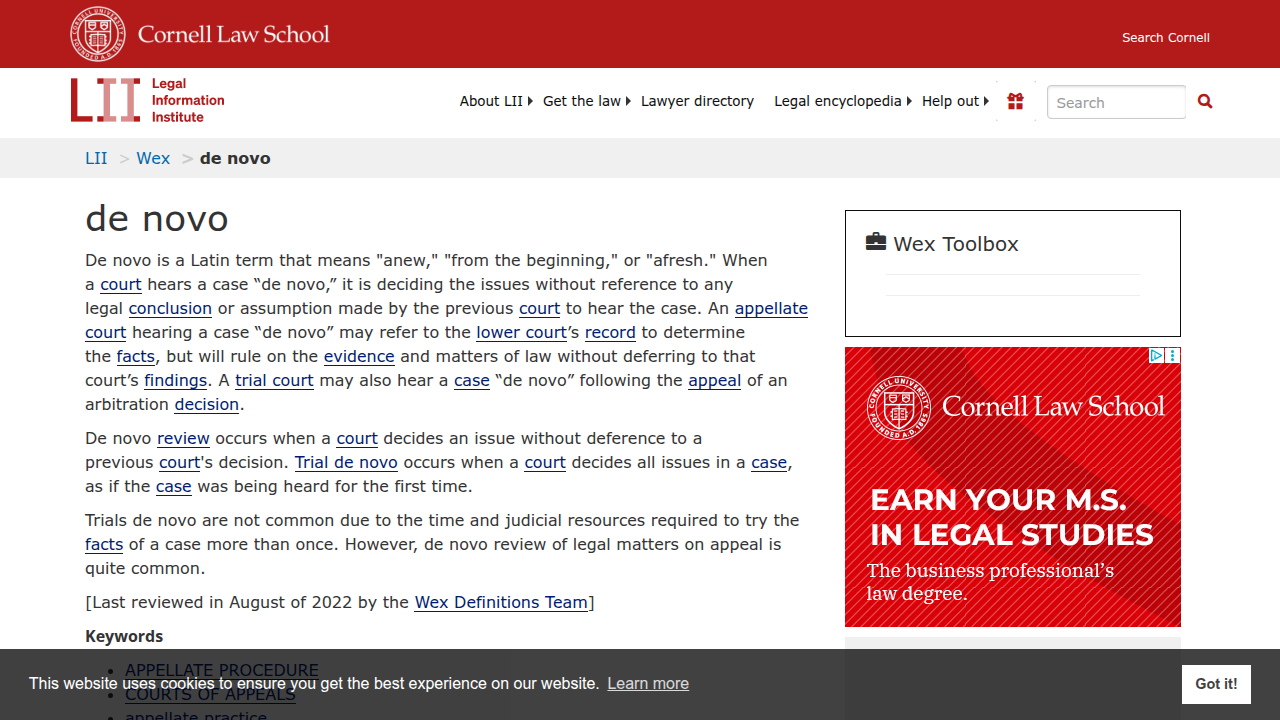
So what does "de novo" actually mean? At its simplest, it is Latin for "from the beginning." When a court hears a case de novo, it starts fresh. It does not give any special weight to what the previous court decided. The Cornell Legal Information Institute offers this clear explanation: a de novo review occurs when a court decides an issue without deference to a previous court’s decision.
This concept matters more today than ever. In 2026, appellate strategy, arbitration clauses, and AI-driven legal analysis all depend on a clear understanding of de novo review. When an appeals court reviews a legal question, it uses the de novo standard. When a party appeals an arbitration decision, a trial de novo may reset the entire case. And when AI tools analyze past rulings, they need to know whether the decision was a fresh look or a deferential one.
The effects of law reach far beyond the courtroom. On any given law day, attorneys, judges, and clients rely on these distinctions to know their rights and next steps. That is why this article exists.
We will break down the de novo law concept in plain language. You will learn what it means, how courts use it, and why it matters for your practice or your case. We will also explore how legal technology is reshaping the way lawyers approach de novo review in 2026.
If you want to stay ahead in legal tech, check out The AI Newsletter Worth Reading for daily updates that cut through the noise.

And for a real-world example of how leading firms are embracing innovation, look at how Pillsbury Law Innovation Drives Record Growth and AI Leadership.

Their approach shows the value of understanding both the law and the tools that make it work.
What Does ‘De Novo’ Mean in Legal Terms?
Let us get specific about what de novo law really means in practice.
The words "de novo" come from Latin. They translate to "anew," "from the beginning," or "afresh." That is what the authoritative Black’s Law Dictionary definition of de novo confirms. When a court takes a de novo look at a case, it starts over as if no decision had been made before.
Here is the key difference that every lawyer you know should understand. There are two main ways de novo shows up in court:
De novo review. This happens when an appellate court looks at a legal question from scratch. The higher court does not give any special weight to what the lower court decided. It examines the law on its own and makes a fresh judgment. The standards of review for appellate courts explain that de novo is the most favorable standard for finding reversible error because the appeals court owes no deference to the trial judge’s legal conclusions.
Trial de novo. This is rarer. A trial de novo means the whole case gets heard again from the beginning, like the first trial never happened. Courts usually avoid this because it takes up huge amounts of time and judicial resources.
The effects of law here are huge. On any given law day, whether a court applies de novo review or a more deferential standard can determine who wins and who loses. That is why understanding this term matters whether you are a solo practitioner or part of a large firm.
The concept has deep roots. It goes back centuries in common law. Today, it is codified in the Federal Rules of Appellate Procedure and used daily in federal courts across the country. For legal professionals navigating 2026’s fast-changing landscape, knowing when de novo applies is not optional. It is essential.
If you want to stay sharp on how legal definitions shape real outcomes, check out how technology is redefining the attorney role in modern practice.

The tools may change, but understanding the foundation of terms like de novo review never goes out of style.
De Novo vs. Clearly Erroneous vs. Abuse of Discretion
Now that you know how de novo review works, it is time to see how it fits with the other two main standards of appeal. Every lawyer you know will tell you that picking the wrong standard can sink an appellate argument before the judge even reads the brief.
The three standards are:
De novo. This applies to questions of law. The appellate court gives zero deference to the lower court’s legal conclusions. The judges decide the law from scratch, as if the trial court never ruled on that issue.
Clearly erroneous. This applies to findings of fact. When a trial judge decides what happened (like who was at fault or how much damage was done), the appeals court gives some respect to that finding. The higher court only overturns it if the trial judge was clearly wrong. This is a middle ground.
Abuse of discretion. This applies to decisions where the trial judge had room to choose, like whether to admit certain evidence or set a sentence length. The appeals court gives the most deference here. It only steps in if the trial judge acted unreasonably or arbitrarily.
As one discussion of these standards explains, legal questions get no deference, bench fact findings get clear error review, and jury fact findings get substantial evidence review (which is similar to abuse of discretion in practice). Understanding which standard applies can determine the difference between winning and losing on appeal.
The effects of law here are massive. On any given law day, if you argue de novo review when the court uses abuse of discretion, you will lose credibility fast. That is why every lawyer you know needs to know the difference before writing a brief.
This foundation matters whether you are a new associate or a seasoned partner. Even as technology reshapes how attorneys work, the basic rules of appellate review do not change. For more on how modern tools are changing the lawyer’s role while these standards stay constant, check out how technology reshapes the attorney role in 2026.
Staying current on legal fundamentals is only half the battle. You also need to keep up with how Artificial Intelligence is transforming court procedures, research, and client expectations. Get clear daily AI updates from The Deep View Newsletter. It is a quick way to stay ahead of trends that affect your practice every day.
When Do Courts Apply De Novo Review?
De novo review is not just a backup option. Courts are required to use it for specific types of legal questions. Knowing when this standard applies can save you time on any given law day.
A simple breakdown helps every lawyer you know get this right.
Pure questions of law.
This is the most common trigger for de novo review. When the issue is about what a law says or means, the appeals court decides it from scratch. The lower court gets no say.
Statutory interpretation is a perfect example. The Supreme Court’s 2024 decision in Loper Bright Enterprises v. Raimondo made a huge change here. Before that case, courts often deferred to federal agencies on unclear laws. Now, courts use de novo review instead. As one detailed guide on appellate standards explains, courts are now the final deciders of what a statute means.
This is a major shift in the effects of law for anyone dealing with federal regulations.
Constitutional and jurisdictional questions.
De novo review also applies every time a constitutional question comes up. If someone argues that a law violates the First Amendment or the Equal Protection Clause, the appeals court has to look at it with fresh eyes.
Jurisdictional rulings work the same way. Did the lower court have the power to hear the case in the first place? The appeals court decides that question without any deference. The Legal Information Institute gives a clear rundown of how this standard works in practice.
Mixed questions of law and fact.
This is where things get complicated. A mixed question asks whether a set of facts meets a legal test.
Different circuits handle this differently. Some use de novo review. Others use a more deferential standard.
The Supreme Court dealt with this recently in Urias-Orellana v. Bondi (2026). The issue was whether certain facts rose to the level of "persecution" in an asylum case. Six circuits had applied de novo review, while five used a deferential standard. The Court ruled that the deferential standard applies nationwide. Reading the full analysis of this case shows how much these standards can change the outcome for real people.
Keeping up with these procedural rules takes effort. Fortunately, firms today can use modern resources like smart content interactive legal tools to stay organized and prepare stronger arguments.
De Novo Review in Appeals and Arbitration
So where does de novo law show up in practice? Two settings matter most: traditional appeals and arbitration. Each one treats this standard differently, and every lawyer you know should know the difference.
In traditional appeals, de novo is the starting point.
When an appeal raises a pure question of law, the appellate court takes a fresh look. It does not care what the trial judge thought. This is the default for legal issues like statutory meaning, constitutional rights, and jurisdictional boundaries.
The standard matters because it gives appellants their best shot at a win. A detailed guide on standards of review explains that de novo review is the least deferential standard and often decides whether an appeal succeeds or fails. If you can frame your issue as a legal question, you get a clean slate.
This is why smart attorneys spend time shaping their arguments around legal errors rather than factual disputes. The effects of law here are clear: the right framing can change everything.
Arbitration is a different story.
The Federal Arbitration Act (FAA) sharply limits how courts review arbitration awards. Unlike a trial court ruling, an arbitration award gets almost no de novo review. Courts cannot reexamine the legal merits of the award.
Instead, they only vacate an award on narrow grounds: fraud, corruption, evident partiality, or if the arbitrator exceeded their powers. That is it. No fresh look at whether the arbitrator got the law right.
This means arbitration offers finality but not a safety net for legal error. If you are drafting an arbitration clause, you need to understand this trade-off. Parties agree to give up the de novo standard in exchange for speed and privacy.
How legal tech helps you navigate these rules.
The challenge is knowing which issues trigger de novo review and which do not. That split-second decision can determine your entire appeal strategy.
Modern tools now help attorneys sort through these questions faster. For example, AI contract analysis for legal teams can scan arbitration clauses and flag language that limits judicial review. Other platforms help research whether a specific circuit applies de novo or a deferential standard to mixed questions.
Staying ahead of these procedural shifts takes consistent learning. The landscape changes every year. For daily updates on how technology and law intersect, a reliable information source keeps you sharp without wasting time.
As we head into 2026, the tools for managing de novo law keep getting smarter. The key is knowing when to use them.
De Novo Review of Administrative Agency Decisions
One area where knowing how to use de novo law matters most is administrative law. For decades, federal agencies operated under a special set of rules. When a court reviewed an agency’s interpretation of a law, it often gave heavy weight to what the agency said. This was known as Chevron deference. It meant agencies had the power to fill in gaps in unclear statutes.
The effects of law here were huge. Agencies could change how laws worked without Congress having to vote again. But in 2024, the Supreme Court changed everything with the Loper Bright decision. The court eliminated Chevron deference. Now, courts apply real de novo review to questions of statutory interpretation, even when an agency is involved.
A detailed article on when and how appellate courts apply de novo review explains that courts now look at the statute fresh, without deferring to the agency’s reading. This puts courts, not agencies, in charge of what a law means.
What does this mean for the lawyer you know who works in compliance or regulatory law? It means every agency rule can now be challenged on pure legal grounds. Compliance professionals can no longer hide behind old agency guidelines as safe bets. A court might just disagree with an agency’s reading and set aside years of settled practice.
The compliance landscape shifted overnight, and every law day since has brought new questions. Staying on top of this change requires constant learning. To keep up with how legal technology and procedural shifts come together in 2026, a reliable information source helps professionals stay sharp. For guidance on navigating these rapid changes, turn to The AI Newsletter Worth Reading for clear daily updates that cut through the noise.
For a deeper look at how these legal shifts reshape daily practice, check out our guide on how technology reshapes the attorney role in 2026. It connects the dots between procedural change and real-world lawyering.
Legal Tech Implications: AI and De Novo Review
These broad procedural shifts are not staying inside the courtroom. They are filtering directly into the legal tech tools landing on your desk. As de novo law becomes the default standard for pure questions of legal interpretation, the software lawyers rely on every single day is having to adapt just as fast. This creates both new challenges and new opportunities for legal professionals in 2026.
One of the biggest changes comes in predictive analytics. AI tools can now scan thousands of appellate decisions to forecast how a court might rule on a legal issue. If the standard of review is de novo, the chance of winning an appeal is often higher compared to a deferential standard like abuse of discretion. Lawyers use this data to decide whether to fight or settle. A great roundup of AI tools for lawyers in 2026 highlights how several major platforms now include features that estimate success rates specifically for de novo review. This completely changes the mathematics of risk for every case. It gives lawyers a data-driven edge that did not exist just a few years ago.

Document review tools also need to understand the standard deeply. When a court reviews a legal question de novo, it does not defer to the lower court at all. But if the standard is deferential, the focus of the appeal changes completely. Automation software must account for this difference. It has to know which parts of the record to flag and how strongly to flag them. The concept of AI-ready legal data review applies directly here. Engineers train models to look for pure legal errors when de novo applies, rather than re-weighing facts. This saves hours of manual work and reduces the risk of missing a key legal point.
Startups are pouring serious resources into this area. They are building analytics dashboards that track how individual judges handle different standards of review. This lets lawyers tailor their arguments with surgical precision. For example, an attorney working on a contract dispute can use AI contract analysis for legal teams to identify clauses that hinge on a legal interpretation. The tool tells the team whether they will get a fresh look from the appellate court or whether the trial judge gets the final say.
For the lawyer you know who is navigating an appeal in 2026, these tools are becoming just as important as knowing the case law. The effects of law are now built directly into the software itself. Every law day brings a new opportunity to use technology to build smarter, more persuasive arguments. Understanding both the procedural rule and the tech that tracks it is the real competitive edge in modern practice.
Common Misconceptions About De Novo Law
All the advanced tech in the world won’t save a flawed legal strategy. If your team misunderstands what de novo law actually means, even the best AI tools can lead you down the wrong path. Several common misconceptions trip up experienced attorneys regularly. Let’s set the record straight on three big ones.

Myth 1: De Novo Review Means a Completely New Trial
This is probably the most widespread misunderstanding. When an appellate court applies de novo review, it does not mean everyone goes back to square one with new witnesses and new evidence. Instead, the court looks at the specific legal issues with fresh eyes. It gives no respect or deference to the trial judge’s legal conclusions. But it does not redo the entire trial. The facts found by the lower court usually stay put. The only question is whether the law was applied correctly. As Cornell Law School’s Legal Information Institute makes clear, de novo review means the court decides an issue without any deference to a previous court’s decision on the law.
Myth 2: De Novo Review Applies to Every Part of an Appeal
Not even close. De novo review is only for pure questions of law. Think about a motion to dismiss or a summary judgment ruling. These involve legal conclusions, so an appellate court will review them from scratch. But if the appeal is about how a judge managed a trial or whether a jury’s factual finding was reasonable, the standard shifts to abuse of discretion or clear error. These are much harder to win. You can dig deeper into why this distinction matters by reading about the Standards of Review: The Hidden Determinants of Appellate Success.

Legal professionals who blur these lines waste time arguing facts that an appellate court will not reweigh.
Myth 3: De Novo Review and Trial De Novo Are the Same Thing
These terms sound alike, but they mean two very different things. De novo review is what an appellate court does to check legal errors. A trial de novo, on the other hand, is a completely fresh trial on all issues, like when a small claims court decision is appealed to a higher trial court. That second court starts entirely over from scratch. Confusing these two concepts can lead to bad advice and bad strategy.
Why Getting It Right Matters in 2026
Every law day brings new challenges. The effects of law are always shifting, and the lawyer you know who masters these basics will always have a real edge. A clear understanding of de novo law lets you use your legal tech tools more effectively, from AI-driven document review to analytics dashboards. If you want to stay ahead of every procedural shift while keeping up with the latest technology, check out how technology reshapes the attorney role in our detailed guide. And for busy professionals who need to cut through the noise daily, The AI Newsletter Worth Reading delivers clear, practical updates straight to your inbox.
Summary
This article explains the legal concept of de novo—Latin for "from the beginning"—and why it matters for appeals, arbitration, administrative law, and legal technology in 2026. It defines de novo review and trial de novo, contrasts de novo with clearly erroneous and abuse-of-discretion standards, and shows when appellate courts must give issues a fresh, non-deferential look. The piece explores major shifts such as the post-Loper Bright landscape for agency interpretations, practical differences between appeals and arbitration, and how AI tools now factor standards of review into strategy and predictive analytics. Readers will finish with a clearer sense of when to press a legal question as de novo, how to avoid common misconceptions, and how modern legal tech can identify and support winning appellate arguments.