
ERISA Whistleblower Claims How Attorneys Build Strong Retaliation Cases Under Section 510

Introduction: The Convergence of Whistleblower Law and Employee Benefits
ERISA whistleblower claims are quietly becoming one of the fastest-growing areas of employment litigation. Yet many legal professionals don’t know much about them. That’s a problem because the rules are tricky. Section 510 of ERISA gives whistleblowers protection when they report plan violations, but courts disagree on how far that protection goes. Some circuits cover all internal complaints. Others only protect formal reports. This ERISA whistleblower provision overview from Seyfarth Shaw shows just how easy it is to miss this area of law.
The complexity doesn’t stop there. You also have to deal with ERISA preemption, different retaliation standards, and tough evidence rules. A whistleblower attorney who handles these cases needs to understand both employee benefits law and traditional retaliation claims. Mix in constantly changing case law, and it becomes a real challenge for any litigation lawyer.
This article gives you a practical roadmap. You’ll learn the core protections under Section 510, see how to build a strong case, and discover ways to use technology to grow your practice.

Whether you’re an experienced employment attorney or just exploring this niche, the steps ahead will help you serve clients better and stand out in a competitive field.
Staying current is key. That’s why legal professionals who want to stay ahead of trends often rely on smart resources. For example, The AI Newsletter Worth Reading delivers clear daily updates on technology that can sharpen your practice. You can also check out this guide on employment attorney 2026 skills and tools for more practical ideas.
The bottom line: ERISA whistleblower law is growing fast, and the lawyers who get ahead of it now will have a major advantage. The rest of this article will show you exactly how to do that.
Understanding the Intersection of Whistleblower Law and ERISA
Imagine an employee who notices their 401(k) plan is losing money because of bad investments. They report it to their boss. A week later, they are fired. Is that legal? Under ERISA, it might not be. Section 510 of ERISA protects workers who speak up about problems with employee benefit plans.
Section 510 makes it illegal for any person to fire, fine, suspend, or discriminate against a plan participant or beneficiary for exercising their rights under ERISA. That includes giving information or testifying in any inquiry related to the law. The U.S. Department of Labor explains that a complainant must show they are a plan participant or beneficiary and that they engaged in protected activity like reporting a violation. A whistleblower attorney needs to know these basic building blocks to build a solid case.
But here is the tricky part. Courts do not agree on how far Section 510 protection goes. Some circuits, like the Fifth and Ninth, say it covers all internal complaints, even unsolicited ones. Other circuits, like the Second, only protect employees who give information during formal proceedings. This circuit split matters a lot. A careful analysis of Section 510’s whistleblower reach from Fordham Law Review shows the depth of this disagreement. If you are a litigation lawyer handling a case in the wrong jurisdiction, your client’s claim might fail even though the facts are strong.
It is also important to distinguish ERISA whistleblower claims from other federal protections. The Sarbanes-Oxley Act and Dodd-Frank Act also protect whistleblowers, but they have different procedures, deadlines, and remedies. An erisa attorney must figure out which law applies in each situation. Picking the wrong one can cost the client their case.
For a whistleblower attorney practicing in Texas, the Fifth Circuit’s broad protection aligns with the state’s public interest in encouraging workers to report benefit plan violations. That is good news for employees. But it also means attorneys must stay sharp on current case law.
If you are looking for a experienced whistleblower attorney, you can use a resource like the Texas Bar attorney search tool to verify a legal professional’s credentials before hiring them. Knowing who you are working with is the first step toward a strong case.
Core ERISA Whistleblower Protections: What Every Attorney Must Know
Let us walk through a real scenario. A plan participant notices their employer is skimming money from the 401(k) matching contribution. They report it to HR. Three days later, they are demoted to a lower paying role with no explanation. Is that illegal? Under ERISA Section 510, it very likely is.
Section 510 of ERISA makes it unlawful for any person to discharge, fine, suspend, expel, discipline, or discriminate against a plan participant or beneficiary for exercising their rights under the law. That sounds straightforward. But the details matter a lot for any whistleblower attorney building a case.
What Counts as Protected Activity
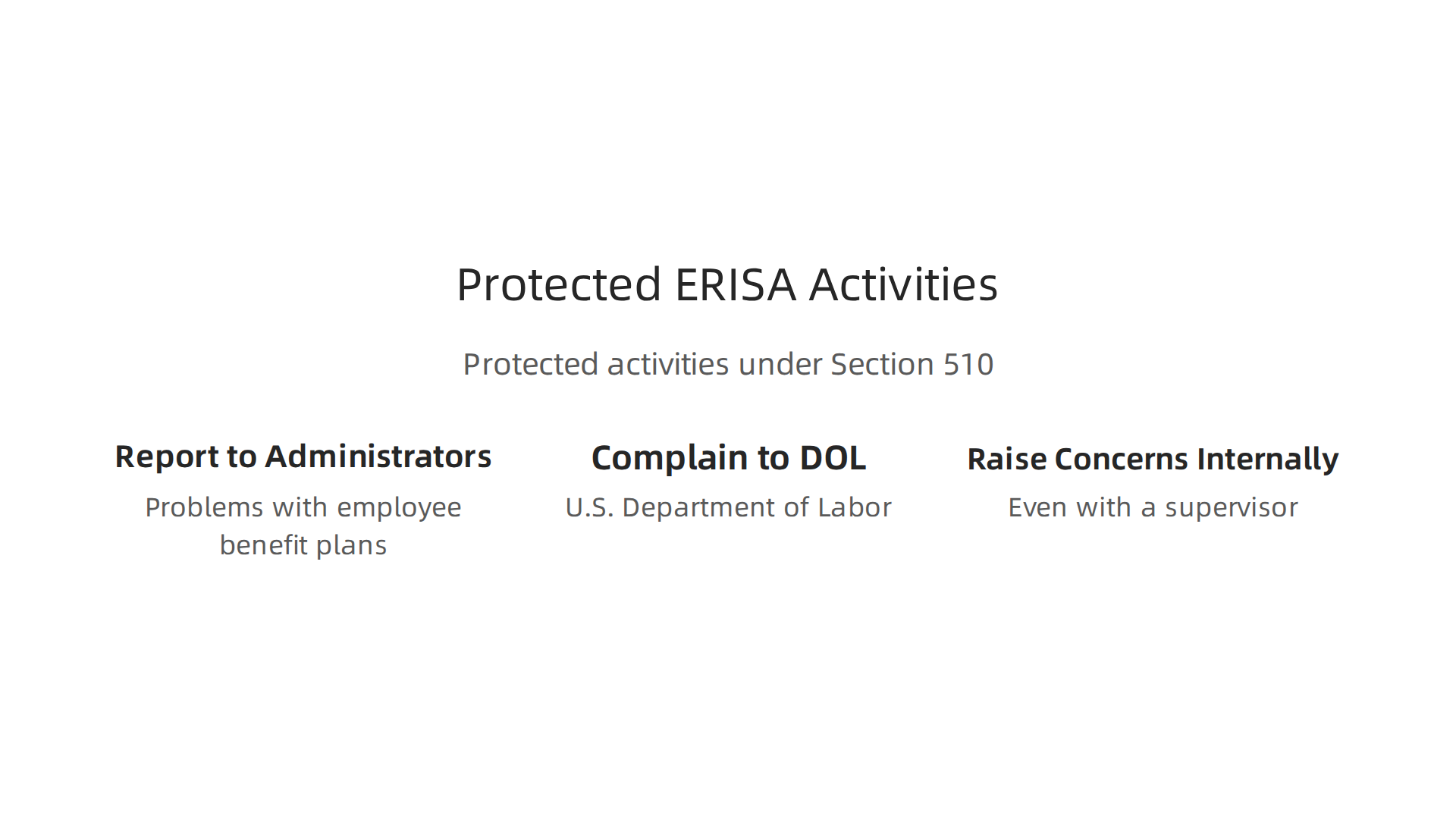
The law protects employees who give information or testify in any inquiry or proceeding related to ERISA. That includes reporting problems to plan administrators, complaining to the U.S. Department of Labor, or even raising concerns internally with a supervisor.
The key is that the employee must be engaged in activity tied to their rights under a benefit plan.
A lesser known part of Section 510’s second clause protects ERISA whistleblowers from retaliation after engaging in specific protected activity. This means an employee does not need to file a formal complaint with a government agency to be covered. An internal report about plan mismanagement can be enough. A careful review of the DOL enforcement manual for participant rights confirms that the complainant must show they are a plan participant or beneficiary and that they engaged in protected activity like reporting a violation.
The Burden Shifting Framework Courts Use
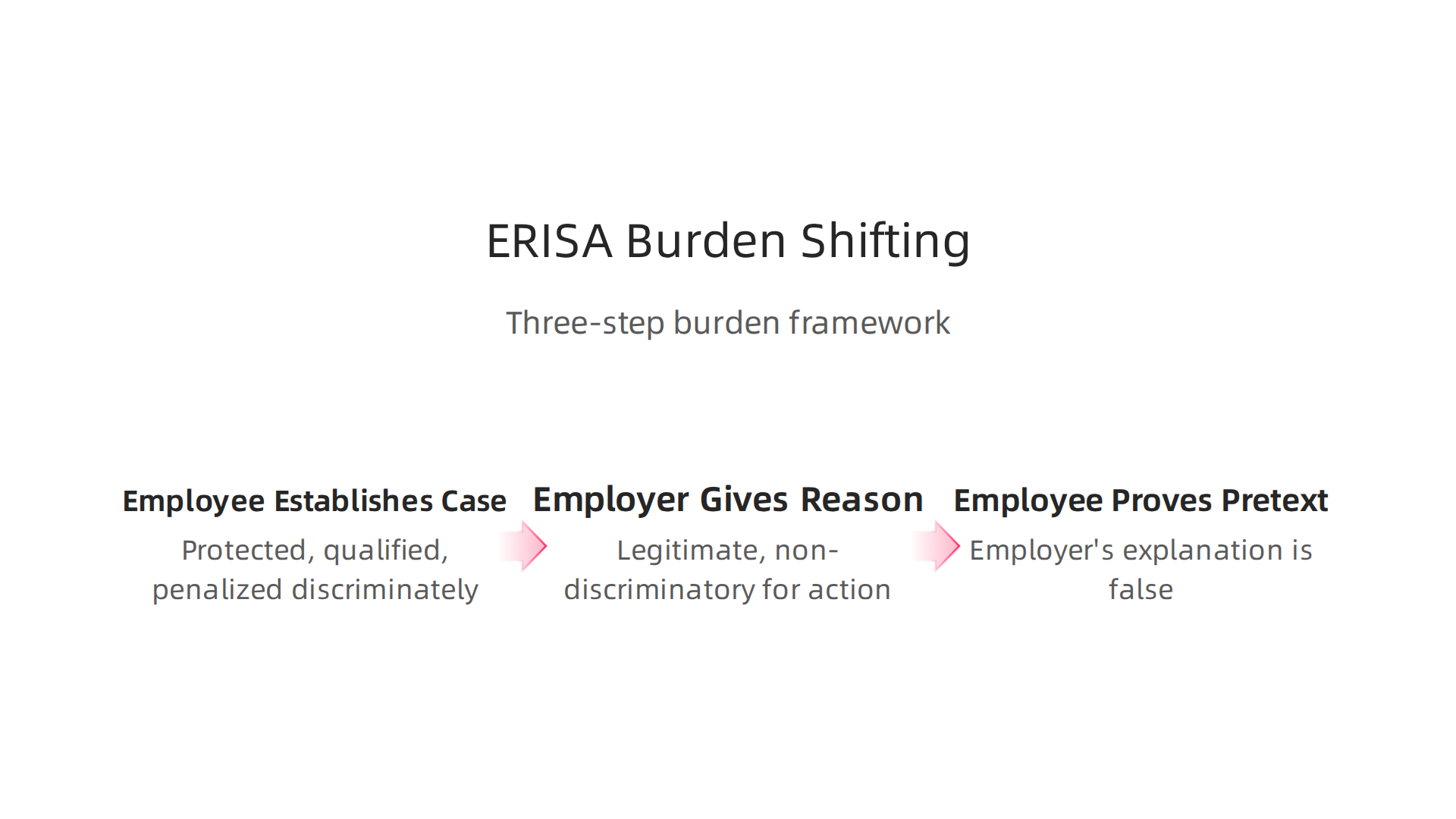
Here is where the law gets practical for a litigation lawyer. Most federal courts apply a burden shifting framework to ERISA Section 510 retaliation claims. It works like this.
First, the employee must establish a basic case. They need to show they were protected under ERISA, they were qualified for their position, and they were fired or penalized under circumstances that suggest discrimination. Once they do that, the burden shifts to the employer. The employer must give a legitimate, non-discriminatory reason for the adverse action.
If the employer provides a reason, the burden shifts back. The employee must show that the employer’s explanation is false or that the real reason was to interfere with their ERISA rights. This is called proving pretext.
The courts do not require direct proof of intent in every case. Circumstantial evidence can be enough if it points toward an improper motive.
Recent Court Decisions on Causation
Different circuits handle causation differently. Some courts require proof that the employer acted with specific intent to interfere with ERISA rights. Others use a "motivating factor" test, meaning the protected activity only needs to be one factor in the decision to fire or penalize the employee. An in depth analysis of internal complaints under Section 510 from Seton Hall Law Review highlights how the circuit split on causation standards is still very much alive in 2026.
For a whistleblower attorney, this means the jurisdiction where the case is filed can decide whether it wins or loses. Knowing the local circuit’s causation standard is not optional. It is essential.
What This Means for Your Practice
If you handle employment law or benefits litigation, understanding these core protections helps you spot viable claims faster. You also need to know how to build the record early. Document every internal complaint. Preserve emails and memos. Get the timeline straight from the start.
For a lawyer looking to strengthen their practice in this area, reading up on modern employment attorney skills and tools can give you practical ideas for managing complex retaliation cases more efficiently.
Staying Current on Legal Developments
The law around ERISA whistleblower protections keeps evolving. Court decisions shift. DOL enforcement priorities change. Sticking with outdated knowledge can cost your client their case.
That is why staying informed matters so much. If you want daily updates on how technology and regulation are reshaping the legal industry, you can subscribe to The AI Newsletter Worth Reading. It delivers clear, practical insights straight to your inbox so you never miss a key development.
Knowing the core protections under Section 510 is the first step. Applying them correctly in your client’s case is what makes the difference between winning and losing.
How a Whistleblower Attorney Builds an ERISA Retaliation Claim
Once you understand those core protections, the next question is how to actually build a claim from scratch. A skilled whistleblower attorney knows that success starts long before filing anything in court. It starts with the very first conversation with the client.
Initial Intake and Evidence Gathering
The first step is a thorough intake. You need to confirm the client is a plan participant or beneficiary. Then you collect everything that shows protected activity and adverse action.

Get the plan documents first. They define who administers the plan and what rights the participant has. Pull every email, memo, and performance review. Build a clear timeline. When did the client report the problem? When did the employer respond with a demotion, termination, or other penalty?
A good erisa attorney also preserves evidence of the employer’s knowledge. Did the client send an email to HR? Did they mention the issue in a meeting? That paper trail is gold. For a deeper look at how to manage the evidence side of these cases, check out this guide on employment lawyer career skills for 2026. It covers practical habits for building strong records in complex retaliation work.
Drafting the Complaint: DOL vs. Federal Court
Here comes a strategic fork in the road. You can file an administrative complaint with the U.S. Department of Labor, or you can go straight to federal court under ERISA Section 502.
The DOL route is often faster and cheaper. The agency investigates and can order reinstatement and back pay. But the remedies are limited. You cannot get compensatory damages for emotional distress or punitive damages. Federal court gives you more flexibility on damages but comes with a heavier burden. The litigation lawyer must prove the case by a preponderance of the evidence, and discovery can get expensive.
Consider the client’s goals. Do they want their job back quickly? Or are they looking for maximum financial recovery? The choice of forum shapes the entire strategy. For a full breakdown of what each forum requires, the ERISA litigation basics from SGR Law explains the discovery limits and standards of review that apply in federal court.
Some cases also touch on state law claims, especially if the employer is based in a state like Texas. A whistleblower attorney familiar with texas law public interest can sometimes find angles that complement the federal case, though ERISA preemption is always a risk.
Proving the Case: Direct and Circumstantial Evidence
The burden of proof under Section 510 follows the framework we covered earlier. But how do you actually prove causation?
Direct evidence is rare. An employer rarely says "we fired you because you reported the 401(k) theft." So you rely on circumstantial evidence. Timing is the most common clue. If the adverse action happens days after the report, that looks suspicious. So do shifts in the employer’s explanations. If they give one reason for the firing in a memo and a different reason in court, that is evidence of pretext.
A strong plaintiff attorney also looks for inconsistent treatment. Did other employees with similar performance issues get warnings instead of termination? Did the employer suddenly start enforcing a rule only against the whistleblower? All of that builds the picture.
The key is to assemble enough dots that a jury can connect them. You do not need a smoking gun. You need a pattern that points toward interference with ERISA rights.
Building an ERISA retaliation claim takes patience, organized evidence, and a clear strategy from day one. Get the intake right, choose your forum wisely, and let the evidence tell the story.
Defending Clients: Common Defenses and Strategic Responses in ERISA Whistleblower Cases
As a whistleblower attorney, you need to know what the other side will throw at you before they do. Employers facing an ERISA retaliation claim usually rely on a few familiar defenses. If you anticipate them, you can build your case around them from the start.
Three Defenses You Will See Over and Over
First comes "lack of protected activity." The employer argues the employee never actually reported an ERISA violation. Maybe the complaint was vague or informal. Courts split on whether unsolicited complaints to management count as protected activity under Section 510. Check the Whistleblower Litigation and Whistleblower Retaliation page for more on what courts recognize as protected conduct.
Second is "no adverse action." The employer insists the demotion or termination was routine. But if the employee lost pay, benefits, or seniority, that is adverse. Even a shift change or reduced hours can qualify. A good erisa attorney documents every change, no matter how small.
Third is "business justification." The employer claims the termination was about performance, not retaliation. Here is where timing and inconsistent treatment matter. If the employer suddenly enforces a rule only after the complaint, that is pretext. If other employees with worse records kept their jobs, that is evidence too.
Fighting ERISA Preemption
Sometimes the whistleblower also has a claim under state law or another federal statute like the False Claims Act. Employers often argue ERISA preempts those other claims. The Emory Law Journal article on reinterpreting ERISA protection explains how courts handle preemption when an employee makes informal complaints about plan violations. The key is to show the state claim is separate from the ERISA claim. A litigation lawyer who knows both frameworks can keep both alive.
Using Expert Witnesses and Forensic Analysis
Numbers do not lie. An expert can review benefit plan data to show the employer’s stated reason makes no financial sense. Maybe the employer claimed the employee was fired for poor performance, but the data shows the real motive was avoiding a costly benefit payout. Forensic analysis of plan records, payroll data, and termination patterns can dismantle a business justification defense.
For more on how to manage the evidence side in modern employment cases, see this guide on employment attorney 2026 skills and tools. It covers practical habits for building strong records in complex retaliation work.
Staying ahead of these defenses takes preparation and the right resources. If you want to keep up with legal tech trends that affect how you build your cases, The AI Newsletter Worth Reading delivers daily updates on AI tools and litigation strategies that matter in 2026.
Leveraging Legal Technology and Data Analytics in ERISA Whistleblower Practice
Defending a whistleblower case means digging through mountains of emails, plan documents, payroll records, and performance reviews. In 2026, doing that by hand is not just slow. It leaves critical evidence on the table. That is why a smart whistleblower attorney now uses legal technology and data analytics to build stronger cases faster.

Case Management Software and E-Discovery Tools
The first step is choosing the right e-discovery tools. ERISA whistleblower cases often involve thousands of electronic files. Emails between managers about the employee’s benefits, internal memos about plan costs, and HR communications about the termination all matter. AI-powered e-discovery tools can process and categorize those documents in hours instead of weeks. They flag keywords, date patterns, and relationships between people that a human reviewer might miss.
For example, the article on AI in eDiscovery and Litigation explains how technology-assisted review (TAR) and generative AI have moved from experimental to mainstream. These tools cut costs and surface key evidence much faster. A litigation lawyer who uses them can respond to discovery requests with greater accuracy and less stress.
Data Analytics for Benefit Plan Trends
Data analytics goes beyond just finding documents. It helps a whistleblower attorney examine benefit plan trends, participant communications, and financial irregularities. Suppose the employer claims the employee was laid off because of a company-wide restructuring. But the data shows that only employees with high-cost medical claims were let go. That pattern, revealed through aggregate plan data, points directly to retaliation.
You can also analyze the timing of plan changes. If the employer modified a benefit plan right after the employee filed a complaint, that is a red flag. Analytics tools make these connections visible. The insights can be presented to a judge or jury as compelling evidence.
AI-Powered Document Review and Pattern Recognition
The hardest part of an ERISA retaliation case is proving intent. Employers rarely admit they fired someone for complaining about a plan violation. But AI can spot patterns in large employment files that suggest the real motive.
For instance, you can use AI to review every performance review, written warning, and email about the employee. If the company suddenly started documenting minor issues only after the complaint, the pattern is clear. AI also helps find inconsistent treatment: other employees with similar or worse performance records who kept their jobs. That inconsistency is strong evidence of pretext.
For more on how to use AI and modern tools in employment litigation, check out this guide on malpractice attorney role in 2026. It covers how legal tech is changing the way attorneys handle complex cases, including whistleblower work.
Putting It All Together
The best litigation lawyer in 2026 does not just know the law. They know how to use data to tell a story. Spreadsheets become witnesses. Email timelines become timelines of retaliation. AI helps you find the needle in the haystack before the other side even knows there is a needle.
Adopting these tools is not optional anymore. Clients expect efficiency. Courts expect thorough discovery. And your case expects the truth. Technology gives you the advantage.
Ethical Considerations and Compliance Trends for ERISA Whistleblower Attorneys
Using data and AI to build a case is powerful, but it also brings new ethical duties. A whistleblower attorney must balance the push for evidence with the rules that protect client rights. In 2026, three areas demand special attention.
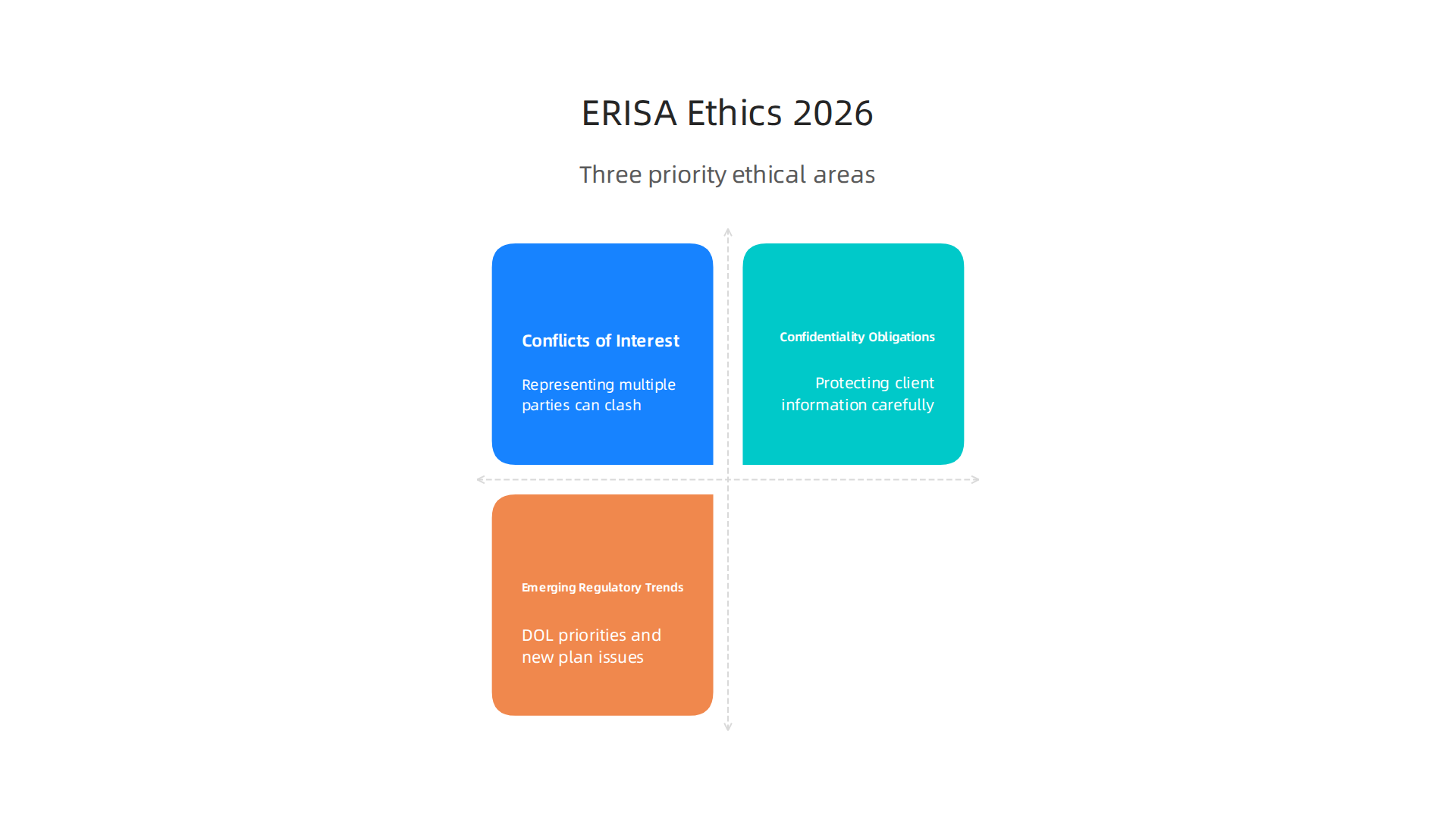
Conflicts of Interest When Representing Multiple Parties
One tricky situation arises when you represent both a whistleblower and an ERISA plan participant. These roles can clash. The whistleblower wants to expose wrongdoing. The plan participant may want to protect their benefits. Their interests do not always line up.
The academic paper on Inherent Attorney Conflicts of Interest Under ERISA explains that representing dual role fiduciaries creates a strong presumption against joint representation. The same logic applies when you try to serve both a whistleblower client and a participant client in the same matter. You owe each client undivided loyalty, and that is hard to give when their goals differ.
A smart whistleblower attorney clarifies the role from day one. You spell out who you represent and who you do not. If a conflict appears later, you withdraw from the part that creates the problem. Getting informed consent in writing is your best protection.
Confidentiality Obligations and Privilege in Internal Investigations
ERISA whistleblower cases often start with internal complaints. The employee reports a violation to the company first. At that point, the company’s lawyer is not your client’s lawyer. That sounds simple, but it gets messy quickly.
If your client shared information with the company’s internal investigator before hiring you, that information may not be protected by attorney-client privilege. You need to figure out what is privileged and what is not. The same goes for documents your client sent to HR or the plan administrator.
Ethical rules require you to protect confidential information. But modern communication tools make that harder. Emails can get forwarded. Slack messages get saved. A good whistleblower attorney in 2026 uses secure platforms for sensitive conversations and carefully reviews all client communications before sharing them in discovery.
For a deeper look at how technology affects the modern attorney’s ethical duties, check out this guide on employment attorney 2026 skills and tools. It covers how digital tools change the way you protect client confidences.
Emerging Regulatory Trends: DOL Priorities and New Plan Issues
The Department of Labor changes its enforcement focus every few years. In 2026, the DOL released Field Assistance Bulletin 2026-01, which shifts attention to the most egregious conduct and significant harm to plan participants. The agency now puts special focus on breaches of the fiduciary duty of loyalty, especially when fiduciaries use plan assets for personal gain or for goals unrelated to participants’ best interests, including ESG objectives.
That matters for whistleblower attorneys. If your client reports that a plan fiduciary is pushing ESG policies that hurt returns, the DOL wants to know. The agency also says it will finish routine investigations within 18 months and complex ones within 30 months. That timeline creates pressure on both sides.
Another big shift is the DOL’s focus on cybersecurity risks for retirement plans. As more plans include digital assets and cryptocurrency options, security becomes a top concern. Whistleblowers who spot weak security around crypto retirement accounts have a strong case under the new priorities.
The official DOL page on ERISA enforcement priorities lists these national projects for fiscal year 2026. You can use that page as a starting point to check whether your client’s complaint matches what the agency is hunting for.
Staying Ahead of the Curve
Ethical practice in 2026 means knowing the rules and knowing how technology changes them. The best whistleblower attorneys invest time in learning about new DOL priorities, new plan types, and new ethical pitfalls.

One easy way to stay current is to follow a daily newsletter that covers AI and legal tech shifts. The AI Newsletter Worth Reading delivers clear updates on how emerging tech affects the legal profession. That kind of knowledge helps you spot compliance trends before they become problems.
Summary
This article explains the growing niche of ERISA whistleblower litigation and gives a practical roadmap for attorneys who want to spot, build, and defend these claims. It reviews Section 510 protections, the circuit split over whether informal internal complaints qualify as protected activity, and how courts apply burden‑shifting and different causation standards. The piece walks through intake and evidence preservation, forum choice (DOL administrative route versus federal court), and the kinds of circumstantial proof that win cases—timing, inconsistent explanations, and disparate treatment. It also covers predictable employer defenses, ERISA preemption issues, and the use of experts and forensics. The article stresses modern practice tools—AI e‑discovery, analytics, and case management—and highlights ethical pitfalls around privilege, confidentiality, and conflicts. After reading, lawyers will know how to triage potential claims, assemble persuasive records, choose strategy, and adopt technology while staying compliant with evolving DOL priorities.