
What Does Attorney at Law Abbreviation Mean and How to Use It Right

Introduction
Have you ever seen the phrase "attorney at law" and wondered what it really means? You are not alone. Many people get confused by legal titles like Esq., J.D., and the attorney at law abbreviation itself. These terms get mixed up all the time, even by professionals who work around the legal world.
Here is the thing. Using the right designation matters more than you might think. Whether you are hiring a corporate business lawyer, working with probate lawyers, or exploring lawyer jobs for yourself, knowing what these titles actually mean builds trust and shows professionalism.

The term "attorney at law" has a long history. It comes from English common law, where lawyers who could practice in the common law courts were officially called attorneys at law.
This article is here to clear things up. We will break down common abbreviations, explain what different types of lawyers do, and share best practices for using legal titles in 2026. By the end, you will know exactly what that attorney at law abbreviation means and when to use it the right way.
Legal professionals today also need to stay sharp on industry changes and new tools that affect their daily work. If you want to keep up with the latest developments in legal technology and AI, a short daily read can make a big difference. That is why we recommend The Deep View Newsletter.

It gives you clear, practical updates so you never miss what matters.
In the next section, we will look at how the role of lawyers has evolved over time and why the attorney at law abbreviation became the standard we use today.
What Does ‘Attorney-at-Law’ Mean? Origin and Usage
So where did the phrase "attorney at law" actually come from? The word "attorney" traces back to Old French and Latin. It means "to act on behalf of another." That is the whole idea. An attorney is someone who steps into your shoes and handles legal matters for you. That core meaning has stayed the same for centuries.
The full title "attorney at law" is a direct hand-me-down from English common law. In England, up until 1873, lawyers who were allowed to practice in the common law courts were officially called attorneys at law, according to LawCrossing.
Other lawyers who worked in the equity courts had different names. So the "at law" part was a way to say which court system a lawyer belonged to. The title stuck even after the systems merged.
Why does this matter today? Because the phrase signals something specific. It means a person is a licensed legal practitioner. Not just someone with a law degree. A licensed professional who can actually represent you in court. Understanding this distinction helps whether you are hiring a corporate business lawyer or looking for probate lawyers to handle an estate.

It tells you the person has passed the bar and earned the right to practice.
The history of the legal profession goes back much further of course. Ancient Greece and Rome had advocates and orators who argued cases. But the formal title "attorney at law" as we know it today comes from that English tradition.
If you are exploring lawyer jobs for yourself, knowing this background helps you use the title with confidence. It also helps you spot when people use it correctly and when they do not. Different types of lawyers all share this same core designation. Whether you end up in corporate law, family law, or criminal defense, "attorney at law" marks you as someone qualified to practice.
Modern legal professionals need to stay up to date on everything that affects their practice. From historical titles to 2026 technology changes, the landscape keeps shifting. That is why we recommend The Deep View Newsletter. It delivers clear daily updates on AI and legal tech so you never fall behind.
Now that you know where the term comes from, let us move to how the role of lawyers has actually evolved over the centuries and why the attorney at law abbreviation became the standard we all recognize today.
Common Attorney-at-Law Abbreviations and Their Meanings
You have probably seen letters like Esq. or J.D. after a lawyer name. But what do they actually mean? And more importantly, when should you use them? Mixing these up can hurt your credibility, especially if you are looking into lawyer jobs or hiring a corporate business lawyer.
Here are the most common attorney at law abbreviations and when to use them.
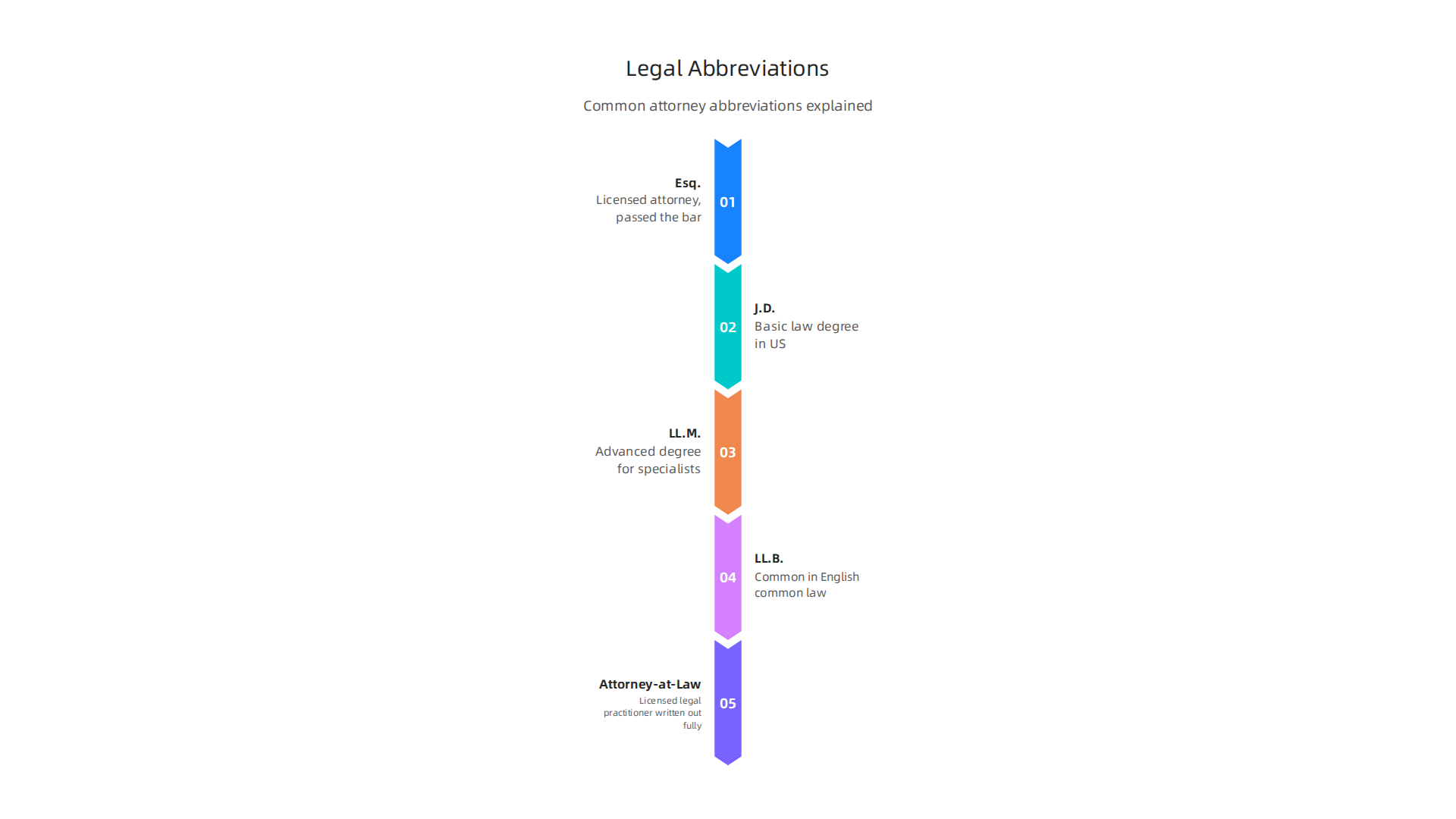
Esq. (Esquire)
This one stands for a licensed attorney. According to Arash Law, Esq. means the person has passed the bar and can legally practice law.
You will often see it after a lawyer name on business cards and letters. It is a professional title, not a degree.
J.D. (Juris Doctor)
This is the basic law degree in the United States. It shows someone graduated from law school. But a J.D. alone does not mean they are licensed to practice. Many people with a J.D. work in business, government, or teaching.
LL.M. (Master of Laws)
An advanced degree for lawyers who want to specialize. The KRASA LAW article explains that an LL.M. comes after a J.D. and focuses on a specific area like tax, intellectual property, or corporate law.
LL.B. (Bachelor of Laws)
Common in countries that follow English common law, like the UK. In the US, the J.D. replaced the LL.B. decades ago.
Attorney-at-Law
When written out fully, this abbreviation simply means a licensed legal practitioner. It is the safest way to describe yourself or someone else in formal documents.
Misusing these abbreviations can cause confusion. The State Bar of Michigan warns that using Esq. incorrectly could even be seen as misleading. So always check before you add letters after a name.
If you are exploring types of lawyers or thinking about probate lawyers, knowing these titles helps you verify credentials and show professionalism.
Want to stay sharp on legal terminology and industry trends? Subscribe to The Deep View Newsletter for clear daily updates on AI and legal tech. And for a deeper look at how the role of lawyers is changing, read our guide on how technology reshapes the attorney role.
Attorney vs. Lawyer: Is There a Difference?
You hear both words all the time. But if you are filling out a legal document or looking for help, which one is right?
In the United States, the answer is clear. A lawyer is anyone who has graduated from law school with a J.D. An attorney is a specific kind of lawyer. According to LawFirm.com, an attorney has passed the bar exam and holds a license to practice law in a specific state. This license lets them represent clients in court. Every attorney is a lawyer, but not every lawyer is an attorney.
That is why the full title "Attorney-at-Law" means so much. This precise attorney-at-law abbreviation signals to clients that you are qualified to handle their case in court. It is the official term for a licensed practitioner.
The rules change when you cross borders. In the UK, for example, the system uses "solicitors" and "barristers." A person with a law degree is usually just called a "lawyer." If you are a corporate business lawyer working on a deal in another country, using the wrong title can hurt your credibility. As The Valley Law Group points out, state laws in places like Arizona strictly define who can call themselves an attorney and give legal advice.
Here is why this difference matters for you:
- For your career: When you apply for
lawyer jobs, use the right title. If you are licensed, use "Attorney-at-Law" or "Esq." If you are not licensed, just use "J.D." - For hiring help: If you need
probate lawyersor acorporate business lawyer, always verify they are a licensed attorney in your state. A law degree alone is not enough.
Understanding this simple rule helps you communicate professionally in a global legal market.
Want to stay informed about how attorneys are using technology in 2026? Read our guide on how technology reshapes the attorney role. And for daily insights on the tools changing the legal industry, subscribe to The Deep View Newsletter.
Professional Roles: Understanding Legal Titles Across Practice Settings
Now that you know the difference between a lawyer and an attorney, let’s look at how the attorney-at-law abbreviation shows up in real jobs. When you search for lawyer jobs, you will see a lot of different titles. These titles matter. They tell you where someone sits in the pecking order and what they actually do each day.
In a law firm, the most common titles are associate and partner.
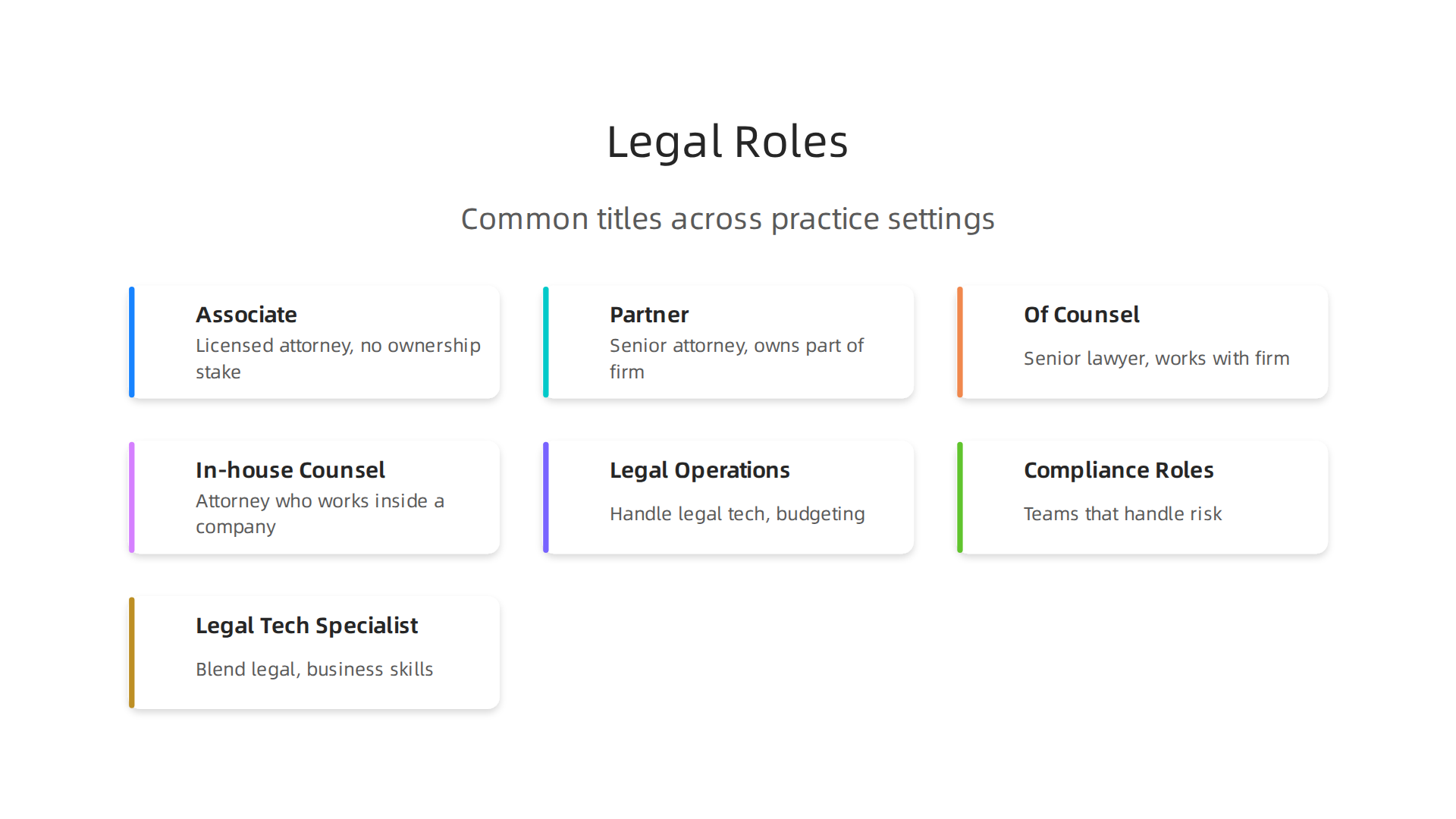
An associate is a licensed attorney who works for the firm but does not have an ownership stake. A partner is a senior attorney who owns part of the firm. Then there is of counsel, which is a weird one. It usually means a senior lawyer who works with the firm but is not a full partner. It is a flexible role. You might also see in-house counsel. That is an attorney who works inside a company, not at a law firm. They handle all the legal needs for that one business.
These are not just fancy labels. They affect your responsibilities, your pay, and your career path. If you ask a corporate business lawyer about their title, you will quickly learn how much weight that word carries. Same goes for probate lawyers or any other types of lawyers. The title tells clients and other lawyers who they are dealing with.
Here is something new in 2026. Legal operations and compliance roles are growing fast. Many law firms and companies now have teams that handle legal tech, budgeting, vendor management, and risk. These people often have hybrid titles like "Director of Legal Operations" or "Compliance Counsel." They might not practice law every day, but they are essential.
Startups are also mixing things up. You will see roles like "Legal Tech Specialist" or "Legal Project Manager." These hybrid titles blend legal knowledge with business skills. They show how the field is changing.
So when you look at lawyer jobs, pay close attention to the title. It is a shortcut to understanding the role. And if you are building your own career, pick a title that fits your license and your goals.
Want to stay ahead of these changes in the legal world? Subscribe to The Deep View Newsletter for daily updates on how technology and new roles are reshaping law. And if you are interested in a specific path, read our guide on how to become a probate lawyer in 2026 to see how titles and responsibilities work in a real practice.
How to Use Attorney Abbreviations Correctly in Professional Communication
Have you ever received an email from a lawyer and seen “Esq.” after their name and wondered what it means? Or maybe you have a law degree but you do not practice law. Can you still put “J.D.” on your business card? Getting these attorney-at-law abbreviation rules right matters more than you think.
First, let us be clear on the two most common abbreviations. Esq. stands for Esquire. Under attorney-at-law abbreviation rules in most states, only a licensed attorney who has passed the bar should use it. As Arash Law explains, "Esq." signals that a person can legally practice law. If you are not admitted to the bar, do not put Esq. after your name. State bar associations discourage non-lawyers from using it, and some may see it as misleading.
J.D. stands for Juris Doctor. That is the law degree itself. Anyone who graduated from law school earned a J.D. It is fine to use J.D. even if you are not licensed. But be careful. Some ethics opinions, like this one from the Texas Center for Legal Ethics, say using "J.D." or "Doctor" could confuse people into thinking you are a practicing attorney. So context matters. In an academic setting, J.D. is safe. In a client-facing role, you might want to avoid it.
Here are a few practical tips for signatures, business cards, and email:
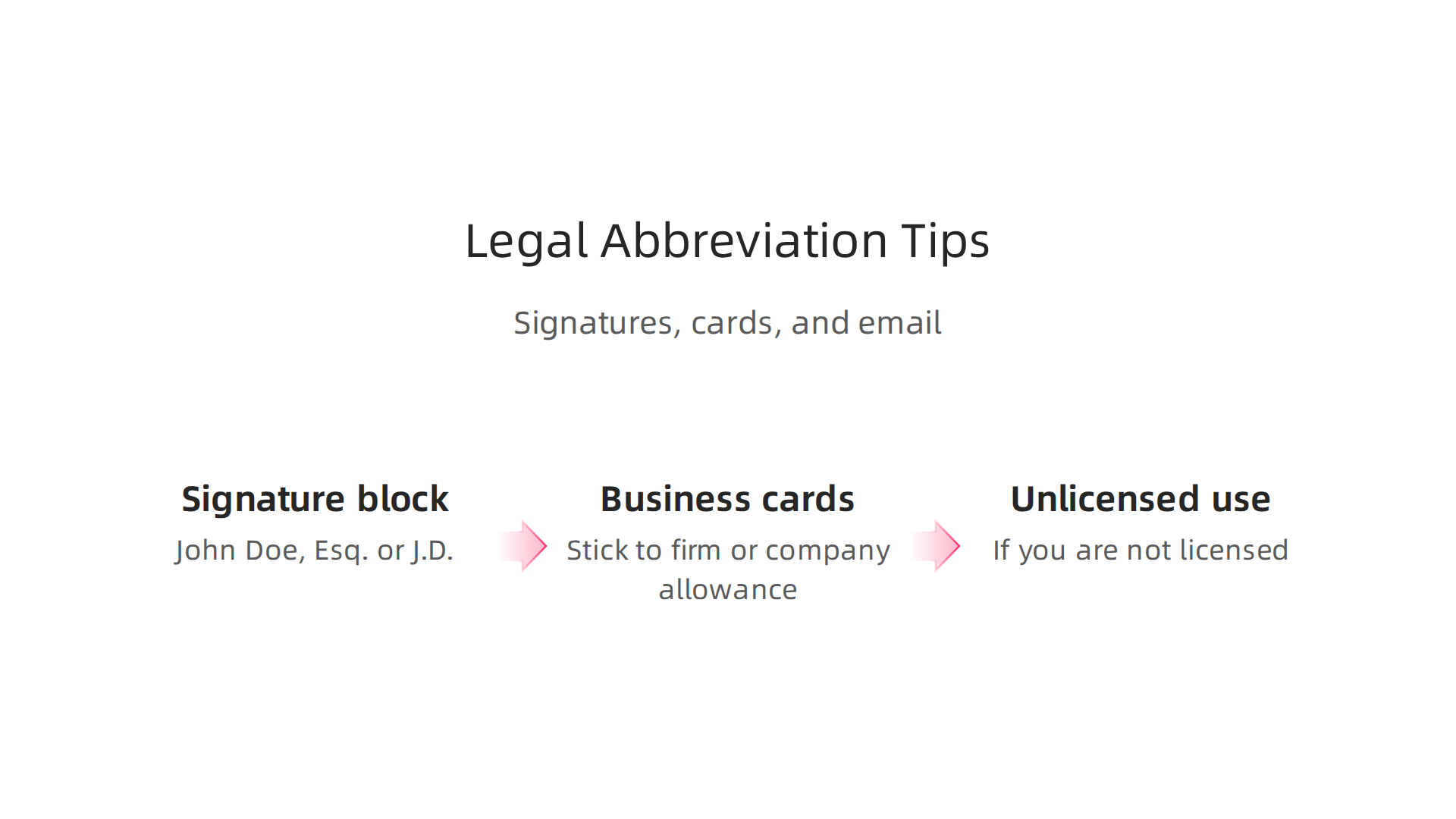
- Signature block: If you are a licensed attorney, write “John Doe, Esq.” or “John Doe, J.D.” – but check your firm’s style guide. Many firms follow NYU Law’s editorial style and drop periods in degree abbreviations.
- Business cards: Stick to what your firm or company allows. Some in-house teams use “J.D.” for non-attorney legal staff, as the Association of Corporate Counsel notes.
- Never use Esq. if you are not licensed. It is not a federal crime, but it is bad practice and could land you in front of a bar ethics committee.
Whether you are a corporate business lawyer, a probate lawyer, or any of the many types of lawyers, using the right abbreviation builds trust. If you are just starting out in one of these lawyer jobs, mastering these details early will keep you professional.
Want to stay sharp on legal tech and career tips in 2026? Subscribe to The Deep View Newsletter for daily insights that help lawyers like you navigate the evolving landscape. And if you are curious about how attorney-at-law abbreviation fits into a specific practice, read our guide on how to become a probate lawyer in 2026 to see real-world examples.
Now that you know the rules for Esq. and J.D., let’s talk about how things are changing. The way lawyers identify themselves is shifting faster in 2026 than you might expect. A few big trends are behind it.
Younger lawyers want simpler titles. Gen Z associates are pushing for less formality in the workplace. According to Clio’s data on Gen Z lawyer expectations in 2026, 89% say a sense of purpose matters more than rigid tradition. That mindset carries over into how they label themselves. Many skip the “Esq.” altogether and use just their name or a simple “Attorney at Law.” It feels more approachable to clients.
Legal tech and global work are driving change too. When you work across borders with remote teams, old-school titles can feel clunky. The Wolters Kluwer Future Ready Lawyer Report highlights how lawyers now operate in a much more connected, tech-driven world. A formal title like “John Smith, Esq.” doesn’t translate well in a global email thread or a virtual collaboration platform. Simpler is better.
Gender-neutral alternatives are becoming more common. Some firms now recommend “Atty.” or just “Attorney at Law” instead of “Esq.”, which has traditional gender associations. This shift is part of a wider move toward inclusivity in the profession. If you work in a progressive firm or a large corporate department, you might see this in style guides already.
These trends don’t mean old rules are dead. But they show that the attorney-at-law abbreviation you choose says something about your personal brand. Whether you are a corporate business lawyer or one of the many types of lawyers exploring new lawyer jobs, your title is part of your story.
Want to keep up with how these changes affect your daily work? Subscribe to The Deep View Newsletter for practical insights delivered straight to your inbox. And if you want to understand how technology is rewriting the playbook, read our piece on how technology reshaping the role of lawyers affects your career path.
The Global Perspective: Legal Title Variations Across Jurisdictions
Even if you choose a simple title in the US, the rules change the moment you work with clients or partners in another country. Legal systems around the world rely on different traditions, and those traditions shape which titles are accepted. Understanding these differences is essential if you are a corporate business lawyer handling international deals or one of the types of lawyers exploring new lawyer jobs abroad.
Most countries follow one of four major legal traditions: common law, civil law, customary law, or religious law. The Wikipedia list of national legal systems provides a helpful overview of which countries fall into each group. This map of legal systems around the world shows how widespread these differences are.
In common law countries like the United States, Canada, and the United Kingdom, you will see titles like attorney, solicitor, and barrister. But even within that group, the meaning shifts. In the UK, a solicitor handles legal paperwork and client advice, while a barrister represents clients in court. In the US, one term covers both roles, which is why attorney at law abbreviation works as a catch-all.
Over in civil law countries like France, Germany, and Japan, the title changes again. You will hear avocat, Rechtsanwalt, or bengoshi. These professionals perform similar work but carry titles from their own legal heritage. For a probate lawyers working with international clients, these differences matter a lot. Knowing the right title helps build trust and avoid confusion.
Treaties and trade agreements sometimes harmonize designations, but most of the time you adapt to local rules. When you list your credentials on a global legal platform, using the correct local term shows respect. It also keeps you compliant with foreign bar regulations.
Staying on top of these changes is easier with a daily update. That is why many lawyers recommend The Deep View Newsletter for practical insights on international legal trends. And if you are considering a global career path, read our guide on how to become a probate lawyer in 2026 to understand how licensing works across borders.
Why Correct Legal Title Usage Matters in Client Relations and Marketing
Here is a quick test. You visit a law firm website and see someone listed as "Dr." without any mention of being a lawyer. Do you trust them with your legal case? Probably not. Small title mistakes create big trust issues.
Clients notice how you present yourself. When you use the correct attorney at law abbreviation consistently, you send a clear signal that you know your craft and take your profession seriously. But when titles are sloppy or misleading, clients wonder if your legal work will be just as careless.
The ethical stakes are even higher. State bar associations watch how lawyers use titles. The Texas Center for Legal Ethics confirmed that using "Dr." or "J.D." is not automatically banned, but context matters a lot. If you use a title in a way that confuses the public about your role, you could face disciplinary action. The Texas Disciplinary Rules of Professional Conduct make it clear that lawyers cannot mislead in their marketing.
This gets tricky when firms use "Esq." for non-lawyer staff. According to the ACC resource on denoting law degrees, some companies use "Esq." to designate both attorney and non-attorney staff. That is a dangerous practice. State bars generally discourage non-lawyers from using "Esq." because it misleads clients.
Your marketing materials need to pass the sniff test. Your website bio, LinkedIn profile, and business cards all need accurate titles. If you list yourself with a title you do not hold, you violate the spirit of the Model Rules of Professional Conduct. Even if you do not get a formal complaint, you lose credibility with the people who matter most, your clients.
For corporate business lawyer professionals working on international deals, title accuracy builds cross-border trust. When you work with clients or probate lawyers in other countries, they check your credentials first. A small error in your attorney at law abbreviation can make them question your entire background.
Want to keep your marketing clean and your title usage correct every time? Check out our guide on how to use the PA attorney lookup to check a lawyer’s license and disciplinary history to see how easy it is to verify your own credentials. And if you are exploring lawyer jobs or updating your professional profile, a daily dose of practical legal insights can help. The Deep View Newsletter delivers clear updates on ethical standards and title best practices straight to your inbox.
Ethical Considerations in Using Legal Titles and Abbreviations
We have covered why title accuracy builds trust with clients. Now let us look at the strict ethical rules every lawyer must follow when using an attorney-at-law abbreviation.

State bar rules are clear. You cannot use a title that misleads the public. The Model Rules of Professional Conduct ban false or misleading communications. The Texas Disciplinary Rules of Professional Conduct enforce this strictly. If your attorney-at-law abbreviation implies a license you no longer hold, you could face disciplinary action. This applies to all types of lawyers, whether you are a corporate business lawyer or run a solo practice.
Using "J.D." or "Doctor" requires careful context. According to the Texas Center for Legal Ethics Opinion 550, using these titles is not automatically prohibited. But if a non-lawyer uses "Esq." in their email signature, it signals they are an attorney when they are not. The ACC resource on denoting law degrees highlights how some companies let non-lawyers use "Esq." This is a dangerous practice. It can easily violate unauthorized practice of law rules.
Retired or inactive lawyers must also adjust their titles. You cannot hold yourself out as an active practitioner if you are not eligible to practice. If you were a probate lawyer and are now retired, your bio must say so. A simple way to check current credentials is to use the PA attorney lookup tool.
These ethics rules are not static. They evolve. Stay current with daily updates from the Deep View Newsletter. It delivers clear, practical guidance on title ethics and professional responsibility straight to your inbox.
Legal Titles in the Digital Age: Email Signatures, Social Media, and Legal Tech Platforms
You’ve probably seen an email signature like "Jane Doe, Esq." or a LinkedIn profile showing "Jane Doe, J.D., Corporate Business Lawyer." In 2026, your digital presence is often the first impression you make. And that impression needs to follow the same ethical rules as a printed business card.
Let’s start with email signatures. Every state bar has rules about how you can list your attorney-at-law abbreviation. You can’t just add "Esq." to look official if you’re not actively licensed. Some jurisdictions even require you to include your state bar number or a note like "Licensed in Texas only." Because laws vary by location, you should always check the local rules. The Oxford LibGuides to legislation of other countries can help you find the specific laws that apply in your jurisdiction.
Now think about social media, especially LinkedIn. Many lawyers combine "J.D." with their current role. That’s fine as long as it’s clear you’re not holding yourself out as something you’re not. For example, if you’re a corporate business lawyer, write "Corporate Counsel, ABC Corp. | J.D." not just "Attorney at Law." The key is honesty. Different types of lawyers handle this differently, but the principle stays the same: your profile should never mislead someone into thinking you practice in an area you don’t.
Legal tech platforms like Clio and PracticePanther give you custom title fields. You can set your display name, firm name, and credentials. This is a handy feature, but it’s also a trap if you use it wrong. If you retired from being a probate lawyer, don’t put "Probate Attorney, Esq." on your platform profile. Update it to "Retired Probate Attorney" or remove the credential entirely. The PA attorney lookup tool can help you verify your current status before you update anything.
The digital world moves fast, but ethics still apply. To get clear, daily guidance on title rules and professional responsibility across email, social media, and legal tech, subscribe to The Deep View Newsletter. It delivers practical insights straight to your inbox so you never miss a rule change.
Summary
This article explains what the phrase "attorney at law" actually means, where it comes from, and why the distinction matters today. It breaks down common abbreviations (Esq., J.D., LL.M., LL.B.), clarifies the practical difference between a lawyer and an attorney, and shows when and how to use each title in signatures, business cards, and online profiles. The guide covers ethical rules, state bar concerns, and the potential disciplinary consequences of misleading title use, plus how titles vary across jurisdictions. It also outlines how career titles signal responsibility within firms and how technology and changing workplace norms in 2026 are reshaping how lawyers present credentials. After reading, you will know which abbreviations you can legally use, how to verify credentials, and best practices for professional and digital communication.