
The Justinian Code Is the Hidden Foundation of Modern Legal Tech

Why the Justinian Code Still Matters for Modern Legal Tech
You might wonder why a set of laws written 1,500 years ago has anything to do with the cutting-edge legal tech tools you use today. But here is the thing. The justinian law codes, officially called the Corpus Juris Civilis, are the hidden foundation beneath much of the legal software and digital platforms that lawyers rely on in 2026.
Emperor Justinian I ordered this massive legal project back in the 6th century. His goal was simple. He wanted to take centuries of Roman laws, rulings, and opinions and pack them into one clear, organized system. Before his code, judges had to dig through thousands of scrolls just to find the right rule. Sound familiar? Legal professionals today face the same kind of information overload, just in digital form.

The Code of Justinian became the backbone of civil law systems across Europe and beyond. Countries like France, Germany, Spain, and most of Latin America built their legal frameworks on its logic. And when legal tech companies build tools for these markets, they are working within a system that traces straight back to Justinian’s original design.
So what does this mean for you as a legal tech professional? Understanding the sources of law that shape modern regulations helps you predict how new technologies will interact with existing rules. The alloy of law that Justinian created blended imperial decrees, jurist opinions, and legal textbooks into a single system. Today’s regulatory environment is no different. It is a mix of statutes, case law, administrative rules, and international treaties. Knowing how these pieces fit together makes you better at designing or choosing software that handles compliance, contract analysis, or e-discovery.
Some experts also point to the justinian law codes as an early source of international law. The idea that law can be written down, organized, and applied across different regions laid the groundwork for modern treaties and trade agreements. Legal tech tools that manage cross-border transactions or multi-jurisdictional compliance owe a quiet debt to this ancient system.
The core ideas from Justinian’s work, legal order, systematization, and clear source hierarchy, are just as relevant today as they were in the 6th century. They help you understand how legal principles get codified, interpreted, and eventually digitized. In a world where AI tools and automated contracts are changing the game, knowing where the rules came from gives you a real edge.
If you want to stay ahead of the curve, you need resources that connect these historical foundations with today’s fast-moving tech. The AI Newsletter Worth Reading delivers clear daily updates on AI and technology that matter for the legal sector. And if you are looking to sharpen your research skills, check out this guide on master legal research databases to see how modern tools build on these age-old principles.
The Birth of the Justinian Code: A 6th-Century Legal Revolution
Before Emperor Justinian stepped in, Roman law was a complete mess. For nearly a thousand years, the Romans had piled up laws, decrees, and legal opinions. Some contradicted each other. Many were lost or forgotten. Judges wasted hours digging through dusty scrolls just to find the right rule. Sound frustrating? It was exactly the kind of chaos that called for a fix.
In 528 AD, Justinian I created a commission of top legal experts. Their job was huge. They had to gather every important Roman law, sort through it, and organize it into one clear system. The result was the Corpus Juris Civilis, or Body of Civil Law. This is what we now call the justinian law codes. It was a true legal revolution.
The Corpus Juris Civilis had four main parts. Each one served a different purpose.
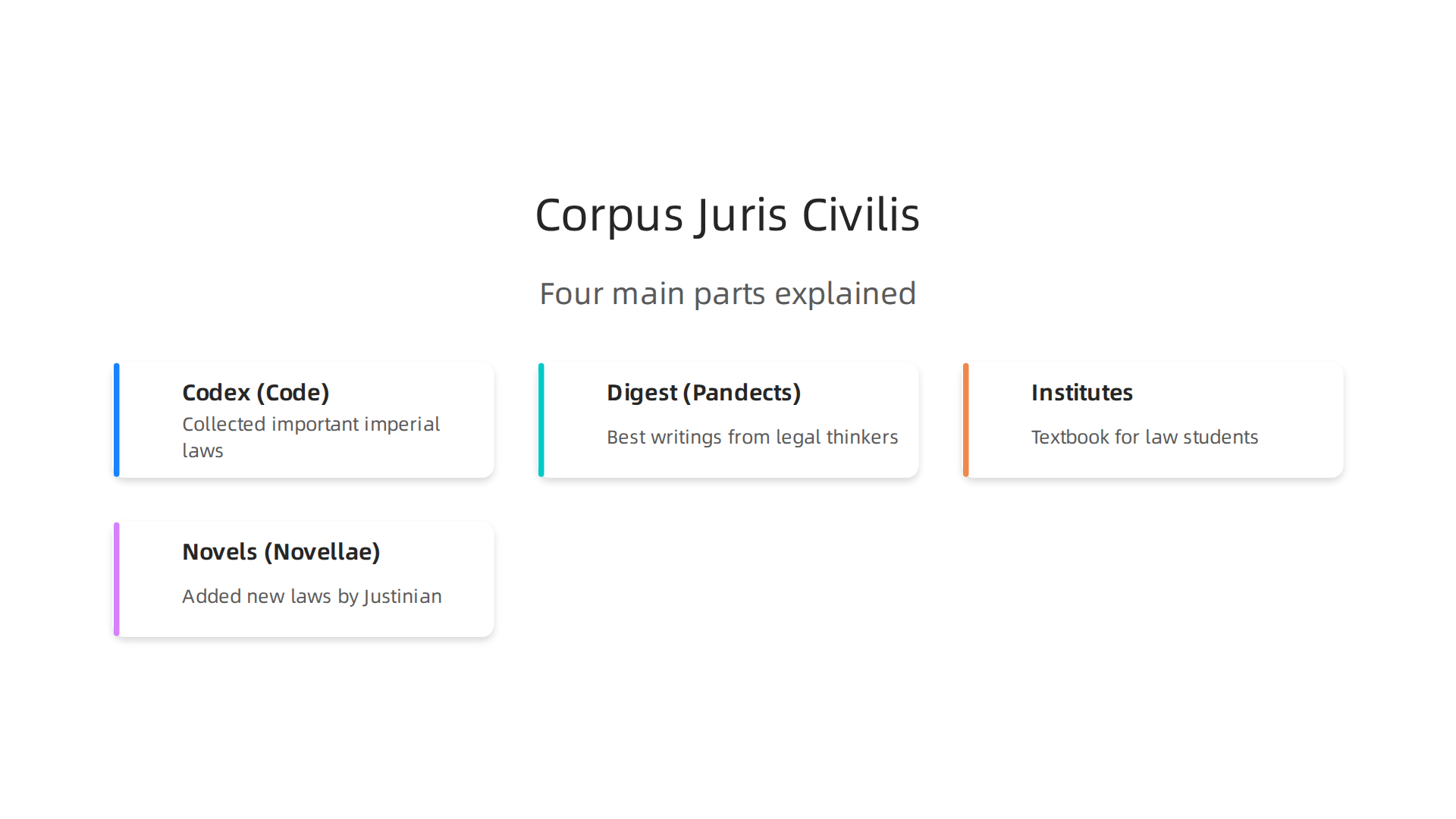
- The Codex (Code) collected all the important imperial laws still in use. It got rid of outdated or repeated rules.
- The Digest (Pandects) pulled together the best writings from Rome’s greatest legal thinkers. It was like a super library of expert opinions.
- The Institutes served as a textbook for law students. It explained the basic principles in simple language.
- The Novels (Novellae) added new laws that Justinian passed after the Code was finished.
This four-part structure became the model for later legal systems. It showed how you could turn centuries of scattered rules into a logical, usable system. That idea is still the core of modern legal codification.
Why did Justinian do all this? He wanted to unify his empire. A single clear set of laws made it easier to govern from Constantinople to the distant provinces. He also wanted to show that his rule was strong and orderly. By creating a master source of law, he gave judges, citizens, and officials one place to look for answers. No more guessing. No more conflicting rulings.
For anyone working in legal tech today, this story is more than just history. It is a reminder that organizing legal information is a timeless challenge.

The tools change from scrolls to databases to AI, but the goal stays the same: make law clear, consistent, and accessible. The alloy of law that Justinian forged blended imperial power with jurist wisdom and educational clarity. Modern legal tech does something similar when it merges statutes, case law, and commentary into a single digital platform.
If you want to see how this ancient system connects to modern legal research, check out this guide on the Yale Law Journal shapes legal tech innovation. It shows how major legal publications continue to organize and influence law today.
For a deeper look at the Corpus Juris Civilis itself, the Corpus Juris Civilis Wikipedia entry breaks down all four parts in detail.
The justinian law codes did not just fix Rome’s legal mess. They created a blueprint that would shape law for centuries to come. And that legacy lives on in every legal database, contract analysis tool, and AI research platform you use today.
Anatomy of the Code: Structure, Content, and Compilation Process
So what did this massive legal collection actually look like up close? The justinian law codes were not just thrown together. They followed a careful design that made Roman law usable for the first time in centuries.
The whole project was built around four main parts, each with its own job. Let us walk through them so you can see how the pieces fit together.
The Codex came first. Published in 529 AD, it collected imperial laws issued by Roman emperors from the time of Hadrian all the way up to Justinian himself. The Codex had 12 books and contained about 4,562 laws. Every outdated or conflicting rule was cut. What remained was a clean, enforceable set of imperial commands.
Next came the Digest, also called the Pandects. This was the hardest part. The commission read through thousands of legal writings from Rome’s greatest jurists. They pulled out the most important excerpts and organized them into 50 books. In all, the Digest contained over 9,000 excerpts. Imagine sorting through a library of scrolls and picking only the best pieces of legal wisdom. That is exactly what Tribonian and his team did.
The Institutes served a completely different purpose. It was a textbook for first-year law students. Written in simple language, it explained the basic ideas of Roman law like justice, rights, property, and contracts. If you wanted to learn the sources of law from the ground up, this was your starting point.
Finally, the Novels or Novellae added new laws that Justinian passed after the Codex was finished. They covered everything from marriage rules to church property to criminal penalties. These updates kept the code fresh and responsive to real life.
The compilation process itself was a massive feat of knowledge management. The commission did not just copy laws. They edited, removed contradictions, and added clarifying notes. Every excerpt in the Digest had to be checked for accuracy. Every imperial law in the Codex had to be verified as still in force. This kind of structured legal editing is exactly what modern source of international law projects still do today.
If you want to see how today’s legal researchers handle the same challenge of organizing vast amounts of legal information, check out this guide on master legal research databases. It shows how modern tools do what the Digest did for Rome, just much faster.
For a deeper look at the three original parts of the Corpus Juris, the Corpus Juris Civilis Max-EuP 2012 entry breaks down how the Institutes, Digest, and Codex were all given the force of law.
And if you want to stay current on how modern legal tech solves similar knowledge organization problems, The AI Newsletter Worth Reading delivers clear daily updates on AI and legal innovation.
The justinian law codes were not just a collection of rules. They were a carefully engineered system for managing legal knowledge. That is an alloy of law that still impresses legal scholars and technologists alike.
From Constantinople to the World: The Code’s Influence on European Legal Systems
The justinian law codes did not have an easy road at first. After Justinian died in 565 AD, his great legal work mostly disappeared from the West. For almost 500 years, the carefully organized laws sat in libraries collecting dust.
Then something remarkable happened. In the late 11th century, a complete copy of the Digest was rediscovered in Italy. This discovery changed everything. Scholars flocked to study it. In 1088, the University of Bologna was founded partly because of this revival of Roman law. Legal historians point to this rediscovery as the spark that lit the fire of modern European law, as described in this Justinian’s Code research starter from EBSCO.
From Bologna, the influence spread outward. Trained judges and administrators carried Roman legal ideas across Europe.
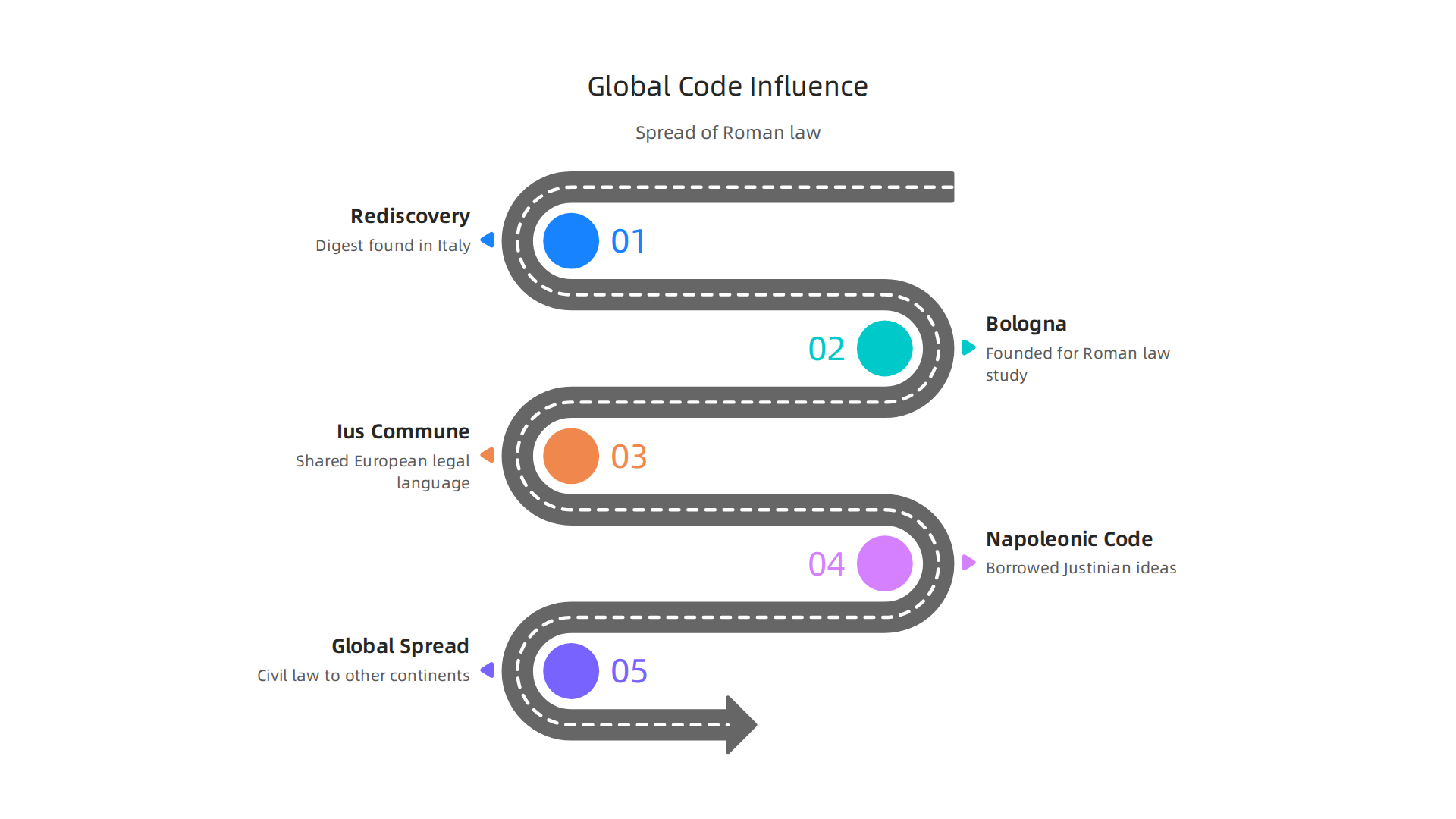
They created what scholars call the ius commune, or common law of continental Europe. This was not one single code. It was more like a shared legal language that different regions could adapt to their own needs.
The biggest impact came much later. In 1804, Napoleon Bonaparte created the Napoleonic Code. It borrowed heavily from the structure and ideas of Justinian’s work. The same is true for the German Civil Code, known as the BGB, which took effect in 1900. Both of these modern codes are direct descendants of the justinian law codes. As the Britannica entry on the Code of Justinian explains, the code was not a new set of laws itself, but it organized and preserved centuries of Roman legal wisdom in a way that future generations could use.
The reach did not stop in Europe. When European powers colonized other parts of the world, they brought their legal systems with them. That is why countries in Latin America, Africa, and Asia have civil law traditions rooted in the same Roman foundations. From Brazil to Japan to South Africa, the influence of Justinian’s work lives on.
For a deeper look at the rediscovery itself, you can read this History of Information entry on the Code of Justinian, which traces how the code became the basis for civil law in Western Europe.
And if you are curious about how modern legal systems handle the same challenge of reviewing and interpreting laws passed down through history, check out this guide on de novo review approaches in today’s courts. The link between Rome’s legacy and today’s legal tools is stronger than you might think.
Sources of Law Reimagined: How Justinian’s Framework Shaped Civil Law Traditions
When Justinian’s team set out to organize centuries of Roman legal materials, they had a big problem. How do you decide which laws matter most? The empire had statutes from emperors, opinions from respected jurists, decrees from the Senate, and centuries of conflicting rulings. Something had to give.
The solution they landed on changed legal thinking forever. Justinian created a clear hierarchy of legal sources. At the top sat imperial statutes, the laws directly issued by the emperor.
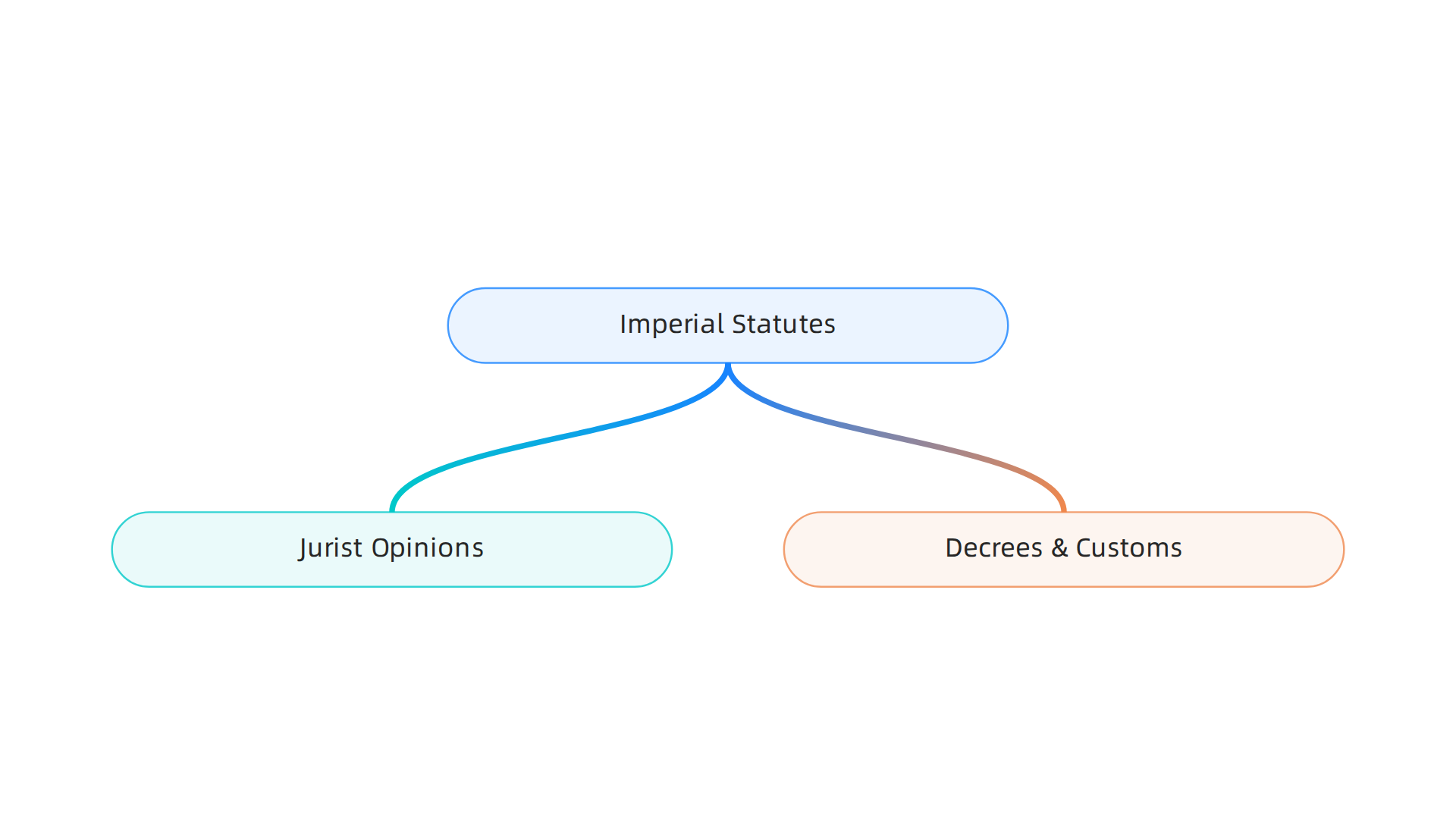
Below them came the writings of approved jurists, the legal scholars whose opinions carried official weight. And at the bottom sat earlier decrees and customs, which only applied if they did not conflict with higher sources.
This structure was a radical idea for its time. Before Justinian, there was no agreed upon way to rank legal authority. Different courts might follow different sources. A judge in Constantinople could apply a different rule than a judge in Antioch, even for the same kind of case. The justinian law codes changed that by creating one clear system. As the Wikipedia entry on the Code of Justinian explains, the Codex Justinianus sought to eliminate obsolete laws and provide a cohesive legal code that would be applicable across the entire Byzantine Empire.
Now here is where it gets interesting for us today. That same hierarchy of sources became the foundation of modern civil law systems. In countries like France, Germany, Japan, and Brazil, codified statutes still sit at the top. Judges in these systems do not make law through their decisions the way common law judges do. They apply the written code.
This is a direct line from Justinian. The idea that a statute written down in a code should always beat a judge’s opinion from a past case. It is the opposite of how the U.S. and U.K. work, where past court decisions carry huge weight.
Why does this matter for legal tech in 2026? Because understanding the source hierarchy is critical when you build or use compliance tools that operate across multiple jurisdictions.

A tool that works perfectly in a common law jurisdiction might fail in a civil law jurisdiction because it is looking for the wrong kind of authority. If you are managing compliance for a business that operates in both the United States and Germany, you need to know that a German court will prioritize the written code over any past ruling. That changes how you search, how you analyze risk, and how you build your compliance strategy.
For a practical example of how different jurisdictions handle legal requirements, check out this guide on New York LLC formation and compliance requirements. It shows how even within a common law system, the written code still plays a huge role.
And if you want to stay ahead of how technology keeps reshaping legal research and compliance across all these different systems, you might find value in The AI Newsletter Worth Reading. It delivers clear daily updates on the AI developments that are changing how legal professionals work.
The Justinian Code in the Digital Age: Relevance for Legal Tech Today
The influence of Justinian’s system did not stop with civil law traditions. It directly shaped the way modern legal tech tools are built and used today. When you open a platform like Westlaw or LexisNexis, you are interacting with a digital version of the same organizational thinking that Tribonian’s team used back in the sixth century.
Think about what those databases do. They sort legal materials into clear categories. They assign weight and authority to different sources. They let you cross-reference a statute with a judicial opinion or a commentary. That is exactly what the Digest did, just with parchment instead of pixels. The principles of legal taxonomy, hierarchy, and cross‑referencing that Justinian’s team perfected are now embedded in the knowledge graphs that power modern legal research.
As the Wikipedia entry on civil law legal systems explains, civil law is rooted in the Roman Empire and was comprehensively codified starting in the 19th century. That codification mindset is what makes modern legal databases work so well. When you search for a regulation, the tool knows to show you the statute first, then relevant commentary, then supporting cases. That ranking is pure Justinian.
Here is where this gets practical for legal operations professionals in 2026. AI‑powered research tools are becoming standard in law firms and corporate legal departments. These tools scan thousands of documents, summarize case law, and flag relevant clauses. But their accuracy depends entirely on how well they understand the legal hierarchy in each jurisdiction. A tool trained on common law precedent might struggle in a civil law country where the code is king.
The same logic applies to document automation and contract analysis platforms. When you build a workflow that pulls clauses from a contract library, you need the system to know which sources carry binding authority and which do not. That is the Justinian code in action, just running on servers instead of papyrus.
For a deeper look at how modern legal research databases incorporate these principles, check out this guide on mastering legal research databases with AI and smart search techniques. It walks through the practical side of using taxonomies and hierarchies in your day‑to‑day work.
Understanding this historical foundation does not make you a historian. It makes you a better decision‑maker. When you evaluate a new legal tech tool, ask yourself: Does this system understand the hierarchy of legal sources in the jurisdictions I work with? If the answer is no, you are going to get bad results. That insight, born from a code written nearly 1,500 years ago, is still one of the most important questions you can ask in 2026.
Lessons for Legal Innovators: What the Past Teaches About Systematic Law
Here is the thing. If the Justinian law codes teach us one concrete lesson for 2026, it is this: how you organize legal information determines how useful it becomes.
Tribonian’s team did not just collect laws. They built a system. They created categories, ranked sources of authority, and designed a hierarchy that would survive for centuries. Every legal tech company building a knowledge graph or a contract database today is doing the exact same work. The only difference is speed.
As the AI Transformations in Legal Tech 2026 report points out, converting unstructured legal data into structured, AI-driven intelligence is the central focus of modern legal innovation. That is a direct echo of the codification work of the 6th century.
The old challenges never go away. They just change form.
Think about the problems the Byzantine jurists faced. Laws existed in different languages. Regional courts interpreted the same rule in opposite ways. Old imperial decrees contradicted new ones. Every single one of these problems has a modern twin in legal AI.
Today, a tool trained on English common law will struggle with a civil code written in French. An AI model that does not know the difference between a statute and a regulation will give you a wrong answer. An automated compliance system that cannot read a 1990s amendment to a 1950s law will miss critical risks. The "justinian law codes" were the first attempt to solve this mess. Modern legal tech is still trying to finish the job.
So what does this mean for you as a legal innovator?
First, do not trust a tool that cannot explain its legal hierarchy. If it confuses primary and secondary sources, it will fail you.
Second, understand the history of the legal systems you are automating. Legal professionals who study how "sources of law" evolved over time are better at building taxonomies, training AI models, and designing workflows than those who just click buttons. This is a real, measurable advantage. The changing role of a modern attorney reflects this blending of historical skill with new technology. You can read more about how technology is reshaping the profession in this guide on the lawyer defined 2026.
The lawyers and legal ops pros who understand the foundations will be the ones who get AI right. They will know when to trust the output and when to dig deeper.
Staying on top of these changes requires constant learning. To keep up with the latest AI developments affecting the legal world, consider subscribing to The AI Newsletter Worth Reading. It delivers clear daily updates straight to your inbox.
History is not just a subject for law school exams. In 2026, it is a blueprint for building better legal technology. Use it.
Summary
This article explains why the 6th‑century Justinian Code still matters for legal technology today, arguing that its methods of organizing, ranking, and cross‑referencing law are the blueprint behind modern research platforms, knowledge graphs, and contract automation tools. It walks through the Code’s four parts—Codex, Digest, Institutes, and Novels—shows how those parts created a durable hierarchy of legal sources, and traces the Code’s influence from medieval Europe to contemporary civil law systems. The piece connects those historical lessons to practical issues in 2026: how AI tools must respect jurisdictional source hierarchies, why civil‑law markets require different models than common law, and what legal innovators should prioritize when designing taxonomies. Readers will learn concrete evaluation questions for vendors, common pitfalls to avoid when building multi‑jurisdictional systems, and where to look for tools and techniques that mirror Justinian’s systematization. Ultimately, the article argues that knowing legal history is a practical advantage for anyone building or buying legal tech.