
Attorneys Abbreviation Rules That Save Time and Prevent Mistakes

Have you ever stared at a court document and felt lost in a sea of letters?

Terms like "Esq.," "J.D.," and "LL.M." fly around legal papers all the time. But here is the thing: getting these attorneys abbreviation wrong can lead to real trouble. A misplaced abbreviation might confuse a judge, delay a filing, or even cost your firm money.
Mistakes with legal shorthand happen more often than you think. Many lawyers and paralegals guess at the right format or use outdated styles. That small error can hurt your credibility and slow down your work. The good news? You do not have to guess anymore.
This guide gives you a complete reference for the most common legal abbreviations. You will learn the correct way to use them, what each one means, and how to avoid the traps that trip up even experienced professionals. Mastering these shortcuts will save you time, make your writing look sharp, and lower the risk of costly errors. For a deeper look at one specific abbreviation that causes confusion, check out our article on what the attorney at law abbreviation means and how to use it right.
When you use abbreviations correctly, you show that you know the rules. You also help your readers follow your argument without stopping to decode your shorthand. The American Bar Association and other groups have clear standards, but not everyone follows them. For example, the North Carolina Bar Association explains that defining terms properly helps readers avoid confusion. By sticking to the best practices, you set yourself apart.
Want to stay ahead of changes in legal writing and technology? Sign up for The AI Newsletter Worth Reading to get clear daily AI updates that help you work smarter and stay current in 2026.

The Most Common Attorney Abbreviations: A Reference Guide
Legal writing is full of shorthand. You see abbreviations like "Esq.," "J.D.," and "e.g.," every day. But using them incorrectly can confuse readers and hurt your credibility. Let us break down the most common attorneys abbreviation groups so you have a clear reference to use right now.
We will cover three main areas: court and jurisdiction abbreviations, degree designations, and those tricky Latin terms. For a deeper look at one specific abbreviation that causes confusion, check out this attorney at law abbreviation guide.
Court and Jurisdiction Abbreviations
Courts and jurisdictions have their own shorthand. You see these in case citations all the time. Getting them right matters because a wrong abbreviation can send a reader to the wrong court.
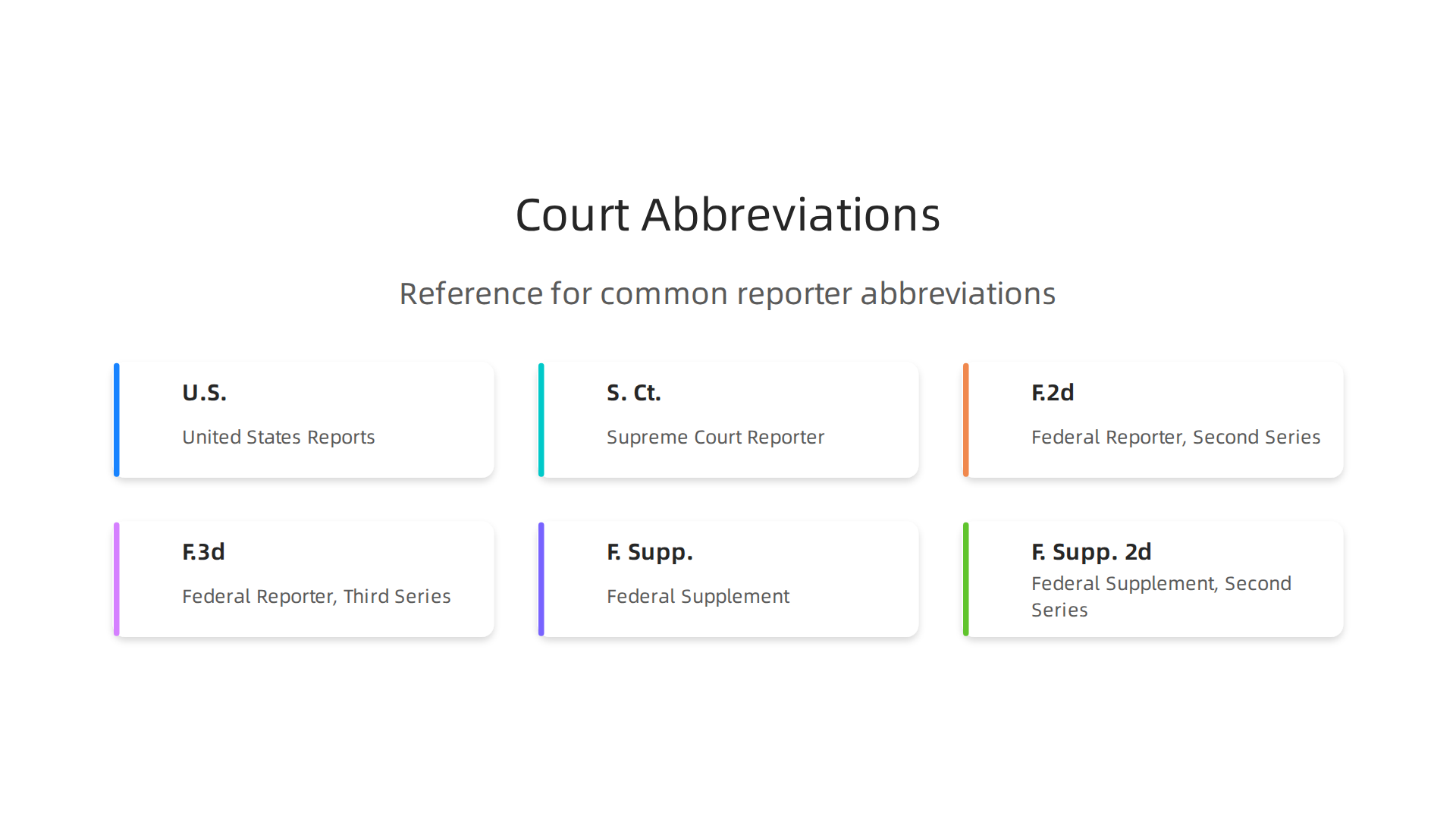
Here are some of the most common ones:
| Abbreviation | Full Name |
|---|---|
| U.S. | United States Reports (Supreme Court) |
| S. Ct. | Supreme Court Reporter |
| F.2d | Federal Reporter, Second Series |
| F.3d | Federal Reporter, Third Series |
| F. Supp. | Federal Supplement |
| F. Supp. 2d | Federal Supplement, Second Series |
| A.2d | Atlantic Reporter, Second Series |
| N.E.2d | North Eastern Reporter, Second Series |
| P.3d | Pacific Reporter, Third Series |
Different courts also have standard abbreviations. For example, "S.D.N.Y." stands for Southern District of New York, and "9th Cir." means Ninth Circuit Court of Appeals. The list of legal abbreviations on Wikipedia gives a full breakdown of these codes.
If you work in specific areas of law, you will see specialized abbreviations too. Multidistrict litigation has its own set, like "ADR" for Alternative Dispute Resolution and "AE" for Adverse Events. A useful common abbreviations in multidistrict litigation guide explains these in detail.
One tricky point: state abbreviations in legal citations follow the Bluebook rules, not the standard postal codes. For example, "Cal." instead of "CA" and "Md." instead of "MD". The Bluebook rules on abbreviations show exactly how to handle these.
Degree Designations: J.D., LL.M., Esq., and More
Attorney credentials can get confusing fast. Here is what each common abbreviation means:
- J.D. — Juris Doctor. This is the basic law degree in the United States. You earn it after three years of law school.
- LL.M. — Master of Laws. An advanced degree for lawyers who want to specialize in areas like tax, international law, or health law.
- LL.B. — Bachelor of Laws. This was the standard law degree in the U.S. before the J.D. became common. It is still used in many other countries.
- Esq. — Esquire. This is not a degree. It is a title used after a lawyer’s name to show they are licensed to practice. Only active attorneys should use it.
- J.S.D. or S.J.D. — Doctor of Juridical Science. The highest research degree in law, similar to a Ph.D.
Many professionals still mix up J.D. and Esq. A J.D. means you graduated from law school. Esq. means you passed the bar and can practice. A person with a J.D. who has not passed the bar should not use Esq.
Some lawyers also use "Of Counsel" (OC) to show a special relationship with a law firm. This is not a formal degree but a working arrangement. The Reddit discussion on standardizing abbreviations shows how even lawyers disagree on some of these.
Common Latin Abbreviations and Their Correct Use
Latin abbreviations pop up constantly in legal writing. But they are often used wrong. The main culprits are "e.g.," "i.e.," "et al.," and "etc."
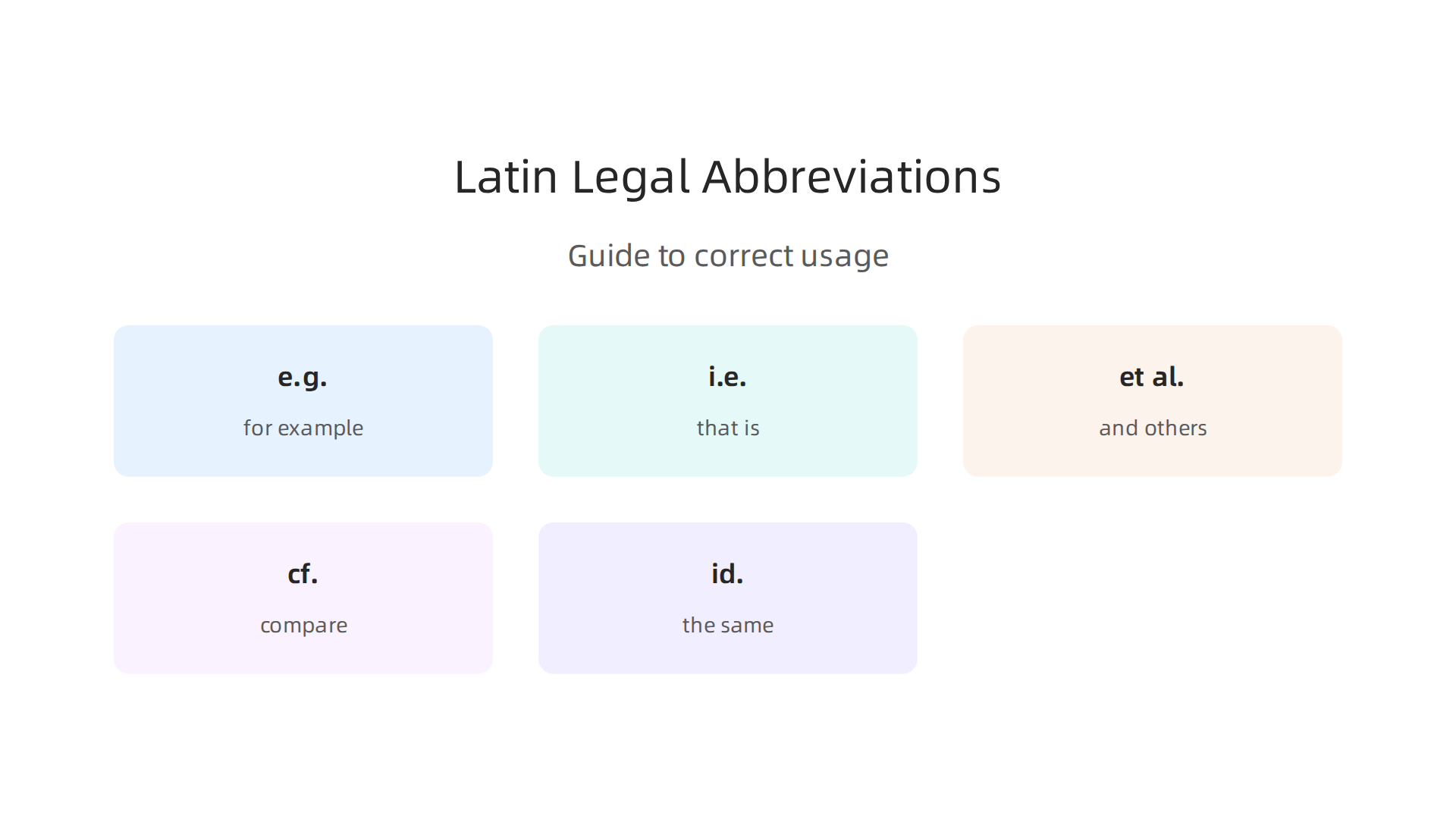
- e.g. — exempli gratia. It means "for example." Use it before listing examples. Do not list every item, just a few.
- Correct: "Negligence claims involve several elements, e.g., duty, breach, and causation."
- Wrong: "Negligence claims involve e.g. duty and breach." (Do not use e.g. as a verb replacement)
- i.e. — id est. It means "that is." Use it to clarify or restate something.
- Correct: "The defendant acted in bad faith, i.e., with intent to deceive."
- Wrong: "The defendant acted in bad faith, i.e., by hiding evidence." (Use "such as" for examples, not i.e.)
- et al. — et alii. It means "and others." Use it when citing a case or article with multiple authors.
- Correct: "Smith v. Jones, et al., 123 F.3d 456 (1999)."
- Wrong: "Smith v. Jones, et alii." (Keep it as "et al.")
- cf. — confer. It means "compare." Use it to point to a contrasting source.
- id. — idem. It means "the same." Use it when citing the same source as the previous footnote.
These Latin terms are powerful shortcuts, but they must be used precisely. Misusing them can make your writing look sloppy. The Cornell Legal Information Institute guide on citations provides complete rules for all these abbreviations.
One more note: always define the abbreviation the first time you use it in a brief or contract. This helps judges and opposing counsel follow your argument without guessing. It also protects you if someone misreads your shorthand. Even in internal firm memos, consistent use of abbreviations improves clarity and professionalism.
Why Accurate Abbreviation Usage Matters for Legal Professionals
You might think mixing up "e.g." and "i.e." is a small mistake. But in legal work, small mistakes can have big consequences. Getting your attorneys abbreviation usage wrong can confuse judges, upset clients, and even lead to malpractice claims. Here is why accuracy matters so much.
Misinterpretations Can Lead to Disputes
Legal documents are built on precision. A single wrong abbreviation can change the meaning of a sentence. For example, writing "i.e." when you mean "e.g." tells a reader you are clarifying something when you are actually giving an example. That can confuse the intent of a contract clause.
When you use undefined abbreviations in agreements, you risk creating ambiguity. If two parties disagree on what a shorthand term means, they may end up in court. That costs time and money. The best practice is to define every abbreviation the first time you use it. An article on making defined terms work for your legal reader explains that using unnecessary defined terms can slow readers down and cause confusion. So use abbreviations only when they truly help.
Even in internal memos, unclear abbreviations create misunderstandings. A partner might read "PL" as "public liability" while an associate reads it as "personal loss." These small gaps lead to wasted hours and frustrated teams.
Professionalism Builds Client Trust
Clients hire lawyers because they trust them to get the details right.

When a client sees sloppy abbreviation use, they start to wonder what else you might be missing. Are you using "e.g." correctly? If not, are you also missing key deadlines?
Using abbreviations consistently shows you care about your work. It signals that you follow industry standards. This is especially important in areas of law like contract drafting or litigation where every word matters. A consistent approach to legal shorthand makes you look organized and reliable. The NYU Law Editorial Style Guide recommends using no periods in abbreviations for degrees like JD and LLM. Following such standards keeps your writing clean and professional.
A polished document also helps you stand out. Clients compare lawyers. If your brief has clean abbreviations and correct citation formats, they notice. It builds confidence in your abilities.
Regulatory Compliance Demands Precision
Court filings have strict rules. The Bluebook and state-specific citation guides dictate exactly how you should abbreviate everything from court names to legal terms. Getting it wrong can get your filing rejected or criticized by a judge.
For example, in federal courts, you must abbreviate "United States Court of Appeals for the Ninth Circuit" as "9th Cir." Using "9th Circuit" or "Ninth Cir." might be accepted, but it shows you did not follow the rules. Judges and clerks appreciate lawyers who respect these conventions. It makes their job easier and reflects well on you.
Regulatory bodies also expect consistency. The Cornell Legal Information Institute citation guide lists standard abbreviations for words used in institutional party names. If you are filing a brief with multiple parties, using the right abbreviations keeps your document clean and correct.
In addition, some legal technology abbreviations are becoming standard. Terms like "AI," "ML," and "LLM" appear in court filings about data privacy and e-discovery. The article on decoding essential legal technology abbreviations notes that lawyers must learn these new terms to keep up with modern practice. Using them correctly shows you are current and competent.
One of the most serious risks is malpractice. If a poorly defined abbreviation leads to a contract dispute or a missed filing deadline, you could face a claim. Lawyers need to be careful with every shorthand they use. A good rule is to spell out any abbreviation that might be unclear to someone outside your practice area.
If you want to stay current on how AI is changing legal work, check out The AI Newsletter Worth Reading and get clear daily AI updates from The Deep View Newsletter. It helps you keep up with the tech abbreviations that are becoming essential in modern law practice.
Bottom line: Every attorneys abbreviation you use sends a message. Use it correctly, and you look sharp and reliable. Use it wrong, and you risk confusion, lost trust, and even legal trouble. Take the time to learn the rules and apply them every time you write. Your career will thank you.
How to Stay Updated on Evolving Legal Terminology and Abbreviations
Legal language does not sit still. New laws get passed. New technology appears. Court rulings change how we interpret old terms. If you want to use the right attorneys abbreviation every time, you need to stay on top of these changes. Here is how to keep your terminology skills sharp in 2026.
Watch for New Laws and Regulations
Every major law or regulation brings a fresh set of abbreviations. Think about the EU AI Act or state-level privacy laws like the California Privacy Rights Act. Suddenly, terms like "CPRA," "GDPR," and "high-risk AI system" become standard. You need to understand what these abbreviations mean and use them correctly in contracts, compliance documents, and client communications.
One smart habit: whenever you start working in a new area of law, make a list of the key abbreviations used in that field. Keep it handy. When you draft a document, check your list to make sure you are using the right shorthand.
Follow Technology Trends in Legal Tech
AI and legal tech are changing the game. Terms like "CLM" (contract lifecycle management), "e-discovery," "LPMS" (law practice management software), and "NLP" (natural language processing) now appear in everyday legal work. The article on Legal Tech Tools 2026 breaks down the categories of tools and the abbreviations that come with them. Reading such resources helps you learn the new shorthand before it trips you up.
Many law firms now use tools like practice management software, and those tools introduce their own abbreviations. The guide on Top 7 Productivity Tools for Law Firms in 2026 is a good place to see what terms are trending. Make it a point to skim these kinds of articles at least once a quarter.
Use Reliable Reference Resources
You do not have to memorize every abbreviation. Smart lawyers know where to look them up. Here are the go-to resources:
- Bar association style guides: Many state and local bars publish guidelines on legal writing and abbreviations. Check yours.
- Legal dictionaries: Black’s Law Dictionary is still the gold standard. It includes standard abbreviations for legal terms.
- Online citation guides: The Cornell LII guide and the Bluebook are essential for court filings.
- Legal software reports: The 2026 Legal Software Report not only lists tools but also helps you understand the acronyms used in the legal tech world.
Bookmark these resources. Use them every time you are unsure.
Take Continuing Legal Education (CLE) Courses
CLE is not just for staying licensed. It is a great way to refresh your knowledge of legal writing and terminology. Many CLE providers offer courses on drafting clear contracts, using proper citation formats, and understanding new legal technology. These courses often cover the newest terms and abbreviations in specific practice areas.
Look for CLE that focuses on legal writing, legal tech, or emerging areas like AI law. Even a one-hour session can update your knowledge and save you from embarrassing mistakes.
Follow Legal Tech News and Publications
Staying updated is easier when you subscribe to quality legal news sources. Legal Tech News Today covers the intersection of law and technology, including the abbreviations that come with new tools and regulations. You can explore articles like a guide to mastering legal research databases in 2026 with AI and smart search techniques to see how abbreviations for AI tools are becoming standard in research.
Also, read blogs and newsletters from reputable legal tech vendors and law schools. They often explain acronyms in context, which helps them stick.
Build a Personal Abbreviation Database
Here is a practical tip: start a running list of abbreviations you encounter in your work. Use a simple spreadsheet or a note in your phone. Include the abbreviation, the full term, and a brief note on when to use it. Update it whenever you learn a new one.
For example, if you work in litigation, you might list "MTD" (motion to dismiss), "SJ" (summary judgment), and "RFA" (request for admissions). In corporate law, you might add "LLC," "SPV," and "M&A." Over time, this list becomes your personal reference tool.
Bottom Line
The legal profession is always evolving. New abbreviations appear faster than ever, especially with AI and technology reshaping every area of law. But you do not have to guess. Use the resources above, stay curious, and keep learning. When you use the right attorneys abbreviation every time, you show clients, judges, and colleagues that you know your stuff. And that kind of trust is priceless.
Common Pitfalls and How to Avoid Them
Even seasoned lawyers trip up on abbreviations. The problem is that a small shortcut can cause big confusion. Let’s look at the most common mistakes with attorneys abbreviation and how to fix them.
Pitfall 1: Overusing Abbreviations
Here is the thing: abbreviations are meant to save space and time. But when you pack too many into a single document, readers lose track. Imagine reading a contract packed with "MTD," "SJ," "RFA," "OC," and "BFP" all in one paragraph. Your brain has to stop and decode each one.
The fix is simple. Use the full term first, then add the abbreviation in parentheses. For example: "The defendant filed a motion to dismiss (MTD)." After that, you can safely use "MTD" throughout. But if you have more than five or six abbreviations in one document, consider using fewer. Your reader will thank you.
A good reference for common abbreviations is the list of legal abbreviations on Wikipedia. Bookmark it. Use it when you are unsure.
Pitfall 2: Jurisdictional Differences Cause Ambiguity
This is a sneaky one. The same abbreviation can mean different things in different places. Take "Ct." In one state, it means "Court." In another, it means "County." If you file a document using "Ct." and the judge reads it as "County," you have a problem.
The same goes for "OC." On Reddit, lawyers debate what standard abbreviations like "OC" really mean. Some use it for "opposing counsel." Others use it for "of counsel." That is a big difference in meaning.
How do you avoid this? Always check the local rules for the jurisdiction you are writing in. Each court system has its own style guide. The UC Libraries Bluebook citation guide is a great resource for understanding how abbreviations vary by jurisdiction. When in doubt, spell out the full term. It is better to be clear than to be wrong.
Pitfall 3: Failure to Define Abbreviations on First Use
This mistake is more common than you think. Lawyers assume that everyone knows what "CPRA," "GDPR," or "LLC" means. But that is not always true. A client reading a contract might not know these terms. A new associate might not be familiar with every abbreviation in your practice area.
The fix is easy. Every time you introduce an abbreviation, write out the full term first. Follow the formula: full term (abbreviation). For example:
- "California Privacy Rights Act (CPRA)"
- "General Data Protection Regulation (GDPR)"
- "Limited Liability Company (LLC)"
The ISU LibGuides on legal research abbreviations is a helpful resource for checking standard forms. Use it to make sure you are defining terms correctly the first time.
How to Build Good Abbreviation Habits
Avoiding these pitfalls comes down to three habits:
- Define everything on first use. Never assume your reader knows the shorthand.
- Limit your abbreviation count. If a document needs more than a handful, use a separate glossary page.
- Check jurisdictional rules. What works in federal court may not work in state court.
If you work across multiple areas of law, these habits become even more important. A term that is standard in corporate law might be confusing in criminal defense. Take the time to adjust your language for each context.
For more tips on how to handle attorneys abbreviation correctly, the guide on what attorney at law abbreviation means and how to use it right is worth a read. It covers the basics that every legal professional should know.
One More Thing: Stay Curious
The legal world changes fast. New abbreviations appear every year, especially with AI and legal tech reshaping how we work. The best way to avoid mistakes is to keep learning.
If you want to stay ahead of the curve on legal tech trends and the terminology that comes with them, check out The AI Newsletter Worth Reading. It delivers clear daily updates on AI and technology that affect how you practice law. A few minutes a day can save you from using the wrong shorthand in an important filing.
Remember: clarity beats cleverness every time. When you use abbreviations the right way, you build trust with clients, judges, and colleagues. And that is worth more than any shortcut.
The Role of Technology in Managing Legal Abbreviations
Building good habits is one thing. But in a busy law practice, even the best intentions get lost between meetings, deadlines, and client calls. That is where technology steps in. In 2026, legal tech tools can take the guesswork out of attorneys abbreviation management and help your whole team stay consistent.
Document Automation Standardizes Everything
Think about how many documents your firm creates in a week. Briefs, motions, contracts, memos. If every lawyer handles abbreviations their own way, the result is a mess. One person writes "MTC" for motion to compel. Another writes "Mot. Comp." A third spells it out completely.
Document automation software solves this. You build templates that include your firm’s approved abbreviation rules. Every time someone uses the template, the system applies those rules automatically. No one has to remember which shorthand is correct. It is just built in.
The growing list of legal tech tools in 2026 shows how many platforms now include this kind of automation as a standard feature. For firms that handle multiple areas of law, this is a game changer. Corporate and litigation documents often use completely different abbreviation sets. Automation handles both without confusion.
AI Tools Catch Inconsistent Abbreviations
Here is the thing about human proofreading. We miss things. Especially when we have read the same paragraph five times. Our brains start to fill in what we expect to see, not what is actually there.
AI does not have that problem. Modern legal writing tools scan your document in real time and flag every abbreviation that does not match your firm’s style guide. They catch abbreviations that were never defined on first use. They spot shorthand that conflicts with jurisdictional rules.
The latest law firm productivity tools include AI features that learn your preferences over time. If you always write "FRCP" instead of "Fed. R. Civ. P.," the system remembers and checks for consistency across every document you create.
Research Integrations Keep You Accurate
Abbreviation standards change. Court rules get updated. New laws create new shorthand. Keeping up with all of it by memory is nearly impossible.
That is why integration matters. When your document writing platform connects directly to legal research databases, you can verify an abbreviation with one click. No flipping through a printed Bluebook. No opening a separate browser tab.
The guide to abbreviations and omissions used in citations from Cornell’s Legal Information Institute is a free resource that many modern tools pull from directly. Having that kind of reference built into your workflow means you are always checking against an authoritative source.
Choosing the Right Tools for Your Firm
Not every legal tech platform handles abbreviations the same way. When you evaluate options, look for these features:
- Custom abbreviation libraries that let you define your firm’s approved terms
- Real-time inconsistency alerts that flag problems as you type
- Jurisdictional presets that adjust rules based on the court or practice area
One example of how AI is changing document review is Iris Law AI contract analysis. Tools like this one can scan contracts for abbreviation consistency across hundreds of pages in seconds. That is work that would take a human hours.
The Bottom Line
You know the rules for using abbreviations correctly. The hard part is applying them day after day across every document your firm produces. Technology makes that easier. It standardizes your approach, catches your mistakes, and keeps you connected to the latest reference materials.
The lawyers who embrace these tools will spend less time worrying about formatting and more time practicing law. And that is a trade worth making.
Summary
This article is a practical guide to the most common attorneys’ abbreviations and why getting them right matters. It explains court and jurisdiction citation shorthand, degree designations like J.D. and LL.M., and frequently misused Latin abbreviations such as e.g., i.e., and et al. The guide shows how a single misplaced abbreviation can cause confusion, damage credibility, or even create legal risk, and it offers concrete habits—define on first use, limit shorthand, and check local rules—to avoid those mistakes. It also covers how technology, from document automation to AI proofreading, can enforce firm style and catch inconsistencies across large documents. Finally, the article suggests practical ways to stay current—CLE, trusted citation guides, and a personal abbreviation database—so you and your team write clearly and confidently every time.