
Leading Law Firms Mintz Morgan Rafferty and Rimon Embrace Technology in 2026

Introduction: Navigating the Landscape of Leading Law Firms
Picking the right law firm in 2026 is harder than it looks.

Legal professionals like you face a tough choice. You need a firm with deep experience. But you also need one that uses modern tools. Finding both in one place takes work.
That is why we put together this guide. We look at four big names in legal services: Mintz Law Firm, Morgan and Morgan Law Firm, Rafferty Law, and Rimon Law. Each one shows a different way to deliver legal help.
Take Mintz for example. It is an Am Law 100 firm with over 600 attorneys. It started in Boston more than 85 years ago. Today it has offices all over the world. The firm has strong practice expertise in many areas. It has also seen ten straight years of growth.
We know you look for more than just a big name. You want firms that adopt the right technology. You want firms that make operations smooth. If you are handling contracts you might also want to read our guide on why you need more than a lawyer for business contracts. It shows how legal ops and tech play a big role today.
In this article we break down each firm’s history, main practice areas, and how they use technology. We also look at what makes them different. This way you get a clear map. You can use it to find the right partner for your needs in 2026.
Mintz Law Firm: A Century of Excellence with a Modern Tech Edge
Mintz Law Firm stands out because it does two things at once. It keeps the deep experience of a firm that started back in 1933, and it also embraces the kind of technology that makes legal work faster and smarter. That balance is rare. And in 2026, it matters more than ever.
The firm began life as a small Boston practice. Today it is an Am Law 100 firm with over 600 attorneys spread across offices in Boston, Los Angeles, Miami, New York, San Diego, San Francisco, Toronto, and Washington, DC. You can see its full footprint on the official offices page. Over the past decade, Mintz has posted ten straight years of revenue growth. That kind of track record does not happen by accident.
Practice areas that carry real weight
Mintz is a full-service firm, but it is especially well known in three areas: health care, energy, and corporate law. In the 2024 edition of Chambers USA, 83 Mintz attorneys and 42 practice areas were recognized as leaders. That tells you the firm has depth where clients need it most.
Where technology gives Mintz an edge
Here is the part that separates Mintz from many older firms. The firm has invested heavily in legal technology. It built an AI-powered document review platform that cuts down the time lawyers spend sorting through files. It also created client-facing portals that give you real-time updates on your matters.
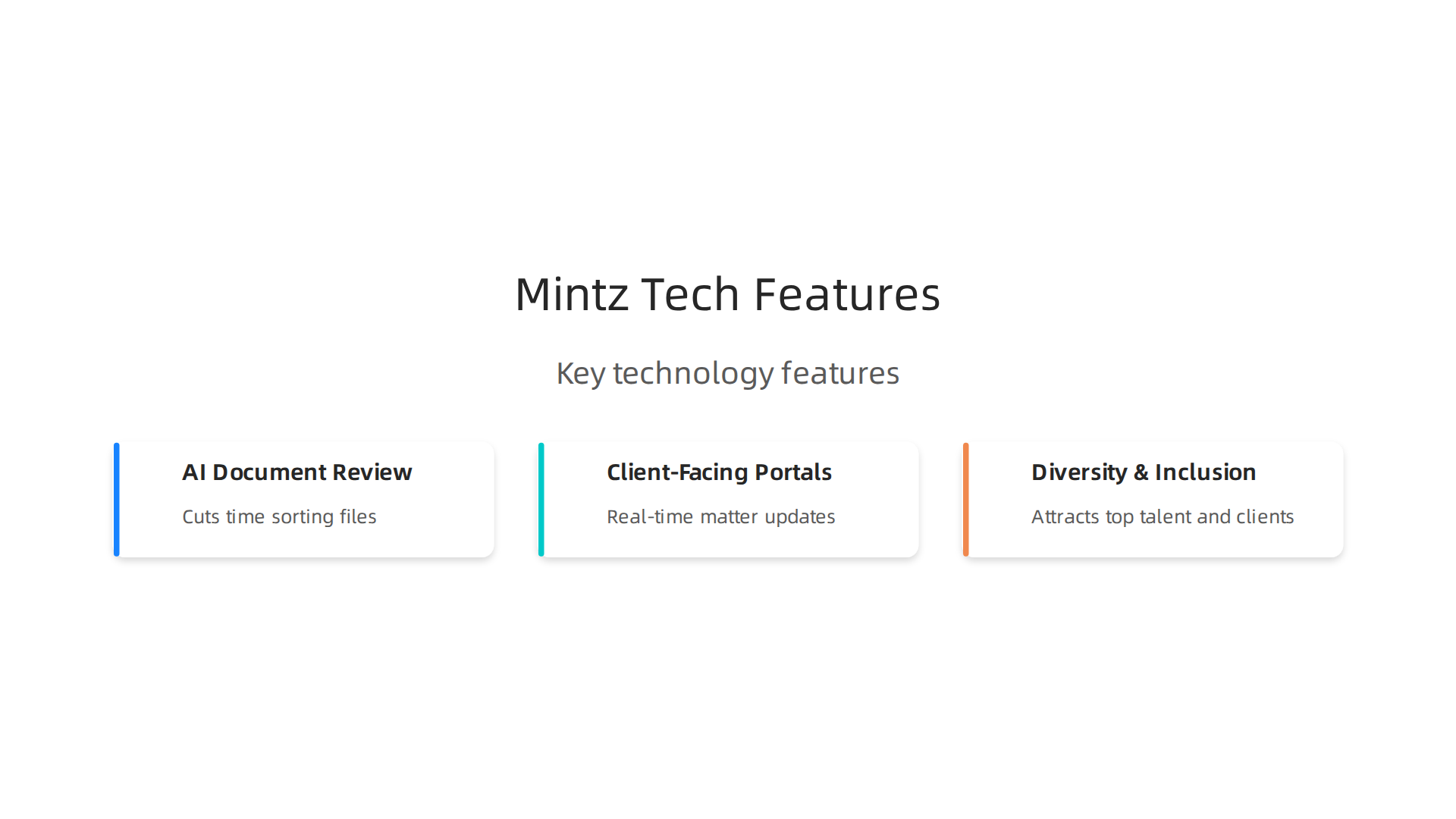
No more waiting for a weekly email. You can see exactly where things stand, when you want.
If you are curious about how AI tools are reshaping document work, take a look at our breakdown of IRIS Law for 2026. It shows how the same kind of technology can speed up contract analysis, a task that every legal team deals with.
Diversity that attracts talent and clients
Mintz also earns high marks for diversity and inclusion. Industry rankings often highlight the firm’s commitment to building a workforce that looks like the communities it serves.

That reputation helps Mintz pull in top lawyers and clients who care about who they work with.
So if you want a firm that blends almost 100 years of know-how with a real commitment to modern tools, Mintz is a strong option. It proves you do not have to choose between tradition and innovation. You can have both.
Morgan & Morgan: Scaling Personal Injury with Data-Driven Litigation
Whereas mintz law firm focuses on corporate and regulatory work with a tech edge, Morgan & Morgan has taken a completely different path. It is a personal injury powerhouse built on massive advertising, a strong brand, and something you might not expect: a data-driven engine that processes thousands of claims every month.
You have probably seen the "For The People" ads. But behind the scenes, Morgan & Morgan is one of the largest law firms in the country, with over 1,000 attorneys and more than $30 billion recovered for clients. That scale is not possible with just hard work. It takes technology.
A “Google-style” tech hub
The firm decided early on that technology would be its competitive advantage. It built what one report called a “Google-style” operation, with a dedicated tech team that creates internal tools to speed up case handling. This includes automated data collection, document sorting, and real-time analytics that help lawyers know exactly which cases are moving and which are stuck.
Data and automation in action
Morgan & Morgan uses data and automation around three goals: move cases faster, maximize recovery, and keep clients informed.
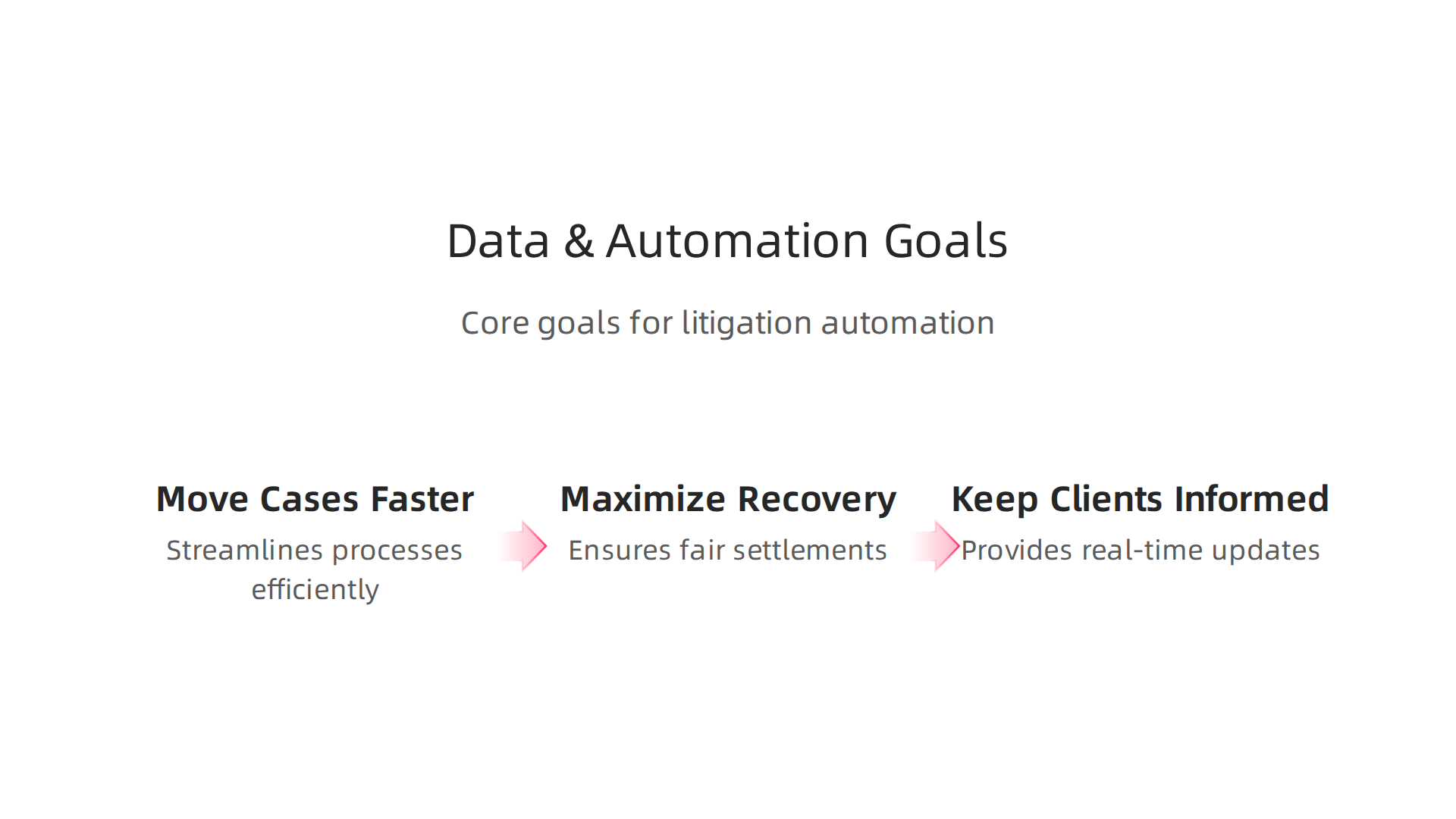
The firm’s own blog explains how it has comprehensive processes for these goals, ensuring every case progresses quickly and reaches a fair settlement.
To keep all those cases on track, the firm uses a case management platform from Litify. This platform standardizes how attorneys handle each step, so no matter which office a client works with, they get the same high level of service.
Clients stay in the loop
Morgan & Morgan also built the M&M Mobile app, which lets clients check case status from anywhere, submit documents, and schedule appointments. That kind of transparency builds trust and reduces the number of phone calls lawyers have to answer.
Scaling without ballooning headcount
The real payoff is that Morgan & Morgan can handle far more cases than a traditional firm of the same size. In a recent post, the firm shared how it uses technology instead of headcount to grow. By automating repetitive tasks, lawyers spend more time on the work that actually matters, like negotiating settlements or preparing for trial.
This data-driven approach sets Morgan & Morgan apart from other personal injury firms like Rafferty Law or Rimon Law, which may not have the same tech infrastructure. It also proves that even in a practice area as old as personal injury, technology is a massive advantage.
For more on how AI tools are changing legal workflows, check out our guide on IRIS Law for 2026, which covers the same kind of efficiency gains in contract analysis.
Morgan & Morgan shows that scaling a law firm is not just about more lawyers. It is about smarter systems. And that is something every firm can learn from.
Rafferty: Niche Expertise in a Digital-First Environment
While mintz law firm and Morgan & Morgan have grown by scaling big, Rafferty takes a different path. Rafferty focuses on deep subject-matter expertise rather than trying to be the biggest. Think of it as a boutique that uses technology to deliver high-quality service in specialized areas like intellectual property, immigration, and business litigation.
Why depth matters more than size
A firm like Rafferty cannot compete with the massive marketing budgets of a morgan and morgan law firm. Instead, it wins by being the best at what it does. Rafferty Domnick Cunningham & Yaffa, for example, earned top rankings in the 2026 Best Law Firms for personal injury, product liability, and insurance litigation. That recognition comes from knowing one area inside and out.
Cloud tools make the difference
Rafferty relies on cloud-based tools for secure collaboration and client onboarding. This lets a midsize firm act like a much larger one. When you specialize in complex matters like technology company representation, you need to share documents safely and bring clients on board fast. The Chambers profile for Colm Rafferty notes he advises many of Ireland’s top venture-backed tech companies. That kind of work demands digital tools that keep data safe and communications smooth.
In contrast, mintz law firm has over 600 attorneys across offices in Boston, Los Angeles, New York, and more. Rafferty does not try to match that scale. Instead, it uses technology to punch above its weight in service quality. Cloud practice management, secure client portals, and automated workflows let a smaller team handle complex cases with the same efficiency as a larger firm.
What other firms can learn
Rafferty shows that you do not need to be one of the largest law firms to succeed with technology. Even a focused practice can adopt the same tools that giants use. If you are a midsize firm looking to modernize without losing your niche, start with a solid case management system and secure client communication tools.
For a deeper look at how AI and automation are changing legal workflows, check out our guide on IRIS Law for 2026. It covers the same kind of efficiency gains that can help a boutique firm compete.
Rafferty proves that expertise plus smart tech is a winning combination. Whether you are an IP specialist or a business litigator, the right digital tools let you focus on what you do best.
Rimon: The Virtual Law Firm Pioneering Remote-First Legal Services
What if you could run a global law firm without a single headquarters? That is exactly what Rimon does.

While mintz law firm depends on its physical offices in Boston, Los Angeles, and other cities, Rimon took a different path from the start. It built itself as a virtual firm with no central office.
Rimon operates with a decentralized model. Lawyers work from anywhere using secure cloud platforms. The firm has partners and contract attorneys spread across many jurisdictions. This structure gives attorneys the freedom to choose their location while still collaborating closely.
How the technology works
Rimon was designed for remote work long before it became common. As the firm explains, its team was built to allow everyone to work and collaborate remotely from day one. The company uses encrypted e-rooms where clients and attorneys can edit documents in real time. It also relies on cloud-based tools for secure communication and file sharing.
One standout feature is AI-driven contract review. This automation speeds up document analysis and reduces errors. If you want to learn more about how AI is changing contract work, check out our guide on IRIS Law for 2026. It covers similar tools that help legal teams work faster.
Why lawyers and clients like this model
For lawyers, Rimon offers flexibility without sacrificing quality. Attorneys get paid directly for bringing in clients, which removes pressure to meet billable hour quotas. They also avoid long commutes and expensive office overhead.
For clients, the benefits are clear. Without rent and utilities for multiple offices, Rimon can offer competitive rates. Clients also get faster turnaround because lawyers can work across time zones. The firm has even been recognized as a top workplace in 2026 by U.S. News.
A contrast to traditional firms
This remote-first approach is very different from larger firms like mintz law firm. Mintz relies on a network of physical offices in eight major cities. Their model works well for in-person meetings and team collaboration. But it also comes with higher costs.
Rimon proves that you do not need a corner office to deliver excellent legal service. The firm has grown by focusing on technology and smart structure instead of real estate.
What other firms can learn
Any law firm, even a small practice, can adopt parts of the Rimon model. Start by moving your documents to a secure cloud system. Use encrypted client portals for sharing files. Consider automation tools for routine tasks like contract review.
The key takeaway? You can build a successful firm without a single physical address. With the right technology, your lawyers can work from anywhere and still serve clients at the highest level.
Comparative Analysis: Innovation and Technology Adoption Across the Four Firms
Now that we have seen how each firm operates, let’s put them side by side. This comparison helps you understand which model might work best for your practice or for choosing legal help.
The table below breaks down the four firms across four key technology dimensions.
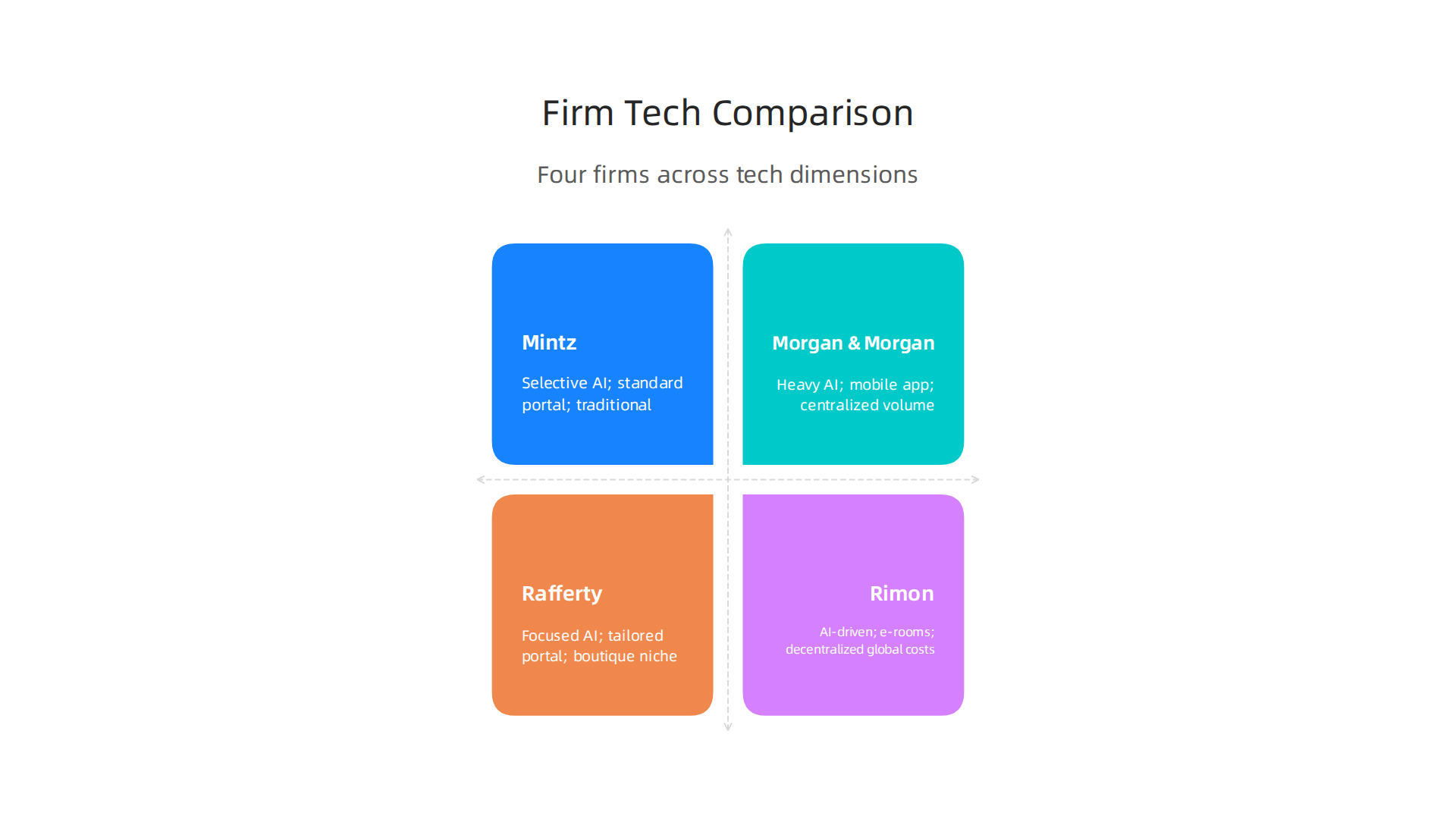
| Dimension | Mintz (Full-Service) | Morgan & Morgan (Volume-Driven) | Rafferty (Niche Expertise) | Rimon (Virtual-First) |
|---|---|---|---|---|
| AI Adoption | Selective, used for document review and research | Heavy investment in proprietary AI for case triage and automation | Focused AI tools for mass tort data analysis | AI-driven contract review for remote teams |
| Client Portal Sophistication | Standard secure portal | Full-featured mobile app for case tracking and document upload | Tailored portals for mass tort clients | Encrypted e-rooms for real-time collaboration |
| Firm Structure | Traditional, multiple physical offices | Centralized with large physical hubs + remote capabilities | Boutique with specialized expertise, moderate use of tech | Fully decentralized, no central office |
| Scalability of Tech Investments | Tech scales with office expansion | Tech designed to scale case volume without adding headcount | Tech scales within niche practice areas | Tech scales globally without real estate costs |
Breaking Down the Differences
Mintz takes a measured approach. As a full-service firm, it uses technology where it adds value, like AI for contract review and secure client portals, but it relies on its network of physical offices. This works well for clients who want both tech convenience and in-person connection.
Morgan & Morgan goes all in on volume-driven technology. The firm built a "Google-style" tech hub that powers its massive personal injury practice. Their data and automation processes ensure cases move quickly, as explained in their blog on using data and automation. They even offer a mobile app that lets clients check case status from case opening to settlement. This focus on scaling with technology instead of headcount is a core part of their strategy.
Rafferty uses technology as an enabler for its deep niche expertise in mass tort and product liability. The firm’s tech investments focus on analyzing large data sets and managing complex litigation. They earned top rankings in 2026 Best Law Firms, showing that smart tech adoption combined with specialized knowledge can produce excellent results.
Rimon builds everything on a virtual-first infrastructure. Since Rimon was designed from the start on a distributed cloud-based model, its technology directly enables its remote workforce. Lawyers collaborate in real time through encrypted e-rooms, and the firm avoids expensive office overhead. This structure makes Rimon one of the most cost-efficient and flexible models among large firms.
What You Can Learn
Each model offers lessons for legal professionals.
-
If you run a traditional firm like mintz law firm, you can selectively adopt AI tools to improve efficiency without changing your structure. Check out our guide on AI contract analysis to see how AI can help your team.
-
If your practice handles high volume, look at how morgan and morgan law firm uses data and automation to scale. You do not need to be one of the largest law firms to use these ideas.
-
If you specialize in a niche like rafferty law, focus on technology that amplifies your expertise rather than trying to do everything.
-
If you want to build a flexible, low-overhead practice, rimon law shows that a virtual-first infrastructure is possible with the right tools.
The key insight? There is no single right way to adopt technology. The best approach depends on your firm’s structure, goals, and client needs. By studying these four models, you can make smarter decisions about where to invest your time and money in 2026.
Lessons for Legal Professionals: What These Firms Teach Us About Technology Strategy
So what can you actually take away from all this? After looking at how mintz law firm, morgan and morgan law firm, rafferty law, and rimon law handle technology, a few clear lessons come through.
Lesson 1: Match Your Tech to Your Firm’s DNA
There is no one-size-fits-all strategy. The largest law firms like Mintz take a careful, selective approach to AI. They add tools where they help but keep their physical offices as the foundation. Morgan & Morgan, on the other hand, builds custom tech to handle massive case volume without hiring more people.
The Harvard Center on the Legal Profession explains that for large firms, AI adoption promises better productivity and client outcomes. But the way you adopt it depends on your business model. A boutique firm like Rafferty should focus on niche analytic tools. A virtual firm like Rimon should build cloud infrastructure.
Your technology spend should match your practice, not the other way around.
Lesson 2: Implementation Beats the Tools Themselves
Every firm we looked at invests in client portals and AI tools. But the difference between a portal that frustrates clients and one that delights them comes down to implementation. The best client portals for law firms in 2026 focus on easy document uploads, real-time updates, and mobile access.
Morgan & Morgan proves this. Their mobile app does not just exist. It is built around how clients actually want to track their cases. Implementation is what makes the same tool work differently across firms.
Lesson 3: Use These Firms as a Benchmark
Legal operations teams can compare their own technology roadmaps against these four models. Ask yourself:
- Does your firm lean more toward the traditional full-service model of Mintz or the distributed model of Rimon?
- Are you trying to win on volume like Morgan & Morgan or on deep expertise like Rafferty?
- What would it take to add a realistic AI policy for 2026 that fits your specific size and practice area?
Legal technology trends for 2026 show that AI is now deeply embedded in legal operations. Your policy and your tech choices will shape how competitive you remain.
Practical Takeaways
Here is how to apply these lessons starting today.
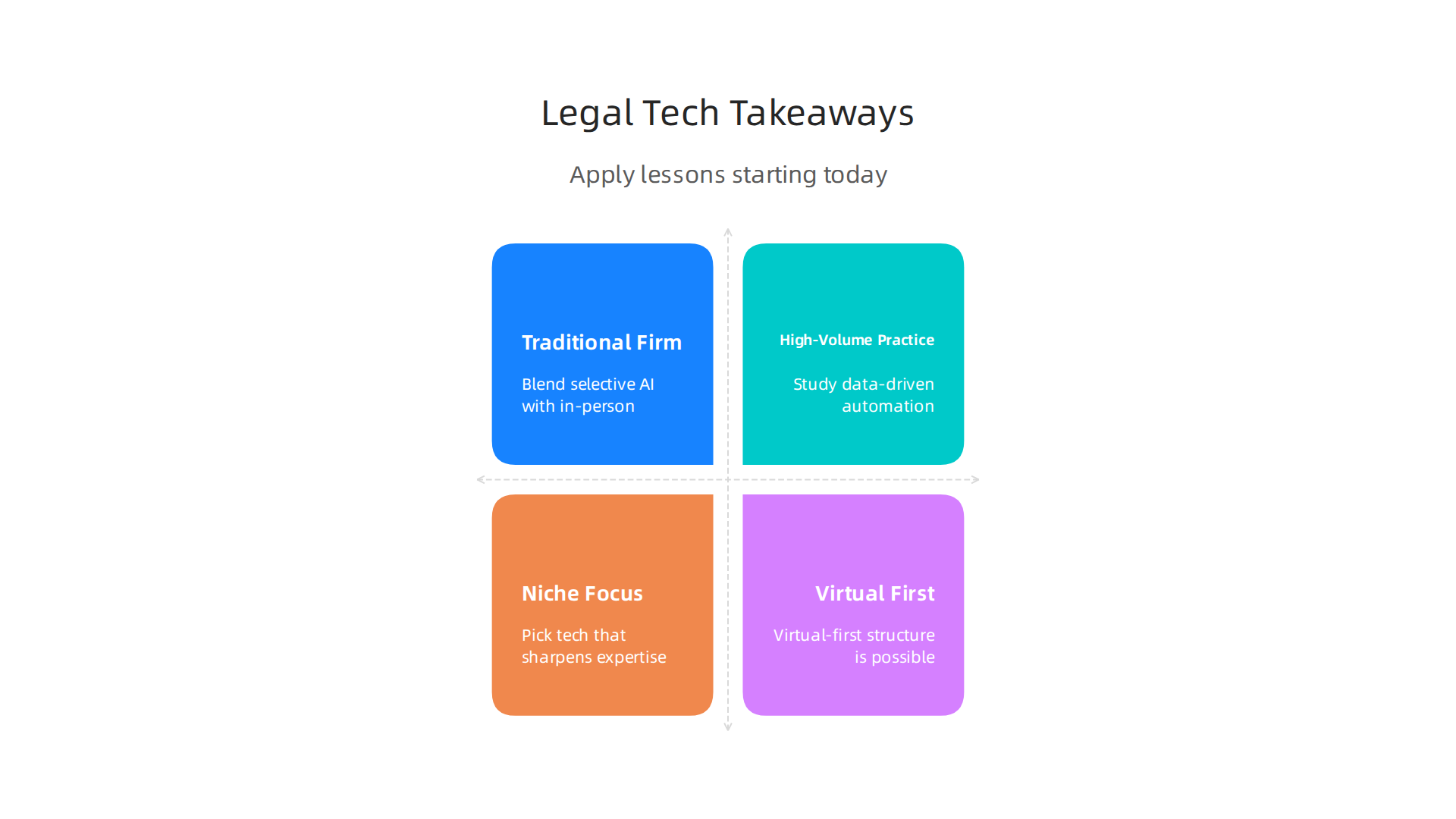
If you work at a traditional firm, look at how Mintz blends selective AI with in-person service. You can start small with AI contract review tools without redesigning your whole practice. Read more about how technology is changing the role of legal professionals in our guide on the evolving employment lawyer career in 2026.
If you run a high-volume practice, study Morgan & Morgan’s data-driven model. You do not need to be one of the largest law firms to use automation for case triage and client communication.
If you have a niche focus, follow Rafferty’s lead. Pick technology that makes your expertise sharper, not tools that try to do everything.
If you want flexibility and low overhead, Rimon shows that a virtual-first structure is possible. It requires strong encrypted systems and a team that buys into remote collaboration.
The bottom line? In 2026, the firms that win are not the ones with the most technology. They are the ones that choose technology that fits who they are and who they serve.

Summary
This guide compares four leading law firms—Mintz, Morgan & Morgan, Rafferty, and Rimon—to show how different business models use technology in 2026. It explains each firm’s history, core practice areas, and the specific tech stacks they use, from AI document review and client portals to proprietary automation and fully virtual collaboration. The article highlights why matching technology to a firm’s structure matters more than buying the latest tools, and it offers side‑by‑side analysis so you can see which model fits your needs. Readers will learn practical lessons for adopting AI, improving client portals, and scaling operations without unnecessary headcount or real estate. By the end you’ll know which firm archetype—traditional full‑service, volume-driven, niche boutique, or virtual-first—best matches your goals and what first steps to take to modernize your practice.