
Why the Am Law 200 Ranking Matters for Your Law Firm’s Growth

Introduction
If you work in the legal industry, you have probably heard the term "Am Law 200" thrown around in meetings, strategy sessions, or industry news. But what does it actually mean? Simply put, the Am Law 200 is the definitive ranking of the 200 largest law firms in the United States, based on gross revenue. Published each year by The American Lawyer, this list is one of the most trusted benchmarks in the legal profession.
For legal professionals—whether you are a partner at a large firm, a corporate counsel, or someone running a lawyers professional corporation—understanding this ranking is critical. It helps you compare your firm against competitors, spot market trends, and make smarter strategic decisions.

The difference between the Am Law 100 (the top 100 firms by revenue) and the Am Law 200 (positions 101 to 200) is not just a number. It tells you a lot about a firm’s size, resources, and market position. You can learn more about the Am Law 100 and Am Law 200 differences from an overview by Lateral Link.

In this article, we will give you a complete look at the Am Law 200 ranking. We will explain how the list is put together, what the data tells us about the biggest legal firms in America, and how you can use this information to grow your practice. We will also compare it to other rankings and share practical tips for law firms and legal professionals alike.
Staying up to date on industry benchmarks is just one piece of the puzzle. To stay ahead of fast-moving trends like artificial intelligence and legal tech—which are reshaping how law firms operate—many legal pros also rely on daily intelligence. That is why we recommend The AI Newsletter Worth Reading, which delivers clear daily AI updates to your inbox. It is a simple way to keep your knowledge current without the noise.
Now, let us dive into what makes the Am Law 200 so important for your career and your firm.
What Is the AmLaw 200?
Imagine a list that ranks the biggest and most powerful law firms in the United States by how much money they make. That is the Am Law 200 in a nutshell. Published each year by The American Lawyer magazine, this ranking is the go-to benchmark for the legal industry. According to the Am Law 200 rankings and insights on Law.com Compass, it is the definitive ranking of the 200 largest law firms in the US by gross revenue.
The main factor that determines a firm’s spot on the list is gross revenue. That is the total amount of money the firm brings in from its clients over a calendar year. But the report does not stop there. It also looks at the total number of lawyers, revenue per lawyer, and profits per partner. These numbers give a much clearer picture of a firm’s health. For example, a firm might rank 150th in total revenue, but have very high profits per partner. That tells you it is a well-run and profitable legal firm. Many of these large practices operate as a lawyers professional corporation. This structure helps the firm manage liability and taxes as it grows to hundreds or thousands of attorneys.
It helps to understand how the list is split. The Am Law 100 covers the top 100 firms. These are the true giants with a global reach. The Am Law 200 covers firms ranked 101 through 200. These firms are still very large and successful. But they might focus on specific regions or areas of law. The difference between these two groups tells you a lot about a firm’s market position.
In 2026, the Am Law 200 matters more than ever. Clients and top legal talent use this list to judge a firm’s reputation. Partners use it to set growth goals. To stay competitive, many amlaw 200 firms are investing heavily in their brand. They often hire a law firm digital marketing agency to build a strong online presence and attract the best clients.
The Am Law 200 is a snapshot of who is winning in the business of law. For a closer look at how the most successful legal firms are changing the way they operate, check out our take on Leading law firms that embrace technology. It explores how smart tools and new strategies are helping firms move up the rankings.
How to Access the Official AmLaw 200 Data
Getting your hands on the full AmLaw 200 list is not hard, but you need to know where to look. The American Lawyer magazine publishes the official ranking each year. You can find it on their website and through the ALM Intelligence platform.

Here is the catch. If you want the deep details like profits per partner and revenue per lawyer, you will need a paid subscription. But do not worry. The magazine often releases a summary table to the public for free. That table shows the basic ranking and gross revenue for each firm. For example, firms like Offit Kurman announced their No. 180 spot on the 2026 Am Law 200 in a press release, giving you a real-life look at the data.
One more tip. Always make sure you are looking at the most current year’s numbers. Rankings shift every year as amlaw 200 firms grow or shrink. Using last year’s list could give you the wrong picture. When you visit a firm’s website, check how the firm presents itself. A strong online presence often signals a well-run practice. If you want to understand why that matters, read our article on why bad law firm websites drive clients away. To stay on top of the latest legal industry news, you might enjoy The AI Newsletter Worth Reading for quick daily updates.
How Are AmLaw 200 Rankings Calculated?
You see a law firm ranked No. 127 on the AmLaw 200 and wonder what that number really means. Is it about how much money the firm makes? How happy the lawyers are? Or something else entirely?
Here is the simple truth. The American Lawyer ranks amlaw 200 firms by one main number: gross revenue. That is the total amount of money the firm billed and collected in the previous calendar year. The firm with the highest revenue ranks first. A firm with lower revenue but higher profits can still rank below a less efficient but bigger firm. So the rank tells you about size, not necessarily about success.
But the story does not end there. The American Lawyer also publishes a full set of extra data alongside the ranking. This includes revenue per lawyer (RPL), profits per equity partner (PPP), total headcount, and profit margin.
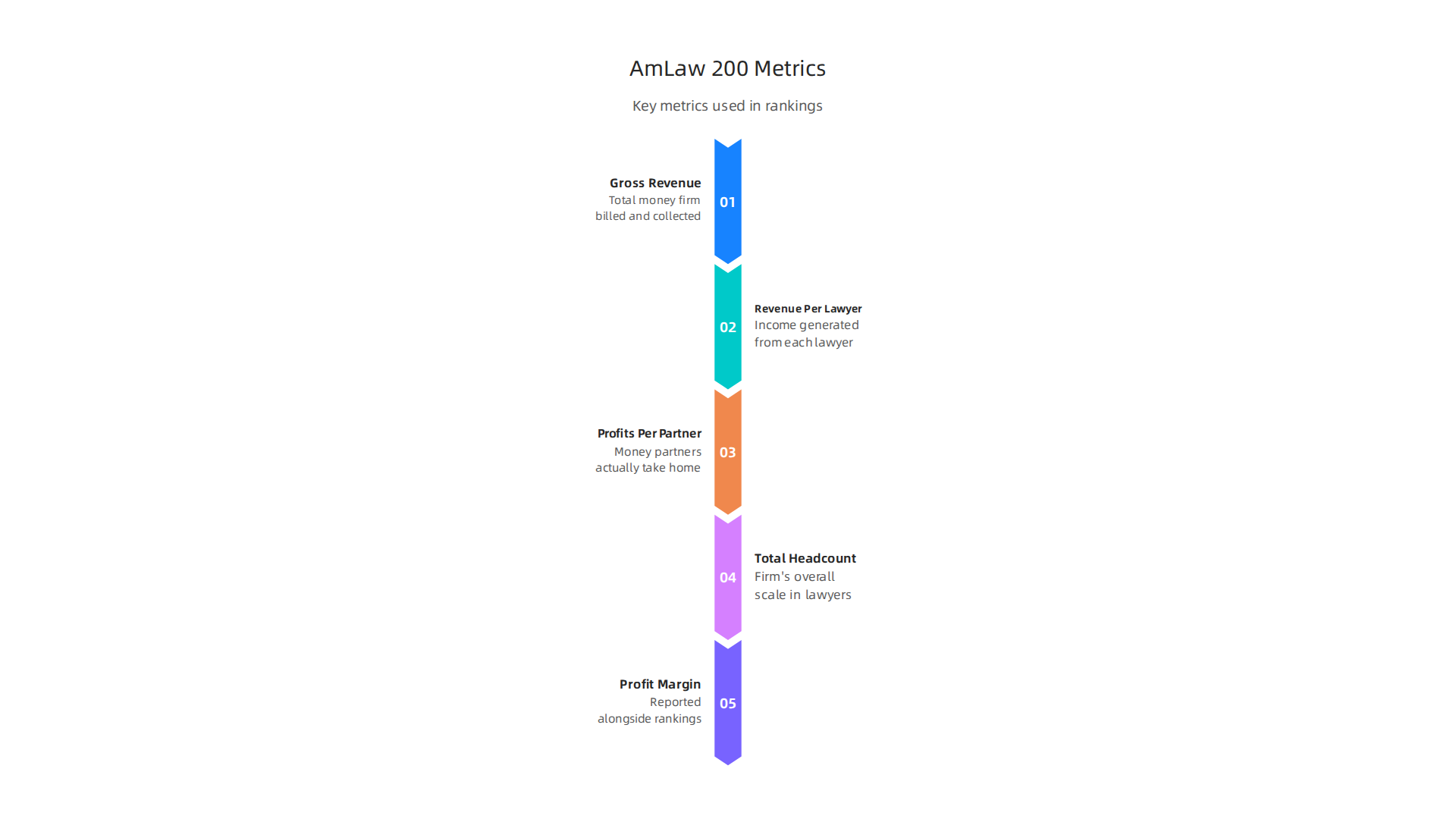
These secondary numbers often tell a richer story than the headline rank alone. For a clear breakdown of how the list works, check out this explanation of the difference between Am Law 100 and Am Law 200 firms.
The ranking covers only U.S. revenue. So a global firm with big international offices might rank lower than its worldwide standing suggests. Rankings also change every year. A firm can jump ten spots one year and fall back the next, depending on how its revenue grows compared to competitors.
The methodology has grown more detailed over time. The American Lawyer now also produces the A-List, which ranks the most well-rounded firms in the AmLaw 200. That list uses five factors: revenue per lawyer, associate satisfaction, pro bono work, inclusion, and the percentage of women equity partners. The A-List looks beyond revenue to measure firm culture and values.
For a real example of how the data works, consider the second hundred firms. These are the firms ranked 101 to 200. In a recent year, they grew revenue per lawyer by 8.6 percent and profits per partner by 12.6 percent, according to an analysis of the 2025 Am Law 200 rankings and financial performance. That kind of growth shows how dynamic these legal firms can be from one year to the next.
Understanding the calculation helps you read the rankings with a critical eye. A firm ranked No. 101 is not necessarily a "better" firm than one ranked No. 150. It just has higher revenue. For more insights into how top law firms operate and embrace new tools, read our piece on leading law firms embracing technology in 2026.
Key Metrics: Revenue, Headcount, and Profits
So you know the AmLaw 200 ranks firms by gross revenue. But that single number only tells part of the story. Three other metrics reveal the real health and strategy of these legal firms.
Gross revenue is still the starting point. It is the total money a firm collects from clients worldwide. A firm like Benesch jumped 10 spots to No. 127 in the 2025 ranking because its revenue grew 28.2 percent. That quick move shows how revenue growth can change a firm’s position fast.

For a deeper look at how one firm pulled this off, read about the Benesch 2025 Am Law 200 ranking jump.
Revenue per lawyer (RPL) measures efficiency. It divides total revenue by the number of lawyers. A high RPL means a firm generates more income from each lawyer. This often signals better use of technology and support staff.
Profits per partner (PPP) tells you how much money the partners actually take home. A firm can have high revenue but low PPP if costs eat up the profits. Comparing PPP across firms reveals which ones run lean and reward their partners generously. For context on how partner compensation compares, check out these criminal lawyer salary benchmarks for 2026.
Headcount shows the firm’s scale. A firm with 500 lawyers has different resources than one with 100. When you compare headcount growth to RPL and PPP changes, you see whether a firm is growing smart or just getting bigger without getting more profitable.
Looking at these metrics together gives you a much clearer picture than the rank alone. If you want to stay ahead of how top law firms are using data to drive decisions, consider getting daily updates from The AI Newsletter Worth Reading.
The Evolution of the AmLaw 200: Historical Trends
Now that you understand the key metrics, let’s zoom out. How have the AmLaw 200 firms changed over the last decade? The story is one of steady growth, but also widening gaps between the top and the rest.
Revenue has climbed nearly every year since the 2008 recession. Rate increases and demand for premium legal services have been the main drivers. In 2024, the Am Law Second Hundred grew total revenue by 10.9 percent, reaching $27.8 billion. That was a strong year by almost any measure. For a closer look at how the second tier performed, check out this breakdown of the 2025 Am Law 200 Second Hundred performance.
But the growth has not been even. The top firms in the Am Law 100 have grown faster than the Second Hundred in recent years. In 2025, the Am Law 100 saw revenue jump 13 percent while the Second Hundred grew only 6 percent. The gap in revenue per lawyer and profits per partner keeps widening. This means the richest firms are pulling away from the pack.
Economic downturns have interrupted this growth pattern. The 2008 recession caused a temporary dip in revenue and headcount at most firms. Demand for legal services dropped as corporate clients cut spending. But the recovery was strong, and firms that survived came back leaner and more profitable. The pandemic year of 2020 was another shock, but this time many firms actually grew because demand for certain practice areas like bankruptcy and litigation surged.
Headcount has also evolved. The Am Law 100 added lawyers at a much faster rate than the Second Hundred in 2024, growing headcount by 7.7 percent compared to just 2.1 percent for the rest. This suggests the largest firms are investing heavily in talent while smaller firms are growing more carefully.
The composition of the list has shifted too. Firms focused on M&A, litigation, and technology have risen faster than those relying on traditional corporate work. Some firms like Fennemore have grown revenue by 144 percent since 2020 through strategic moves. To see how other firms are using technology to fuel their growth, read about leading law firms embracing technology in 2026.
Understanding these trends helps you see which AmLaw 200 firms are positioned for the future and which ones might fall behind.
AmLaw 200 vs. Other Law Firm Rankings
You might see different lists when looking at the biggest law firms in the United States. The AmLaw 200 is just one of them. It ranks the top 200 firms by how much money they bring in each year. But there are other rankings too, and each one looks at things a little differently.
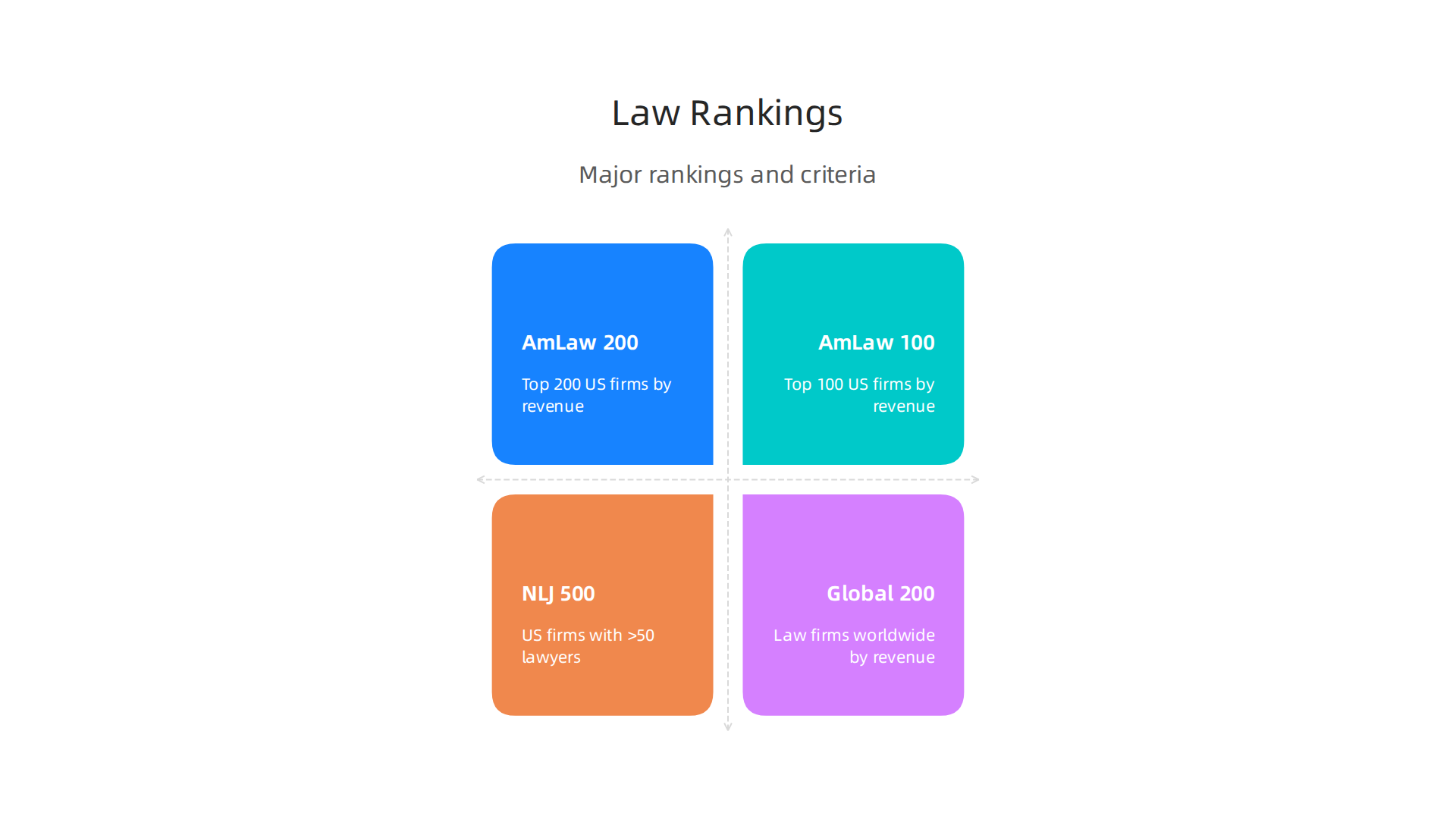
The AmLaw 100 is a smaller group. It is simply the top 100 firms from the AmLaw 200 list. So every AmLaw 100 firm is also an AmLaw 200 firm, but not the other way around. The AmLaw 100 focuses on the very biggest players by revenue. The Second Hundred covers firms ranked 101 through 200.
Another common ranking is the NLJ 500. This list counts all law firms in the United States that have more than 50 lawyers. The NLJ 500 does not care as much about revenue. It is about lawyer headcount. A firm could have lower revenue but still rank high on the NLJ 500 if it hires a lot of lawyers. So the NLJ 500 gives you a different view of the market.
Then there is the Global 200. This ranking includes law firms from all over the world, not just the United States. International firms like Clifford Chance and Freshfields appear on this list. If you want to see how US firms stack up against London or Hong Kong firms, the Global 200 is the ranking to check. The scope is much wider, and it can include firms with a different mix of practice areas and billing rates.
Each of these rankings serves a different purpose. If you want to see which US firms make the most money, the AmLaw 200 is your best bet. If you care about the total size of a firm’s legal team, look at the NLJ 500. If you are comparing across countries, the Global 200 gives you the full picture. Understanding these differences helps you pick the right benchmark for your needs.
To stay on top of how these rankings shift year after year, it helps to follow trusted sources. You can get clear daily updates on legal industry trends by subscribing to The AI Newsletter Worth Reading. That kind of insight keeps you ahead of the curve.
For one real world example of a firm that has moved up through these rankings, take a look at how NST Law grew from a small team to a regional powerhouse. It shows how smart strategy can boost a firm’s position over time.
Why the AmLaw 200 Matters for Legal Professionals
The AmLaw 200 is more than a simple list of top earners. It is a tool that different players in the legal industry use to make smarter decisions.

Whether you lead a law firm, work as corporate counsel, or sell technology to legal teams, this ranking gives you useful data. Here is why each group pays attention to the AmLaw 200.
For Law Firm Leaders
If you run a law firm, the AmLaw 200 shows you exactly where you stand against your competitors. You can compare your firm’s revenue, revenue per lawyer, and profits per partner to firms of similar size. That helps you set realistic growth targets and spot weak areas. For example, if your firm’s revenue per lawyer falls below the average for the Second Hundred, you know you need to work on efficiency or billing rates. The ranking is not perfect, but as a Thomson Reuters analysis explains, using the ranking for benchmarking can reveal important patterns about your firm’s health and strategy. Leaders who ignore these benchmarks risk falling behind.
For Corporate Counsel
When you need outside lawyers for a big merger, a complex lawsuit, or a regulatory issue, you want a firm with proven resources. The AmLaw 200 helps you narrow the field. Firms on this list have the scale, the talent, and the experience to handle high stakes work. You can use the ranking to check a firm’s revenue per lawyer, which is often a sign of how productive and profitable the practice is. For deeper insights, you can look at resources like the Law.com Compass page that ranks AmLaw 200 firms by revenue per lawyer and other metrics. This helps you pick a firm that matches the difficulty and value of your matter.
For Legal Technology Vendors and Investors
If you sell software, AI tools, or marketing services to law firms, the AmLaw 200 is your target list. These firms have the budgets and the need for modern solutions. But many of them have a problem: their marketing and business development teams spend too much time on low value tasks and not enough on strategic growth. A report from Calibrate Strategies found a clear gap in how AmLaw 200 firms allocate their marketing resources. That gap is an opportunity for vendors who can help firms improve their client outreach, digital presence, and overall strategy. A smart law firm digital marketing agency, for example, can step in and fill that need. Investors also watch the AmLaw 200 to see which firms are spending on innovation and which ones are falling behind.
The AmLaw 200 has real, practical value for anyone who works with or inside large legal firms. It is a shortcut to understanding the market and making better choices. To see how real law firms are using technology to grow and compete, check out how leading law firms embrace technology in 2026. That kind of progress is exactly what drives movement in the rankings.
How to Use the AmLaw 200 for Strategic Decisions
The AmLaw 200 gives you raw numbers. But the real value comes from using those numbers to guide your choices.

Whether you run a firm or work in legal operations, here are three practical ways to put the data to work.

Find Gaps in Your Services
Start by looking at revenue per lawyer for firms close to your size. If your number falls below theirs, you may need to improve efficiency or raise billing rates. Also scan the practice areas that top firms offer. If you do not have a service that clients ask for often, that is a gap worth filling. Set a specific revenue target and build toward it. Remember, the headline ranking does not tell the whole story. A good guide on the difference between Am Law 100 and Am Law 200 firms explains that secondary numbers like revenue per lawyer matter more than where a firm lands on the list. Use those details to spot where you can grow.
Study Competitors to Adjust Pricing
Pick a handful of firms you compete with regularly. Compare their revenue per lawyer and profits per partner to your own. This gives you a real market benchmark. If you charge less than similar firms, you might be leaving money on the table. If you charge more, make sure your quality justifies it. You can also see which firms are growing fast and copy what they do right. For example, one firm went from just 8 lawyers to making the list. Their story offers a useful case study of law firm growth strategy that shows how clear targets and steady execution pay off. Use competitor data to set a fair price and track your progress.
Evaluate Outside Counsel with Confidence
When you need to hire outside lawyers, you want a firm that is stable and strong in your area. The AmLaw 200 helps you check both. Look at revenue per lawyer to see how productive the firm is. Look at headcount to make sure they have enough people for your work. Most important, check if the firm has a top practice group in your specific field. For deeper guidance on finding the right legal partner, read this guide on how to select attorneys on retainer for your 2026 legal needs. It walks through the key steps for choosing a firm that fits.
Stay Informed to Stay Ahead
Using the AmLaw 200 well takes knowledge. The legal market changes fast, and new technology shifts strategies quickly. That is why many legal professionals subscribe to The AI Newsletter Worth Reading. It sends clear daily updates about artificial intelligence and legal tech straight to your inbox. Staying informed helps you make smarter strategic choices with the data you already have.
Benchmarking Your Firm Against the AmLaw 200
You do not need to reach the top of the list to benefit from the AmLaw 200. Benchmarking helps you see where you stand right now. Start by comparing your firm’s revenue per lawyer, profit margin, and headcount against the AmLaw 200 medians. These secondary metrics often tell a more useful story than the headline ranking. As one legal industry guide explains, the difference between Am Law 100 and Am Law 200 firms shows that revenue per lawyer is a better measure of firm health than total revenue alone.
Next, pick competitors of similar size and geography. A regional firm with 50 lawyers should not compare itself to a global giant. Look at peers in your own market for a more honest picture. For inspiration, see how one firm grew from a tiny startup by learning about NST Law inside the firm that grew from three lawyers to a regional powerhouse.
Finally, set incremental goals. Aim to increase profits per partner by 10% each year. Small steps add up. And to stay current on legal tech tools that help you reach these targets, consider signing up for The AI Newsletter Worth Reading. It delivers daily updates straight to your inbox.
The Future of the AmLaw 200: Trends and Predictions
The legal industry is changing fast. The amlaw 200 firms you see today will not look the same a few years from now.

Three big trends are already reshaping how legal firms operate, bill their time, and compete for talent.

AI and Automation Are Changing the Work
Artificial intelligence is no longer a future idea. It is here and growing. According to the Top Legal AI Trends for 2026 report, the number of law firms using AI has nearly doubled in the past two years. Firms now use AI to draft contracts, review documents, and summarize transcripts. This changes how legal firms staff their cases. Clients are less willing to pay junior associates for routine work that AI can handle faster and cheaper. As a result, revenue models are shifting. Firms may move away from the billable hour toward value based pricing. This directly affects the revenue per lawyer numbers that drive AmLaw 200 rankings.
Alternative Fee Arrangements Are Growing
The old way of billing by the hour is losing steam. More clients want flat fees or other alternative fee arrangements. They want predictable costs, not surprise bills. This trend can change the income patterns of amlaw 200 firms. Firms that master alternative fee models may climb the rankings faster than those that stick to hourly billing. Revenue per lawyer may look different, but firms with efficient operations can still see strong profits.
Globalization and Remote Work Open the Door
The AmLaw 200 has always been a US focused list. But remote work and global hiring are changing that. Top legal firms from other countries can now build strong US offices without needing a huge physical footprint. More international firms may qualify for the list in the coming years. This will make the competition even tougher.
Staying ahead means keeping up with tech and new business models. For a closer look at how modern firms are adapting, read about leading law firms embracing technology in 2026. The future of the AmLaw 200 belongs to firms that innovate.
Summary
The Am Law 200 is the annual ranking of the 200 largest U.S. law firms by gross revenue and a core benchmark for legal professionals. This article explains how the list is compiled, what secondary metrics like revenue per lawyer (RPL), profits per partner (PPP), and headcount reveal, and where to find the official data. It compares the Am Law 200 with other lists, shows historical trends and why the second hundred firms matter, and outlines how firm leaders, corporate counsel, and vendors use the ranking for strategy. You will learn practical ways to benchmark your firm, identify service or pricing gaps, evaluate outside counsel, and set measurable growth goals. The piece also covers how technology, AI, alternative fee arrangements, and globalization are changing the rankings. After reading, you’ll be able to interpret Am Law 200 data critically and apply it to concrete business and marketing decisions for your firm.