
Navigate the 2026 Legal Tech Companies List: Choose the Right Tools for Your Law Firm

Why a clear legal tech companies list matters for law firms and legal teams
The world of law is changing quickly. In 2026, new technology comes out all the time, making it hard for law firms and legal teams to keep up. It feels like there are new gadgets and programs every day that promise to make legal work easier. Actually, law firms spent a lot more on technology in 2025, with a big jump in how much they put into tech tools, showing how fast things are moving along, according to a report on the state of the legal market Legal Tech Spending Surges 9.7% As Firms Race to Integrate AI ….
This fast growth means lots of options. From smart legal AI tools that help with research to new case management software that keeps everything organized, the choices can be overwhelming. Many legal professionals are already using general AI tools, with nearly three-quarters doing so in 2026, marking a huge shift in the legal field 2026 Legal Industry Report: Trends, Benchmarks & Insights | 8am. Even well-known names like Clio legal software are seeing high rates of AI adoption in firms By The Numbers: What Surveys Show About Law Firm AI Adoption.
That’s why having a clear legal tech companies list is so important. It helps you cut through all the noise.

You don’t want to spend hours looking at every single option out there. Instead, you need a helpful guide that points you to the best tools for your needs.
This guide will give you simple ways to understand what each legal tech startup meaning is all about. We will show you how to pick the right tools by looking at what they actually do. We want to turn all the information out there into clear, helpful steps for you to choose the best legal tech. To learn more about selecting the right tools, check out how to choose the best new legal tech for law firms in 2026.
Staying on top of these changes, especially with AI, is key for any legal professional today.
Get clear daily AI updates from The AI Newsletter Worth Reading.
With so many new legal tech companies coming out, it can feel like trying to find a needle in a haystack. To make sense of it all, we need a way to group these tools. Think of it like organizing your pantry; you put all the spices together, all the canned goods together. This helps you find what you need much faster.
This is exactly what we do with legal technology. By understanding the main types of legal tech companies, you can easily find the right tools for your law firm or legal team. Knowing the categories helps you pick smart solutions that truly fit your needs, rather than just grabbing whatever looks new and shiny. It also helps you understand the true legal tech startups meaning by seeing where they fit in the bigger picture.
Here are the major types of legal tech tools you’ll find in 2026:
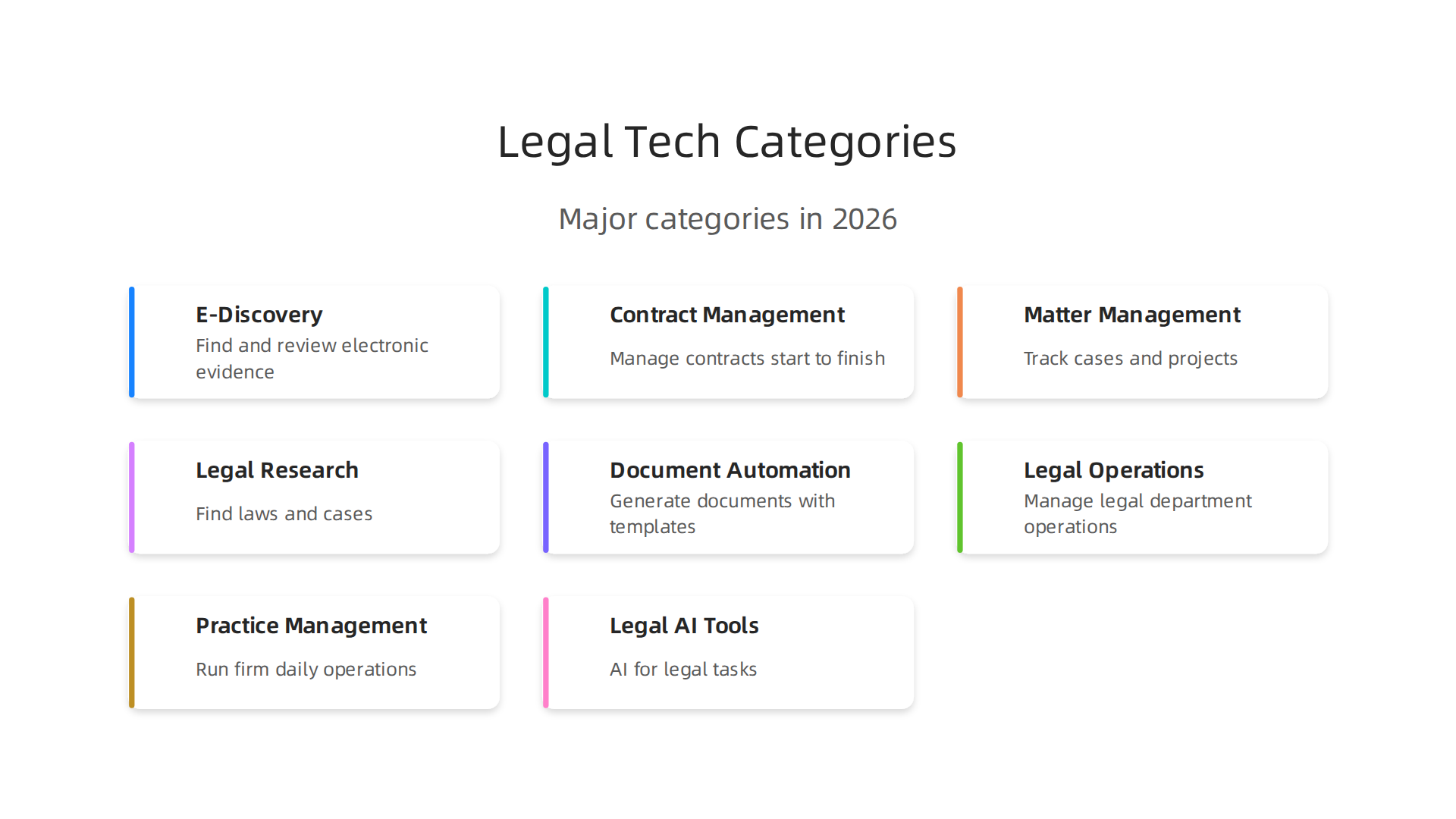
E-Discovery Software
E-discovery tools help legal teams find, collect, and review electronic evidence for court cases. This includes emails, documents, messages, and more. With so much information stored digitally today, these tools are key to making sure no important piece of evidence is missed. They often use advanced legal AI tools to speed up the review process, making it faster to sort through huge amounts of data.
Contract Lifecycle Management (CLM)
Contract Lifecycle Management, or CLM, helps manage contracts from start to finish. This means everything from writing new contracts and negotiating terms to getting signatures, storing them safely, and tracking important dates like renewals. These systems make sure contracts are handled correctly and efficiently, as explained by several experts on legal tech tools Legal Tech Tools 2026: Complete List by Category.
Matter Management Software
Matter management software helps legal teams keep track of all their cases and projects. It is like a central hub for all legal work. This includes managing tasks, deadlines, documents, and even how much money is being spent on each case. It’s often paired with case management software to give a full picture of ongoing matters.
Legal Research Tools
Legal research tools help lawyers find laws, court cases, and other legal information they need. These tools have changed a lot thanks to AI, allowing faster and more accurate searches. They can help with things like natural language searches and checking if a citation is still good. To learn more about modern research, you can also explore how to master legal research databases in 2026 with AI and smart search techniques.
Document Automation
Document automation software helps legal teams create documents much faster. Instead of writing every document from scratch, you can use templates and fill in specific details. This saves a lot of time on tasks like drafting agreements, letters, and other paperwork. This type of legal technology makes sure all your documents are correct and consistent.
Legal Operations Platforms
Legal operations platforms are broader systems that help manage the business side of a legal department or law firm. They often bring together many tools like matter management, billing, and vendor management into one place. These platforms help legal departments run more smoothly and efficiently, focusing on the overall flow of legal work.
Picking Between General and Specialist Tools
When looking at a legal tech companies list, you’ll notice two main kinds of vendors:
- Horizontal Platforms: These are general tools, like a word processor or a project management program, that can be used by many different types of businesses. They are not made just for lawyers.
- Legal-Specialist Vendors: These companies make tools specifically for the legal world. Their software understands how law firms and legal departments work. For example, a contract management tool from a legal-specialist vendor will have features designed for legal clauses and compliance checks.
Choosing between these two is important. General tools might be cheaper, but specialist tools often fit better with legal work and can save more time in the long run. Knowing these categories helps you ask the right questions and pick tools that truly meet the specific needs of your legal practice.
Now that you know the different types of legal tech tools out there, how do you pick the right one for your team?

It’s like buying a new car; you don’t just pick the prettiest one. You think about what you need it for, how safe it is, and if it fits your budget. The same goes for choosing legal technology. You need a clear way to check and compare different tools and the legal tech companies list that offer them.
Here’s how to evaluate legal tech vendors:
Key Things to Look For
When you’re checking out a legal tech company, keep these important points in mind:
- Does it fit your needs? First, think about the problems you want to solve. Does the software actually help with those problems? A good tool solves a real need, not just a small annoyance. Ask for a demo to see it in action and make sure it works for your day-to-day tasks. This is about finding the right fit for your practice, ensuring it aligns with your workflow.
- Is it safe and compliant? Legal work deals with sensitive information. So, security is super important. The legal tech vendor must show how they protect your data. They should follow rules like CCPA for data privacy, ensuring your client information is safe from harm and that they have proper data processing agreements in place, as explained in guides on Data Privacy Compliance: Complete Guide for 2026 and how to protect data when working with SaaS vendors. Make sure they can also handle any other special privacy needs your firm has.
- Can it work with your other tools? Most law firms use several different software programs. It’s best if new legal tech can talk to your existing systems, like your case management software or billing system. This makes everything smoother and saves you from doing tasks twice.
- What kind of support will you get? When something goes wrong or you have questions, good customer support is a must. Find out what kind of help the vendor offers, like training, online guides, or a help desk. Easy-to-reach support and good training can make a big difference in how well your team uses the new tool. According to experts, asking about customer support is one of the top ways to choose the right vendor for your in-house legal team How to Choose the Right Legal Tech Vendor for Your In- ….
- What’s the full cost and what will you gain? Look beyond the price tag. Think about the total cost over time, including setup, training, and monthly fees. Then, think about what you’ll gain. Will it save you money by making work faster? Will it help you get more clients? This is about figuring out the "Return on Investment" (ROI) and making sure the tool is worth the expense. You want to pick tools that help you meet your goals for growth.
- Is the company reliable? You want a vendor that will be around for a long time and keep making their software better. Look at how long they’ve been in business and what others say about them. A stable vendor means less worry for you in the future.
How to Evaluate Legal Tech in Steps
Choosing legal tech isn’t a one-time decision; it’s a process:
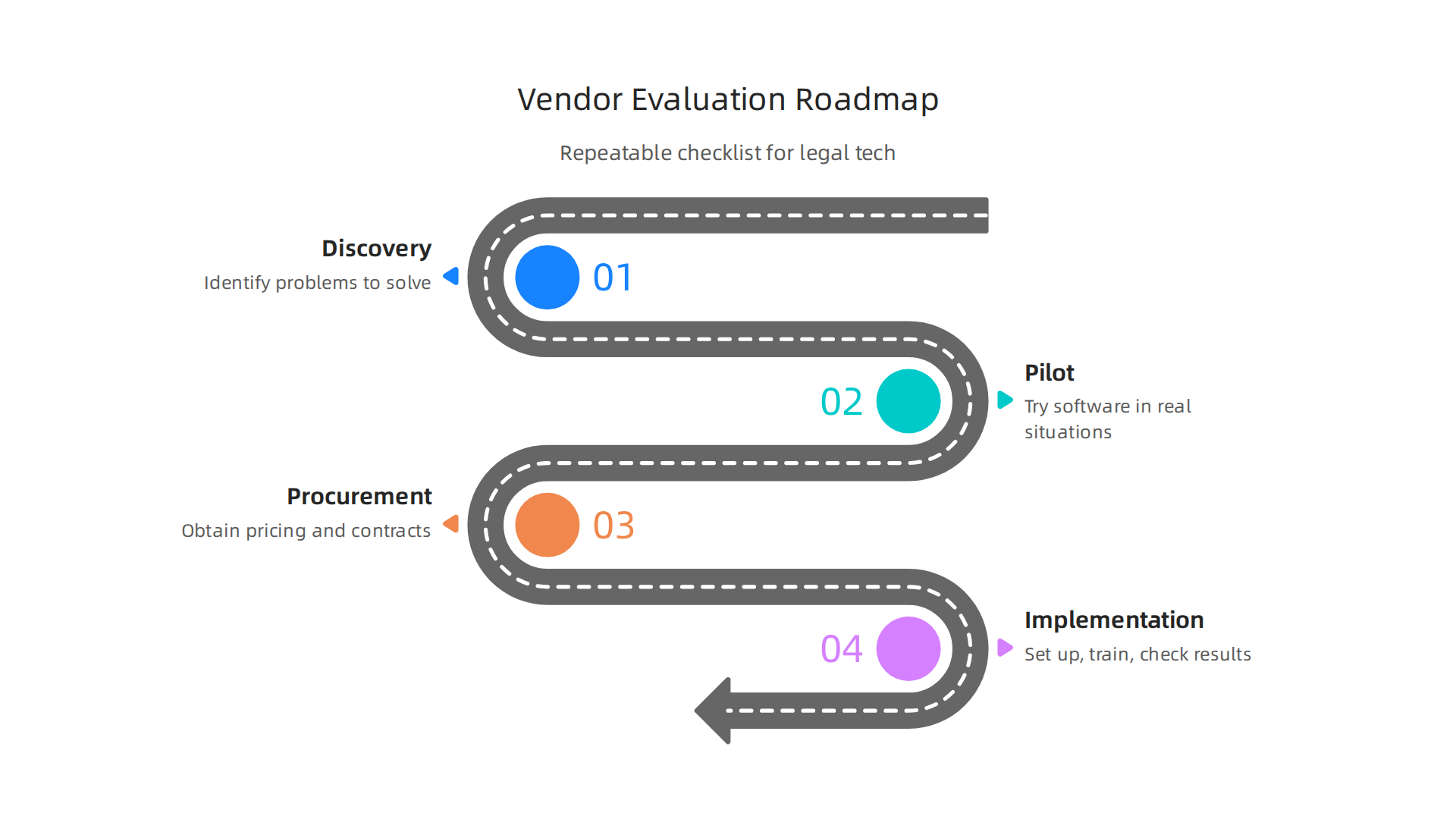
- Discovery: Start by figuring out what problems you need to solve. What are your goals? What features are must-haves? Talk to your team members about their biggest headaches.
- Pilot or Test Run: Before you buy, try the software out. Many companies offer a free trial or a pilot program. This lets your team use the tool in real-world situations to see if it truly works for them. Some companies even offer templates to help you design these pilot programs effectively.
- Procurement: Once you’ve chosen a tool, it’s time for the paperwork. This involves getting prices, signing contracts, and making sure all the legal agreements, especially around data handling, are correct. It’s smart to have a specific committee for this, including IT and legal operations professionals, as highlighted in advice for AI vendor selection for corporate legal departments.
- Implementation and Review: After you buy the software, you need to set it up and train your team. Then, after some time, check back. Is it helping like you thought it would? Are people actually using it? This step helps you make sure the tool is doing its job and if any changes are needed.
Making smart choices about legal tech can truly change how your firm works, making things faster and better for everyone.
Want to understand even more about how technology is changing legal practices?
The AI Newsletter Worth Reading
Making smart choices about legal tech can truly change how your firm works, making things faster and better for everyone. To help you navigate all the options, let’s look at the different kinds of legal tech available. Knowing these categories makes it easier to find the right tools and understand what different legal tech companies offer.
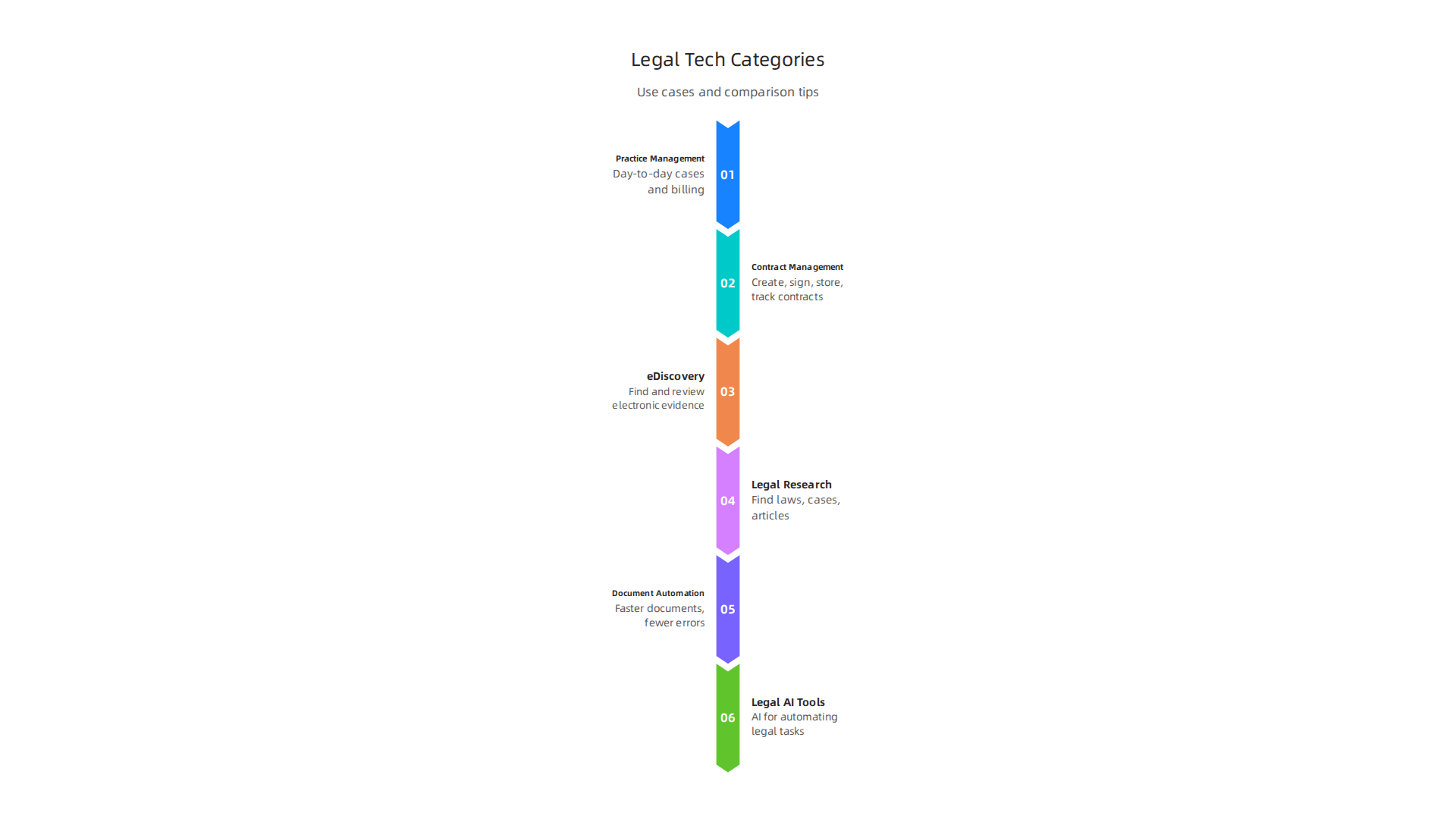
Here is a quick look at common legal tech categories, what they help with, and key things to spot when comparing them:
| Legal Tech Category | What it Helps With (Use Case) | Key Features & Integrations to Look For |
|---|---|---|
| Practice Management | Running your law firm day-to-day, client cases, billing | Features: Case tracking, calendaring, time entry, billing, client intake. Integrations: Accounting software, email, client portals. |
| Contract Management | Creating, signing, storing, and tracking contracts | Features: Template libraries, automated workflows, e-signatures, AI for clause review, obligation tracking. Integrations: ERP, CRM, document management. |
| eDiscovery | Finding and reviewing electronic evidence for lawsuits | Features: AI for quick review, data collection from many sources, redaction, early case assessment. Integrations: Document management, litigation tools. |
| Legal Research | Finding laws, cases, and legal articles | Features: Smart search, AI for insights, citation checks, real-time updates. Integrations: Document drafting tools. |
| Document Automation | Making legal documents faster and with fewer errors | Features: Templates, clause libraries, automated document generation, version control. Integrations: Word processors, contract management. |
| Legal AI Tools | Using artificial intelligence for various legal tasks | Features: Predictive analytics, automated legal memo drafting, contract analysis, risk assessment. Integrations: Existing legal software. |
Digging Deeper into Legal Tech Categories
When you’re looking at a specific legal tech company, it’s helpful to know what makes their tools stand out in each category.
Practice Management Software
This is often the core of a law firm’s tech stack. It helps manage almost everything, from client details to court dates and billing. Think of it as the control center for your firm. Many firms look for strong case management software that can handle scheduling, time tracking, and invoicing all in one place. Popular options like Clio legal software are known for their cloud-based solutions that let you work from anywhere. When comparing tools, check for easy-to-use interfaces, client portals, and mobile app access. According to Bind Legal, practice management software is a key category of legal tech tools for 2026, helping with everyday law firm operations Legal Tech Tools 2026: Complete List by Category.
Contract Management Software
Handling contracts can take a lot of time. Contract Lifecycle Management (CLM) software helps with every step, from writing the first draft to signing and keeping track of renewals. These tools often use legal ai tools to quickly review contracts, find key terms, and make sure everything follows the rules. Good contract management software should offer templates, e-signature tools, and ways to track if contract duties are being met. Experts say that the best tools include workflow automation and obligation tracking to help legal teams, as noted in insights on Top Contract Management Software for Legal Teams.
eDiscovery Solutions
When a lawsuit happens, finding electronic evidence is a big job. eDiscovery tools help lawyers collect, review, and produce emails, documents, and other digital files. The latest eDiscovery platforms use legal ai tools to speed up the review process, making it faster to find important information and redact sensitive data. This saves a lot of time and money.
Legal Research Platforms
Gone are the days of endless paper files. Modern legal research platforms let lawyers search huge databases of laws, cases, and articles using smart search features. Many now include legal ai tools that can help lawyers get quick answers, check citations, and even predict case outcomes. To truly master these tools, learning about Master Legal Research Databases in 2026 with AI and Smart Search Techniques can make a big difference.
Document Automation Software
This type of software helps you create legal documents much faster by using templates and pre-approved clauses. It makes sure that all your documents are correct and consistent, reducing mistakes. This is especially helpful for common documents like wills, contracts, or court filings. Look for tools that can work with your existing word processing software and offer a library of clauses.
Dedicated Legal AI Tools
Beyond integrating AI into other categories, some legal ai tools focus solely on advanced tasks. These tools can help with things like predicting the outcome of cases, automating legal memo writing, or analyzing huge amounts of legal text for risks. They are often used by firms wanting to be at the forefront of legal innovation. When looking at this growing area, you’ll find specialized tools that can seriously boost a legal team’s abilities 8 Best Legal AI Tools for In-House Legal Teams in 2026.
When you’re ready to explore a comprehensive legal tech companies list and compare what they offer in these categories, remember to match their features to your firm’s specific needs and goals.
Choosing the right tools from a legal tech companies list means looking beyond just the cool features. It’s really important to also think about how these tools will work with your current systems, how safe they keep your data, and if they follow all the necessary rules. These things are key to making sure your new legal tech helps your firm run smoothly without causing problems.
Checking How Legal Tech Connects (Integration)
When you pick a new legal tech tool, you want it to play nicely with your other software. This is called integration. If your case management software or accounting programs can’t talk to your new contract tool, you’ll end up doing more work, not less!
Here’s what to check:
- APIs (Application Programming Interfaces): Think of APIs as special messengers that let different software programs share information. When a legal tech company says their tool has good APIs, it means it can connect with other tools easily. This is super helpful.
- Single Sign-On (SSO): This lets you log in once to one system and then access many other connected systems without typing your password again. It saves time and makes things easier for everyone in your firm.
- Data Flows: Understand how your important information will move between different programs. You want this flow to be smooth and automatic. If it’s not, your team might struggle to use the new tech, and your efforts to improve things could fall flat. Good integration makes sure your firm actually uses the new tools, making change management much simpler. To help make smart choices, learn more about how to Choose the Best New Legal Tech for Law Firms in 2026.
Keeping Your Information Safe and Following the Rules (Security and Compliance)
Protecting client information is one of the most important jobs for any law firm. When you choose new legal tech, especially tools that might use legal ai tools or handle sensitive documents, you must make sure they are very secure and follow all privacy laws.
Here are key things to verify:
- Data Residency: This means knowing where your client’s data will be stored. Is it in your country, or somewhere else? Different countries have different data laws, so this can be very important for compliance.
- Encryption: Encryption turns your data into a secret code so only authorized people can read it. You need to know that the legal tech protects your data both when it’s being sent (called "in transit") and when it’s sitting still (called "at rest"). Robust encryption is a key part of good data privacy compliance in 2026, helping protect information from being seen by the wrong people Ultimate Guide to Data Privacy Compliance in 2026.
- Vendor Certifications: Look for proof that the legal tech company takes security seriously. This often comes in the form of certain certifications, like SAS 70 Type II. If the software handles credit card payments, it should also be PCI DSS compliant. These certifications show that the vendor has been checked by outside experts and meets high security standards ASP to SaaS – Security must-haves.
- Compliance with Laws: In 2026, laws like GDPR (General Data Protection Regulation) and CCPA (California Consumer Privacy Act) set strict rules about handling personal data. Any legal tech you use must help you meet these rules, not make it harder. Ask potential vendors on your
legal tech companies listhow their tools ensure compliance. - Vendor Assessment: Before signing any contracts, ask vendors about their security practices. This includes asking for Data Processing Agreements (DPAs) that spell out how they will protect your data. Regularly reviewing a vendor’s security is vital. Understanding how your firm can keep its data safe is always important, especially against modern threats. Learn more about How Law Firms Defend Legal Data Against Phishing Emails.
Staying informed about the latest in AI and tech is crucial for legal professionals.
Get clear daily AI updates from The AI Newsletter Worth Reading.
Pricing models, procurement strategies, and making the ROI case
Once you know a legal tech tool is secure and works well with your current systems, the next big question is about money. How much does it cost, and will it be worth it? Understanding pricing, how to buy the tech, and how to show it’s a good investment is super important.
Understanding Legal Tech Pricing Models
Different legal tech companies offer their products in different ways. Knowing these pricing models helps you pick the best fit for your firm from a legal tech companies list.
Here are some common ways legal tech is priced:
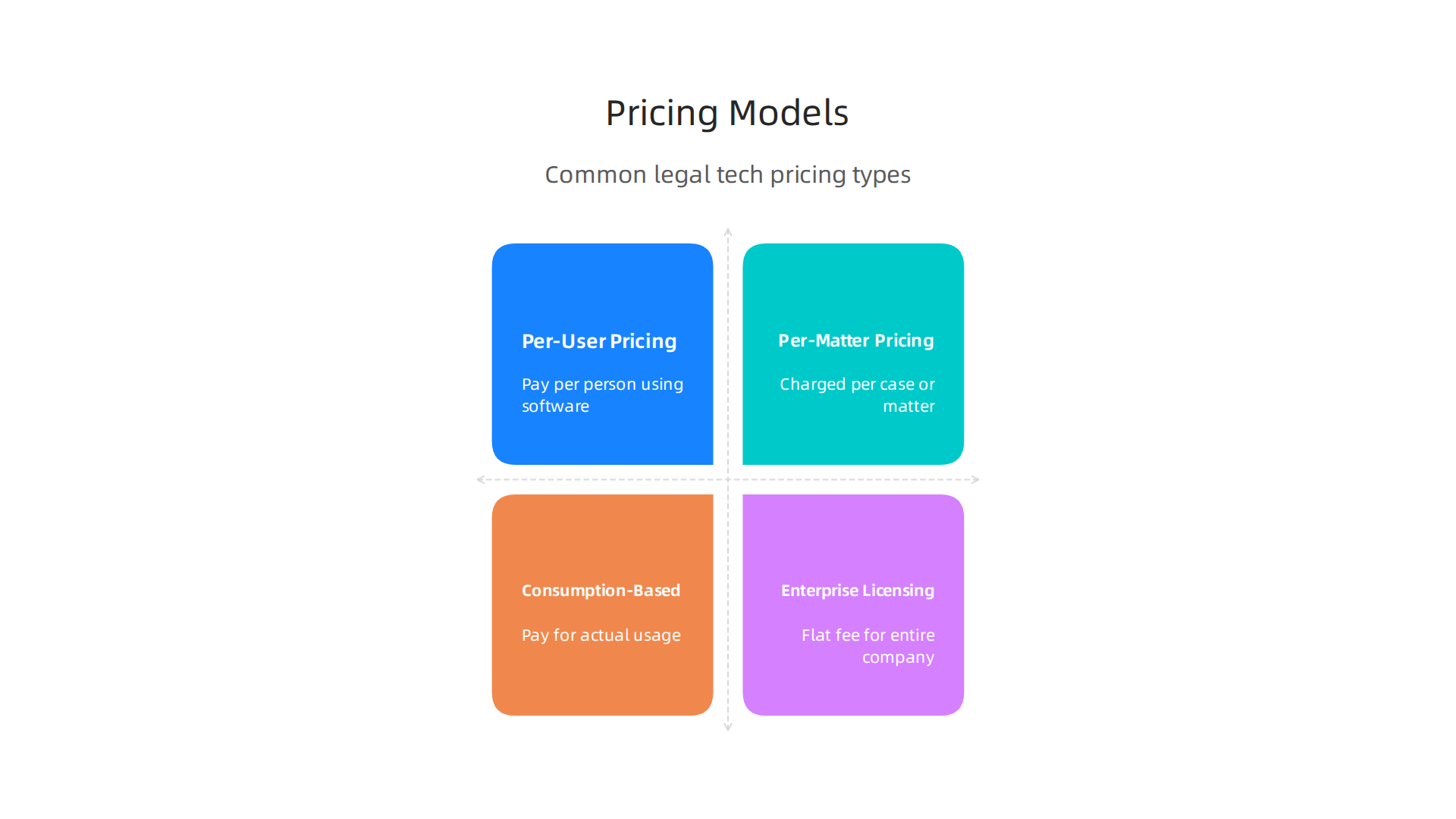
- Per-User Pricing: This is when you pay for each person who uses the software. If you have 10 lawyers and paralegals using
case management software, you pay for 10 users. This is simple, but costs can go up if your team grows. - Per-Matter Pricing: Some tools charge you based on how many cases or "matters" you use them for. This can be good for firms with a low number of high-value cases. However, if you handle many small cases, this might get expensive fast.
- Consumption-Based Pricing: With this model, you pay for what you actually use. For example, if you use
legal ai toolsto review documents, you might pay per document or per hour of AI processing. This can be great for firms with changing workloads. - Enterprise Licensing: Larger law firms might get a special deal called an enterprise license. This is often a flat fee that lets many people use the software across the whole company. It offers predictability in costs.
When looking at a legal tech companies list, always ask about their pricing structure. It’s a key part of making a smart decision, as highlighted in a Legal Tech Selection Checklist.
Smart Ways to Buy Legal Tech (Procurement Strategies)
Buying new legal technology is more than just picking a tool. It’s a process called procurement. For law firms in 2026, this means carefully checking out vendors and their contracts. You’ll want to ask the right questions about pricing and what you get for your money. Building a good buying strategy involves looking at vendor details, checking contracts, and making sure the new tech fits your firm’s goals. A detailed IP Vendor Due Diligence Checklist for Law Firms can help you ask all the necessary questions during this process.
You might even use a special scorecard, like a Legal Tech Vendor RFP Matrix, to compare different options side-by-side. This helps make sure you’re getting the best value.
Showing It’s Worth It (Making the ROI Case)
Before your firm spends money on new legal tech, leaders will want to know if it’s a good investment. This is called making the Return on Investment (ROI) case.

It means showing how the new tech will save money, make things faster, or bring in more business.
To build a strong case for new technology:
- Set Clear Goals: What problems do you want the new tech to solve? Do you want to save 10 hours a week on research? Or cut down on errors by 20%? Write down these goals. A good plan will help you Define quantifiable goals for the short-term and for the future.
- Look at Your Current Costs: How much time and money are you spending now on the old way of doing things? For example, how long does it take to manage cases without updated
case management software? - Show the Benefits: Explain how the new tech will make things better. Maybe
legal ai toolswill help your team review contracts much faster, freeing up lawyers for more important tasks. Or maybe a tool like Clio legal software will make billing simpler and quicker. - Track Results During a Pilot: Sometimes, you can try out new software for a short time. This "pilot" phase is perfect for tracking how much time you save or how much happier your clients are. This early data helps prove the tech is a good buy. Having a playbook for How to Secure Legal Tech Budget for 2026 can provide practical tips.
By clearly showing the costs and the benefits, you can convince your firm that new legal tech is not just a fancy expense, but a smart move for future growth. It helps legal leaders evaluate if the new tech will help their firm grow.
Trends to Watch in Legal Tech in 2026: AI, Automation, and Platform Consolidation
Looking ahead in 2026, the legal technology world is changing fast. It’s not just about finding single tools anymore. Now, it’s about big trends that reshape how law firms work and choose their tech. We’re seeing huge shifts with things like smarter AI, more automated tasks, and different tech tools coming together into bigger platforms.
AI Changes Everything for Legal Tech
Artificial Intelligence (AI) is a game-changer for legal services in 2026. What legal ai tools can do now is much more powerful. AI helps with many tasks, from reading through loads of documents to predicting legal outcomes. This means law firms can work faster and smarter. In fact, many reports show that lawyers are using AI more than ever. For example, almost 7 in 10 legal professionals now use general AI tools for their work, which is more than double the number from just one year ago, showing a very quick change in the profession’s history, as noted in the 2026 Legal Industry Report: Trends, Benchmarks & Insights.
This rapid adoption means that when you look at a legal tech companies list, you’ll find that many new products have AI built right in. AI is moving from being a new idea to a basic part of how law firms operate, especially for things like legal research and creating documents. This shift in legal ai tools means firms need to think about new things when buying tech. They need to ask how well the AI works, if it’s fair, and if it will fit into their daily tasks without causing problems. Choosing a product like Clio legal software that has smart features helps law firms stay ahead.
If you want to keep up with the fast pace of AI news, check out The AI Newsletter Worth Reading for clear daily updates.
Tech Tools Coming Together: Consolidation and Platform Integration
Another big trend in 2026 is that legal tech companies are joining forces. This is called consolidation. Instead of many small legal tech startups meaning to offer just one tool, bigger companies are buying them up. This leads to fewer, but larger, legal tech providers that offer many services all in one place. You might see a single company offering case management software, billing, document review, and even legal ai tools as part of one big platform.
This trend of platform integration means a few things for law firms:
- Simpler Choices: It can be easier to pick one main tech provider that offers everything you need. This might simplify buying and managing your software.
- Better Connections: When all your tools come from one place, they usually work together more smoothly. This means less hassle trying to connect different systems.
- Long-Term Planning: When choosing a vendor, it’s smart to think about what they offer now and what they might offer in the future. A company that is growing its platform might be a better long-term partner than one with just a single, standalone tool.
This shift helps firms make smarter choices about their technology investments. It’s about looking for solutions that will grow with your firm and help you handle all your legal work in one connected way. Understanding how an AI Law Firm Drives Growth with Interactive Legal Tools can show how these integrated platforms can boost your practice.
Summary
This article explains why a clear legal tech companies list is vital for law firms and legal teams facing a fast-changing technology landscape in 2026. It breaks down the major types of legal technology—like e‑discovery, CLM, matter management, legal research, document automation and dedicated legal AI—so you can quickly find tools that match real needs. The guide shows how to compare horizontal platforms versus legal‑specialist vendors, what security and compliance checks to demand, and how to verify integrations with your existing systems. It also outlines a practical vendor evaluation process: discovery, pilot, procurement, implementation and review, and explains common pricing models and ways to build an ROI case. Finally, the article highlights key trends such as AI adoption and platform consolidation that should shape your long‑term buying decisions. After reading, legal leaders will know how to organize vendor options, run pilots, ask the right security and integration questions, and make smarter, cost‑effective tech purchases for their firms.