
Mastering the Powers of the National Government for Legal Compliance in 2026

Why understanding the national government’s powers matters for legal professionals
Understanding the powers of the national government is super important for anyone working in law today, especially in 2026. Think of the government like a big company with a rule book. This rule book, our Constitution, tells the government what jobs it can and cannot do. For legal professionals like lawyers, in-house counsel, and legal operations teams, knowing these rules is key to doing their jobs well.

The powers of the national government can be grouped into three main types:
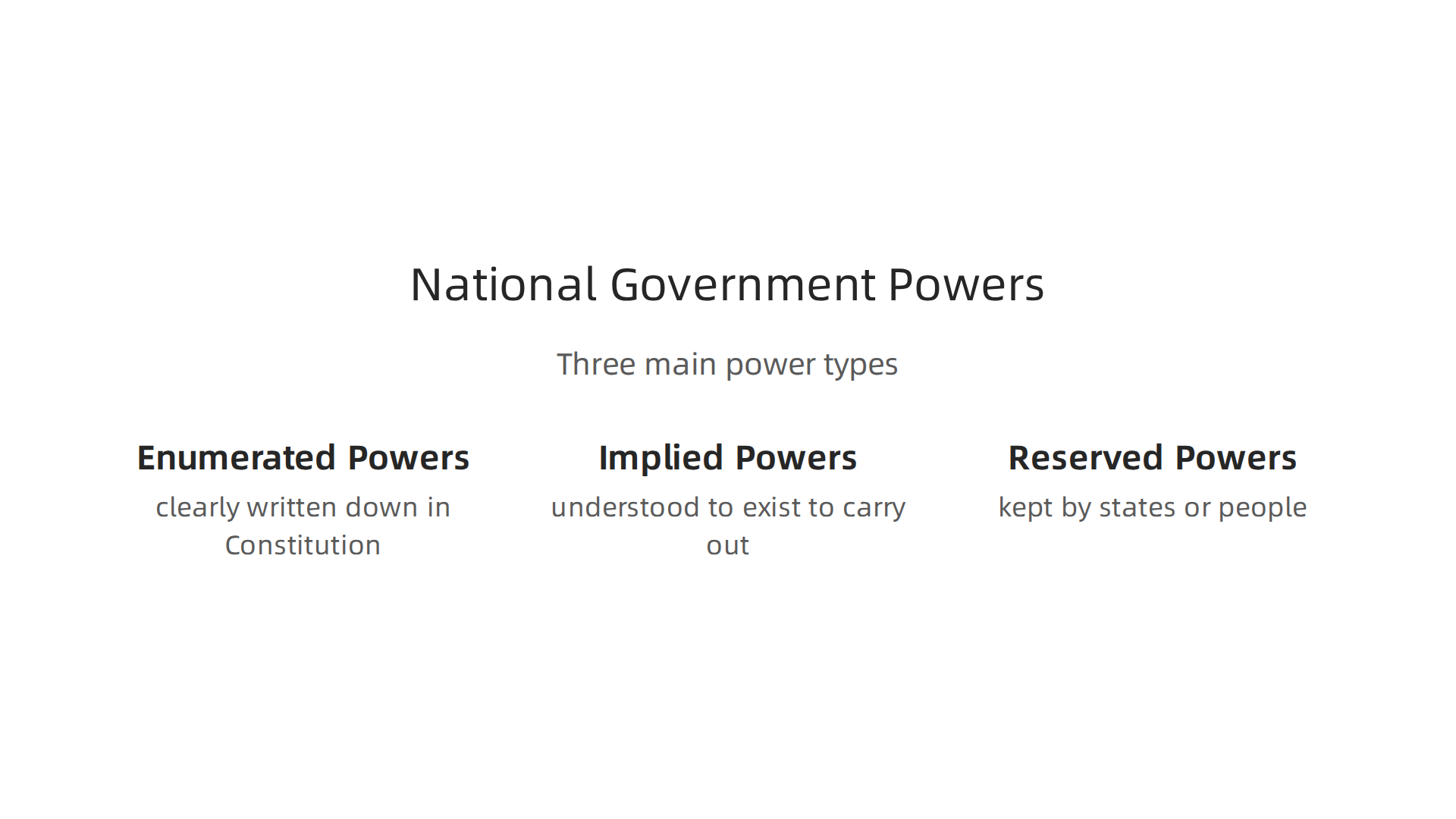
- Enumerated Powers: These are the jobs clearly written down in the Constitution. For example, the power to collect taxes or to declare war is explicitly stated. These are like the "to-do list" for the federal government that everyone can see. As legal education resources explain, enumerated powers are those specifically spelled out for the federal government and Congress in the Constitution itself Enumerated and Implied Power: Definition.
- Implied Powers: These are not written down word-for-word, but they are understood to exist because they are needed to carry out the enumerated powers. For instance, if the government can collect taxes, it needs the implied power to set up a tax collection agency. These powers help the government actually do the jobs it’s been given.
- Reserved Powers: These are powers that the Constitution does not give to the national government and does not forbid the states from having. Instead, these powers are kept by the states or the people themselves.
For legal professionals, having a clear idea of these powers of the national government is not just about knowing facts. It has a real impact on how they advise their clients and build compliance plans. Lawyers, including those at large firms often called "magic circle law firms" that handle complex cases, must know the limits of federal power. This helps them guide businesses and individuals to follow the law correctly. When attorneys at law help clients, they need to know which government rules apply and where those rules get their power.
In-house counsel and legal operations teams also rely on this knowledge to make sure their companies follow federal rules and avoid problems. They design programs that help employees understand and stick to these guidelines. Knowing the source of governmental authority means they can create stronger, more effective plans. Staying updated on these legal principles is a big part of mastering practical law for modern legal teams.
Keeping up with changes in law and technology is crucial.
The AI Newsletter Worth Reading offers clear daily AI updates that can help legal professionals stay informed in a fast-changing world.
Constitutional Foundations: Enumerated, Implied, and Inherent Powers
Building on our understanding of the Constitution as the national government’s rule book, let’s look closer at how those powers of the national government are understood. Legal professionals need to know more than just the basics. They must grasp the fine points of enumerated, implied, and also "inherent" powers, and how these ideas have changed over time.
Enumerated Powers Revisited
As we discussed, enumerated powers are like a clear list of jobs written right into the Constitution for the federal government. For instance, Article I, Section 8 of the Constitution spells out Congress’s ability to collect taxes, declare war, and regulate trade between states Article I Section 8 | Constitution Annotated. These powers are often called "explicit" or "expressed" because they are stated plainly in the text Enumerated vs. Implied Powers in the Constitution. Lawyers often rely on these direct statements when arguing about what the government can and cannot do.
Implied Powers and the "Necessary and Proper" Clause
Implied powers are not written down word-for-word, but they are powers the government needs to carry out its enumerated jobs. Think of it this way: if Congress has the enumerated power to collect taxes, it has the implied power to create the Internal Revenue Service (IRS) to actually do the collecting. The basis for these powers comes from the "Necessary and Proper Clause" in the Constitution, also found in Article I, Section 8. This clause says Congress can make all laws "necessary and proper" for carrying out its listed powers Implied Powers of the U.S. Constitution.
Over time, courts and Congress have broadly interpreted this clause. This means many government actions today, especially by federal agencies, are based on implied powers rather than only those strictly written down. This broad reading has allowed the powers of the national government to grow as the country and its needs have changed. Legal experts learn about this broad interpretation in legal education, which helps them guide their clients.
Understanding Inherent Powers
Beyond enumerated and implied, there are also "inherent powers." These are powers that any sovereign government is assumed to have simply because it is a government. They are not explicitly listed or implied from specific clauses. Instead, they come from the very idea of a country needing to act on the world stage or protect itself. For example, the power to control the country’s borders or to deal with other nations are often considered inherent powers. These are seen as natural powers necessary for a nation’s survival and functioning.
Legal Disputes and the Evolution of Doctrine
The differences between these types of powers are not just for textbooks. They form the basis for many real-world legal fights, especially in 2026.
- Regulatory Reach: A common dispute is whether a federal agency has the power to create certain rules or regulations. Lawyers might argue if an agency’s action falls under an enumerated power or is a proper implied power stemming from it. If the link is too weak, the agency’s action might be seen as overstepping its bounds.
- Preemption: Another big area of dispute is "preemption." This happens when a federal law overrides state laws. The question often becomes: did the federal government have the authority (an enumerated, implied, or even inherent power) to pass that law in the first place? If so, the federal law might "preempt" or take priority over state laws that try to regulate the same thing.
Understanding these legal arguments and how the doctrine of government powers has evolved is vital for anyone in the legal field. Keeping up with these changes helps legal professionals advise companies on compliance and navigate complex federal rules. Staying updated with how these constitutional foundations are interpreted is a core part of being a successful attorney in any firm, from a small practice to magic circle law firms. For anyone in law, it is important to master legal updates websites for timely trusted information in 2026.
The discussion of enumerated, implied, and inherent powers helps us understand what the national government can do. Now, let’s explore how these powers are managed by looking at the "separation of powers." This idea makes sure that no single part of the government becomes too strong. It divides the powers of the national government into three main parts:
The Three Branches of Government
- The Legislative Branch: This is Congress, made up of the Senate and the House of Representatives. Their main job is to make laws. Think of them as the rule-makers for the country.
- The Executive Branch: This includes the President, Vice President, and all the many federal agencies and departments. Their job is to carry out and enforce the laws that Congress makes. They are the ones who put the rules into action.
- The Judicial Branch: This is made up of the Supreme Court and lower federal courts. Their job is to interpret the laws. They decide what laws mean and if they follow the Constitution.
This clear division is sometimes called a "formalist" approach to how powers are separated, but in reality, there’s also a more flexible "functionalist" view that looks at how the branches actually interact A JURISPRUDENTIAL STUDY OF SEPARATION OF ….
Checks and Balances: A System of Limits
To stop any one branch from having too much power, the Constitution sets up a system of "checks and balances."
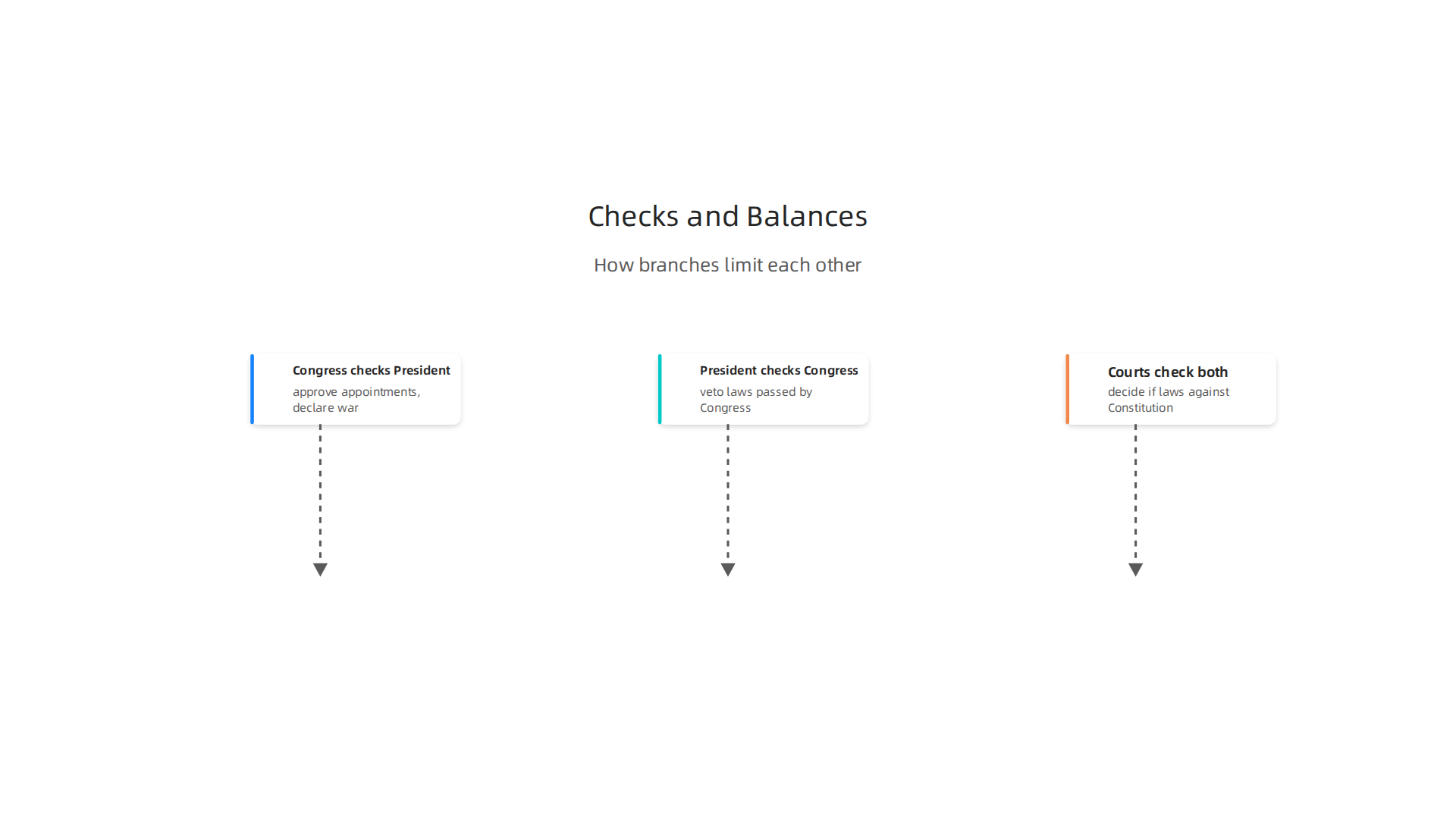
This means each branch has ways to limit the actions of the other two.
- Congress checks the President: It can approve or reject presidential appointments, declare war, and even remove a President from office.
- The President checks Congress: The President can veto laws passed by Congress, stopping them from becoming law unless Congress overrides the veto.
- The Courts check both: The courts can decide if laws made by Congress or actions taken by the President are against the Constitution. This is called "judicial review."
This system helps ensure that the powers of the national government are used fairly and as intended.
How This Affects Administrative Law and Agencies
In 2026, the idea of separation of powers is very important for administrative law. Many federal agencies, which are part of the Executive Branch, do a mix of things:
- They write detailed rules (like Congress).
- They enforce those rules (like the President).
- They even settle disputes about those rules (like courts).
This mix of duties can sometimes make the lines between the branches seem blurry. This has led to many legal challenges. Lawyers often question if agencies are overstepping their bounds. For example, the "nondelegation doctrine" is a legal idea that says Congress should not give away too much of its law-making power to agencies Non Potest Delegari: Agency Law Meets Nondelegation. In recent years, there have been Supreme Court cases, like FCC v. Consumers’ Research in 2025, that have looked at these very issues Federal Administrative Law Cases and Materials (Fourth Edition).
Legal professionals need to carefully study how courts review agency actions. This includes understanding ideas like "deference," which refers to how much courts should respect an agency’s interpretation of a law or fact. Recent shifts, like the Supreme Court’s 2024 decision in Loper Bright Enterprises v. Raimondo, have changed how courts approach deference to agencies, especially on legal questions To Defer or Not to Defer: Squaring the Administrative ….
Staying on top of these complex legal doctrines is a big part of being a successful legal professional today.

It helps attorneys guide their clients through the ever-changing world of government rules. For a deeper dive into how legal tech is changing the profession, you might want to consider how the latest insights from AI and technology shape legal understanding.
Get clear daily AI updates from The AI Newsletter Worth Reading.
Beyond how the national government divides its work among its three branches, there’s another very important way power is split in the United States. This is called "federalism." Federalism means that power is shared between the big national government and the many smaller state governments. Both have their own areas where they can make rules and act, but sometimes these areas overlap.
The Constitution’s Plan for Sharing Power
The Constitution set up this system of shared power. It gives certain jobs directly to the national government. For example, only the national government can print money, declare war, or make treaties with other countries. These are some of the key powers of the national government.
But what about the states? The Tenth Amendment to the Constitution is very clear. It says that any powers not given to the national government, and not forbidden to the states, are kept by the states or by the people. This means states have the power to make laws about many everyday things, like schools, local police, and marriage. This federal system ensures that both levels of government have important roles to play, preventing one from becoming too strong over the others Federalism, Preemption, and Anti-Commandeering.
When National and State Laws Bump Heads: Preemption
Sometimes, a state law and a national law try to do different things in the same area. When this happens, it can cause problems. The Constitution has a special rule called the "Supremacy Clause" that helps solve these conflicts. It says that federal laws are supreme, meaning they usually win out over state laws if there’s a direct conflict. This is known as "preemption."
Preemption can happen in different ways
Federal Preemption: A Legal Primer:
- Express Preemption: This is when a federal law clearly states that no state can make laws on that specific topic.
- Implied Preemption: This is when a federal law doesn’t say "no state laws," but it’s so thorough or covers the area so completely that there’s no room left for state laws. Or, a state law might make it impossible to follow a federal law.
Common areas where preemption often comes up include commerce, environmental protection, and health regulations. For instance, in 2026, there are ongoing discussions about state autonomy and federal preemption in areas like artificial intelligence (AI) governance, which is a new frontier for these types of legal questions State Autonomy in AI Governance: Reassessing Federal Preemption. We also see it in environmental cases, like the ongoing discussion around how the Clean Air Act might affect state and local rules about emissions No. 25-170.
The Courts’ Role in Federalism
It’s the job of the courts, especially the Supreme Court, to decide when federal law preempts state law. They look closely at the words of the federal law and what Congress intended. This helps make sure that the balance of powers of the national government and state governments is kept fair and follows the Constitution. Legal professionals need to master how to master legal research databases in 2026 with AI and smart search techniques to navigate these complex legal questions and stay informed about the latest court decisions and regulatory changes. Staying up to date on these issues is critical for legal teams, and tools that help master legal updates websites for timely trusted information in 2026 are highly valuable.
While the courts play a big role in figuring out when national laws are stronger than state laws, the national government also has some very strong tools it uses to shape rules across the whole country. These tools are the powers to regulate commerce, collect taxes, and spend money. These are known as "enumerated powers" because they are clearly listed in the Constitution, mostly in Article I, Section 8, which lays out many of the specific powers of the national government to make laws.
The Commerce Clause: Regulating Trade
One of the most powerful tools for the national government is the "Commerce Clause." This part of the Constitution gives Congress the power to regulate trade that happens between states, with other countries, and with Native American tribes. When the Constitution was first written, this power mostly meant making sure goods could move freely across state lines without states putting up their own taxes or rules.
Over time, courts have understood the Commerce Clause in a very broad way. This means the national government can make rules about many things that might seem local but still affect trade across states. For example, laws about workplace safety, food quality, or even environmental protection can be based on the Commerce Clause because these things can impact goods and services moving through the economy. This broad power allows the national government to set up nationwide rules that affect almost everyone.
Taxing and Spending: Powerful Levers
The national government also has the power to collect taxes and to spend money. These might seem simple, but they are incredibly important ways for the national government to encourage or even require states to follow certain policies.
- Taxing Power: Congress can tax people and businesses. This money helps fund national programs and projects. But it can also be used to influence behavior. For instance, a special tax on certain products might be used to discourage their use or to raise money for specific health initiatives.
- Spending Power: The national government gives money to states for many different things, like building roads, helping schools, or funding healthcare programs. However, Congress can put conditions on this money. This means a state might only get federal funds if it agrees to follow certain national rules. For example, in the past, states had to raise their drinking age to 21 to get full federal highway funding. This is a common way the national government encourages states to adopt national standards without directly telling them what to do. These legislative powers over commerce, taxing, and spending are crucial for shaping policy.
Limits on National Power
Even with these strong powers, there are limits. The Supreme Court has sometimes stepped in to say that the national government has gone too far. For example, the Court might rule that a certain law doesn’t truly involve interstate commerce, or that the conditions attached to federal funding are too demanding. These decisions help keep the balance between the national and state governments in our federal system. Understanding these complex legal issues is a big part of what lawyers, including those at magic circle law firms for strategic legal tech partnerships, focus on every day.
Legal professionals must also stay updated on how emerging technologies like AI are shaping these areas, from commerce to regulatory frameworks. Getting reliable information on these fast-moving topics is key.
Get clear daily AI updates from The AI Newsletter Worth Reading.
Understanding the vast powers of the national government is not just a job for judges. It’s a daily task for law firms and in-house legal teams. They need to help companies and public groups figure out what these rules mean for them. This means turning big legal ideas into real-world advice to avoid problems.

Turning Rules into Practical Advice
For clients, knowing about the national government’s power is all about managing risk. A business needs to know if a new federal rule about trade, taxes, or even how they use AI will affect their everyday work. Lawyers help corporate clients understand if their actions might cross federal lines, especially with the broad reach of the Commerce Clause. For example, a company making products might worry about national safety rules, while another might need to understand federal tax credits or conditions on government money it receives. Firms also advise public entities on how to deal with federal funding requirements without giving up too much state control. This kind of work helps everyone stay within the lines and plan for the future.
How Firms Organize to Tackle Federal Power Questions
Law firms don’t just hope for the best when it comes to big federal power cases. They set up special teams and plans, often called playbooks, to handle these complex matters. A good playbook clearly shows who does what, especially when dealing with big disagreements or regulatory questions. These teams often include several attorneys-at-law, and they make sure every step is clear, from looking into the facts to dealing with government agencies or even going to court. For serious situations, a crisis legal team workflow guide can help firms act fast and make smart choices. This careful planning is key to helping clients through difficult legal challenges. Top firms also look at the big picture for their clients, often using a Firm Performance Guide 2026 to plan for the year ahead.
The Role of AI in National Authority and Compliance
In 2026, technology like AI is changing how legal professionals think about national authority. While there’s no single federal AI law yet, different agencies are starting to set rules based on existing laws. Many states are also making their own AI laws, which creates a complicated situation. Law firms and in-house counsel must guide clients through this mix of federal ideas and state-level actions. This means staying on top of 2026 AI Laws Update: Key Regulations and Practical Guidance to ensure businesses are compliant. They need to watch out for federal proposals, like the White House’s National Policy Framework Artificial Intelligence, which aims to guide future laws. Keeping up with these changes is a big part of protecting clients. Law firms are also thinking about their own compliance in 2026, especially when it comes to cybersecurity and data.
Staying informed about these fast-moving changes in legal tech and regulation is crucial for every legal professional. To help with this, many lawyers regularly check sources that cover these topics. If you’re looking for strategies to enhance your firm’s approach, consider how to master legal updates websites for timely, trusted information in 2026.
Staying informed about these fast-moving changes in legal tech and regulation is crucial for every legal professional. New technologies, especially AI, continue to bring up fresh questions about the scope of the powers of the national government and how far its reach extends.
Emerging Issues: Technology, AI Regulation, and National Power Claims
The rise of new technologies like AI is constantly changing the rules lawyers must follow. In 2026, there isn’t one big federal law for AI. Instead, we see many states making their own rules, which creates a complex puzzle. This mix of state and federal ideas makes it hard for businesses to know what to do. The lack of a single federal law means there’s a "patchwork" of different rules across the country, making the legal scene confusing for businesses and the plural of attorney at-law who advise them. In fact, as of September 2026, the United States still doesn’t have a full federal law for AI, highlighting this ongoing challenge US AI Policy Crisis: 29 States, No Federal Law [2026].
This situation often leads to talks about "federal preemption." This is when federal laws can overrule state laws. The Supreme Court has said that federal law can explicitly or implicitly preempt state law, meaning it can take priority when a federal statute or regulation clearly states so, or when state law gets in the way of federal goals Federal Preemption: A Legal Primer. For example, if a state creates an AI rule that goes against what the national government wants to achieve with AI, the federal rule might win out. This tension between state and federal powers is a big deal in the world of AI regulation.
Law firms, including even large magic circle law firms, must help their clients through these tricky situations. This involves advising on how to follow rules for AI, data use, and technology that crosses state or even national borders. The risks are high, including lawsuits if companies don’t follow the rules. Firms must make sure clients understand these risks and avoid problems. This can mean checking how data is collected, how AI tools are used, and whether their actions might lead to legal challenges from federal agencies or states.
To deal with these new challenges, law firms are looking for smart ways to use technology themselves. An AI law firm might use AI tools to quickly check new regulations and give faster advice to clients. This helps them stay on top of all the changing rules and protect their clients from legal trouble.
For legal professionals needing to keep up with the fast-moving world of AI and its legal impacts, regular updates are key.
Get clear daily AI updates from The AI Newsletter Worth Reading.
Summary
This article explains why a clear grasp of the national government’s powers—enumerated, implied, and inherent—is essential for modern legal professionals, in-house counsel, and legal operations teams. It reviews constitutional foundations like the Necessary and Proper Clause, the Commerce Clause, taxing and spending powers, and how those authorities expand or limit federal action. The piece also covers separation of powers, checks and balances, and the practical tensions when agencies exercise rulemaking, enforcement, and adjudication roles. It highlights federalism and preemption rules that determine when federal law overrides state law, and shows how courts resolve those disputes. The article connects these doctrines to everyday legal work—compliance programs, litigation strategy, and regulatory risk management—and stresses the growing role of AI and tech in shaping enforcement and rulemaking. Readers will come away knowing which federal powers matter to specific client problems, how to design operational playbooks, and where to monitor legal and technological change to advise confidently.